
A moil point concentrates the breaker's piston impact into a single cone tip, raising contact pressure on hard rock, reinforced concrete, and dense aggregate, while a flat chisel spreads the same strike across a wedge edge to shear asphalt, slice trench walls, and drive controlled cracks [S1][S2].
Both bits are interchangeable shank components on the same air pick or hydraulic breaker, but their geometry changes how the rated impact energy is delivered into the workpiece, which in turn changes fragmentation rate, bit wear, and operator fatigue on long shifts [S2][S7].
Bit Geometry and Energy Transfer
Moil point bits use a conical or pyramidal tip that reduces the contact footprint to roughly the diameter of the tip, multiplying the stress under the bit and driving tensile fracture ahead of the cone [S2][S4]. The pointed profile is engineered for penetration, not for cutting: a moil point drilling into a slab can waste energy by sinking a hole where the job calls for splitting a sheet into slabs [S7].
Flat chisel bits replace the cone with a wedge edge of typically 25–50 mm width, so the same strike energy is distributed as a shearing action along the edge instead of a point load [S1][S3]. This makes the chisel the geometry of choice when the operator wants a clean break line, such as scoring asphalt for removal, opening a trench profile, or peeling a layer off a concrete slab.
Material Pairing: Concrete, Rock, Asphalt, and Rebar
On hard rock and heavily reinforced concrete, the moil point wins because the concentrated load initiates cracks in the matrix and exposes rebar for follow-up breaking [S1][S2][S4]. For unreinforced concrete, plain asphalt, and softer masonry, the flat chisel cuts faster because the shear line propagates fractures parallel to the surface rather than drilling a hole the operator then has to expand [S1][S7].
For secondary breaking of oversize boulders after a primary blast, neither moil nor chisel is optimal: a blunt tool transfers force across a wider face to crush rather than split, which is why most demolition fleets carry all three tip styles [S1][S3]. Tamping pads and pyramidal points cover compaction and quarry duties that fall outside the moil-vs-chisel decision [S3].
Decision Matrix: Criteria Comparison
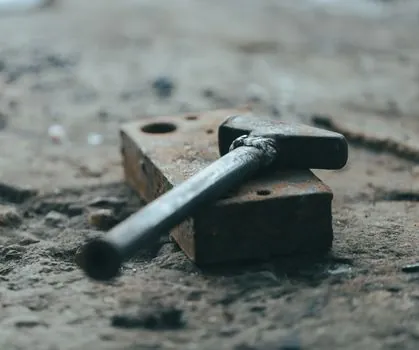
Field data from breaker-tooling suppliers lines up the two geometries against the criteria that actually drive productivity on site: penetration depth per stroke, breakage pattern, rebar handling, surface finish, and bit wear rate [S1][S2][S7].
On penetration depth per stroke, the moil point leads, because its small contact area generates higher contact stress for the same input energy. On breakage pattern, the flat chisel leads when the goal is a directional split or trench wall, since the wedge drives a planar crack. On rebar handling, the moil point is the safer pick because the cone tends to deflect or break rebar aside rather than snag, while a chisel can lock in mesh. On surface finish, the flat chisel leaves a cleaner break line with less spalling on the surrounding material. On bit wear, the chisel generally outlasts the moil on abrasive rock, because the larger mass behind the edge dissipates wear over a wider cross-section, while the moil point tip tends to mushroom and lose profile first [S1][S2][S5][S7].
Shank Match and Pneumatic Compatibility
Pavement breakers and demolition hammers accept the same moil and chisel geometries but require correct shank match to the hammer's drive system, with 7/8 in x 3-1/4 in hex shank as a common pneumatic pavement breaker standard and 1-1/8 in hex with notch used on large electric breakers such as the Bosch Brute family [S4]. Mismatched shanks cause slip, lost impact transfer, and accelerated shank wear, regardless of which tip geometry is fitted.
The same geometry rule applies to handheld air impact wrench tooling on a fab line, where socket retention and shank design dictate how much of the rated torque reaches the fastener, a parallel problem to how the breaker's stroke energy reaches the workpiece [S4].
Common Mismatches and Failure Modes
Using a moil point on asphalt or thin slab is the most common mismatch: the tip punches a hole instead of shearing the surface, leaving the operator to chase the hole with a chisel and effectively doubling tool changes [S7]. Using a flat chisel on hard, intact rock wastes energy along the edge that the rock simply absorbs without fracturing, which heats the bit and accelerates tip rounding [S2][S7].
Running either bit without matched shank tolerance produces the same end result: lost impact transfer, increased vibration at the operator station, and premature bushing wear on the breaker itself [S2][S4]. On a quarry face or trench box, the visible symptom is the bit climbing out of the cut, glazing the tip, and forcing a shutdown long before the rated service life is reached.
Selection Workflow and Field Signals
Start the selection with the answer to one question: does the job need penetration or separation. If the answer is penetration into hard, dense, or reinforced material, fit a moil point; if the answer is separation, shearing, or trenching on softer or layered material, fit a flat chisel [S1][S2][S7]. For fleets running both pneumatic nail gun compressors and breakers, keep at least one of each geometry on the truck so the operator can switch without a trip back to the shop.
Trackable signals over the next quarter: monitor tip wear photos on abrasive quartzite jobs where moil life typically drops below 80 hours, watch for rebar-snag failures on chisel bits in mesh-heavy slab demolition, and verify shank fit whenever a new breaker model enters the fleet, since shank standards vary across pneumatic and electric platforms and a close-but-wrong fit is the leading cause of early shank fatigue [S4][S7].