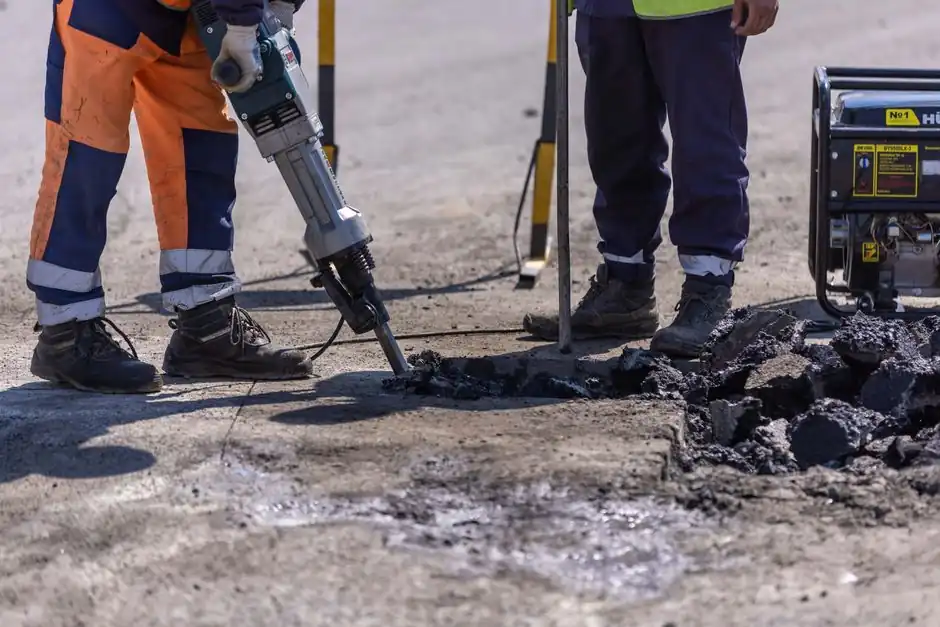
An air pick is only as good as the fit between its chisel shank and the tool's retaining collet, and that fit is governed by two physical parameters: shank cross-section and shank diameter, both standardized across the industry [S1][S3].
For most pneumatic and cordless picks sold in 2025-2026, the practical decision is binary: 1/4 in (6.35 mm) hex quick-change, or a round shank sized to the tool's collet (commonly 3/4 in / 19 mm hex or 7/8 in / 22 mm round on heavier ground rod drivers and demolition tools) [S1][S2].
Two shank families, zero mechanical crossover
Round-shank chisels rely on a friction grip from a multi-jaw chuck or a split collet, with no positive locking feature, so the bit can rotate or be ejected under sustained impact if the collet wears [S3]. Hex-shank chisels use six flat faces that mechanically lock against matching flats inside a quick-change retainer, so torque and impact transfer through geometry rather than friction [S1][S5].
DIN 3126 form C and form E define two common hex geometries for 1/4 in quick-change systems: form C is the general-purpose hex used on most impact-rated driver bits, while form E is a slightly different profile designed for specific quick-change holders [S2]. The practical consequence is that a form C bit generally seats in form E holders, but form E bits may not fully seat in form C retainers, so the bit either bottoms out early or fails to lock [S2].
Standard sizes you will actually see on air picks
For hand-held air picks and light demolition chisels, 1/4 in (6.35 mm) hex is the de-facto quick-change standard, the same dimension that fits all 1/4 in impact drivers, and the bit can be swapped one-handed in roughly 2 seconds without a chuck key [S1]. Round-shank air picks in this size class typically use shank diameters of 10-12 mm, sized to the maker's proprietary collet.
For heavy electric and pneumatic breakers (10 kg+ class), the cross-section jumps to 19 mm or 22 mm hex, which prevents rotation under the high torque loads of ground-rod driving and heavy demolition work [S1]. Some SDS-Plus and SDS-Max rotary hammers share the 10 mm and 18 mm shank families with a four- or five-slot locking system, and these are not interchangeable with hex or round chisel shanks even when the nominal diameter looks similar [S1][S3].
Why the wrong shank is an expensive mistake

Slippage inside a worn chuck or a mismatched hex profile costs real money: cutting runout of just 0.0001 in shifts tool life by roughly 10%, and dropping runout from 0.0005 in to 0.0001 in can extend life by about 40% [S3]. On an impact-driven air pick, the equivalent failure mode is the chisel spinning in the collet, glazing the flats, and chewing up the retaining spring.
Hex-shank chisels avoid the slip path because the six flats distribute lateral load across multiple contact surfaces, so a properly seated hex will not rotate even under stall-level impact [S1][S5]. Round shanks need a tight, unworn collet and clean shank surface to hold rated impact energy, which is why field crews in mining and HDD tend to standardize on hex or threaded connections for any continuous-duty application [S3].
Decision matrix: pick the shank to match the tool class
For a 1/4 in quick-change air pick driving light chisels, scaling, and needle work, hex shank wins on speed and on impact-driver interoperability, with the caveat that the retainer must be rated for impact, not just for drill torque [S1][S5].
For a 10-15 kg pneumatic breaker on concrete or frozen ground, 19 mm or 22 mm hex is the industry default and the only practical fit; round-shank breakers in this class exist but require the maker's matched collet and are not cross-compatible with hex breakers [S1][S3].
For a demolition tool that must also accept SDS-Plus or SDS-Max rotary-hammer chisels, the answer is to buy the SDS tool, not a hex-to-SDS adapter, because the adapter defeats the axial-float hammer mechanism that gives SDS its rated impact energy [S1].
For precision metalwork or electronics-scale picks, a 4 mm hex variant exists alongside the 1/4 in (6.35 mm) hex, and the two are not interchangeable: a 4 mm hex will rattle inside a 1/4 in retainer, while a 1/4 in hex will not enter a 4 mm collet [S4]. Standardize on one hex size per workstation.
Field checks before you load a chisel
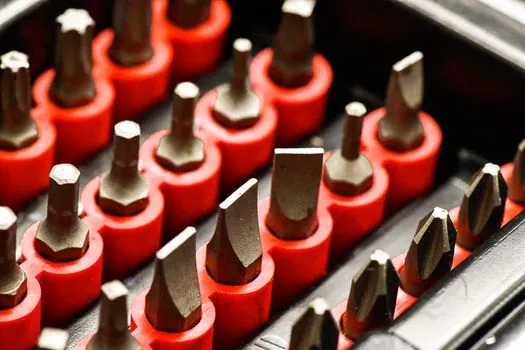
Verify three things: the shank cross-section matches the collet (round to round, hex to hex, never mixed), the nominal shank diameter is within roughly 0.1 mm of the collet rating, and the retainer spring or detent is present and undamaged [S1][S3]. If the chisel seats more than 2-3 mm short of full depth, you likely have a DIN 3126 form C/E mismatch and need the matching retainer [S2].
For continuous-duty air picks in mining, HDD, or heavy construction, replace any hex retainer showing more than roughly 0.2 mm of flat wear, and discard any round-shank chisel with visible collet burnishing, because both symptoms predict slippage and accelerated chuck wear [S3]. Properly engineered, corrosion-protected shank designs have been documented delivering 30% longer service life in heavy rotary applications [S3].
Standards, sourcing, and what to ignore
The relevant public standards are DIN 3126 (form C and form E hex shanks for 1/4 in drive) and the SDS-Plus / SDS-Max geometry defined by Bosch and copied across the rotary-hammer industry, including makers such as Makita, Hilti, DeWalt, and Milwaukee in the 2-5 kg class [S1][S2]. The 19 mm and 22 mm hex demolition sizes are de-facto industry conventions rather than a single DIN or ISO number, so cross-brand matching relies on the nominal dimension rather than a published standard [S1].
For buyers cross-referencing air picks, the related catalog entry on air pick shank retention covers the collet and retainer side, while air impact wrench compatibility hinges on the same 1/4 in hex quick-change standard, so the two tool families share bit geometry in the light-duty class [S1][S5].
Track the following signals over the next two quarters: any new DIN 3126 form revision affecting 1/4 in hex tolerances, and any move by a major breaker maker to switch from 19 mm / 22 mm hex to a unified SDS-Max-class connection on mid-weight electric breakers. Either shift would force a fleet-wide re-standardization of shank inventory [S1][S3].