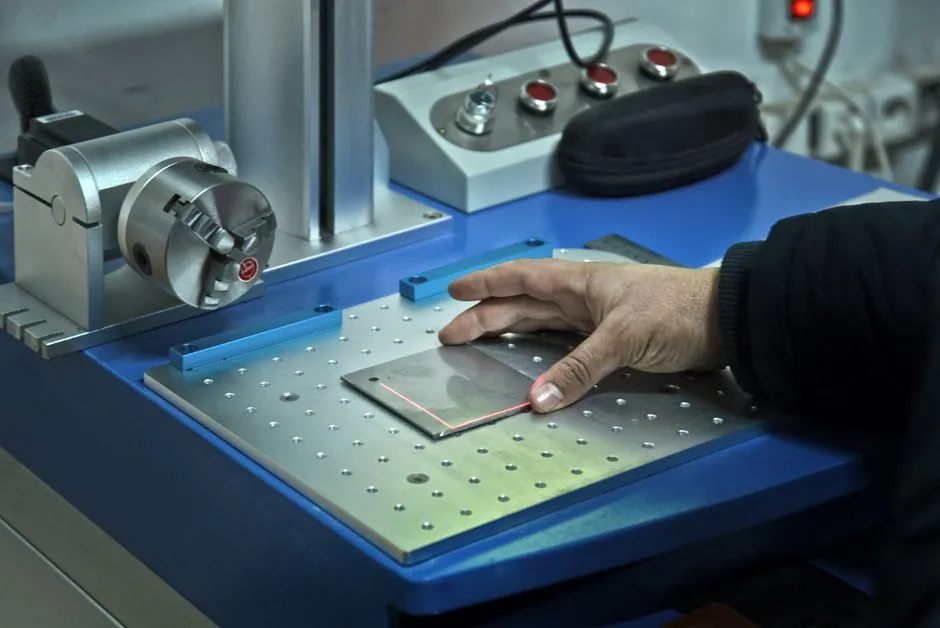
A MOPA (Master Oscillator Power Amplifier) fiber laser is the only practical source for repeatable, controllable color marking on stainless steel, because its independently adjustable pulse width lets an operator tune the oxide-layer thickness that produces the color, a control a Q-switched source does not offer [S1][S2][S3].
Q-switched fiber markers still hold the larger installed base for routine black-and-white identification, serial numbers, barcodes, and deep metal engraving, and they typically cost $3,000–$4,000 less than a comparable MOPA unit at the same average power class [S5]. For shops that need one machine to handle both black ID marks and color branding on stainless steel, the MOPA architecture is now the default, not a premium add-on.
What "color marking" actually means on stainless steel
A 1 μm-class fiber laser wavelength sits in the absorption band of most engineering metals, which is why fiber sources are the dominant tool for this work, while CO2 sources at ~10.6 μm are generally unsuited because stainless steel reflects that wavelength strongly [S3].
The color depends on oxide thickness: roughly 20–30 nm trends toward gold/yellow, 40–60 nm shifts to red/purple, 70–100 nm gives blue, and thicker layers produce grey-green, with each color tolerating only a narrow thickness window before it collapses into grey or a burnt look [S1][S2]. Because pulse width, repetition rate, scan speed, and hatch spacing all move that thickness together, "set and forget" recipes do not exist, and a Q-switched source with a fixed pulse duration cannot independently dial the heat input needed to land on a given color [S2][S3].
Pulse width control: the real engineering difference
A standard Q-switched fiber marker releases stored energy in a short, fixed-duration pulse, typically in the 100–200 ns range, and on many conventional marking sources the relationships among pulse duration, pulse energy, and repetition rate are tightly coupled, so the operator has fewer independent knobs to turn [S3]. The marketed specification of "20 W" or "30 W" average power is the same metric on both platforms, but it hides the variable that actually drives color and edge quality, which is the time each pulse sits on the metal.
A MOPA marker separates a low-power seed oscillator from a fiber amplifier, so the seed defines pulse width and shape (commonly adjustable over roughly 2–500 ns) and the amplifier scales energy on top, giving the operator four independent controls (pulse width, frequency, power, scan speed) instead of three [S2][S3][S4]. For a more general primer on how the laser marker class sits inside a wider marking equipment family, the practical effect is simple: MOPA trades a little peak power for a much wider process window, and that window is exactly what color on stainless steel requires.
Head-to-head on the four criteria that actually decide a purchase

For a buyer comparing a MOPA 30 W and a Q-switched 30 W at the same wavelength, the four criteria that drive ROI are color capability, edge quality on thin or coated parts, throughput on plain metal, and unit cost. The first two favor MOPA clearly; the third is a wash at the same average power; the fourth favors Q-switched. [S3]
On color, the answer is unambiguous: a standard Q-switched fiber laser can produce some black marks and limited, inconsistent color effects on metal, but it cannot deliver the consistent, controllable, repeatable color that a production shop can sell, while MOPA's adjustable pulse width gives the operator the oxide-layer control that repeatable color requires [S2][S6]. On thin aluminum-oxide sheet (the back of phones, tablets, and laptops), Q-switched pulses deposit enough heat to deform the substrate and leave a "convex bulge" on the back side, while MOPA's narrow-pulse, high-frequency settings clear the anodic layer with minimal thermal load and no visible deformation [S4].
On raw engraving depth and throughput, neither architecture holds a structural advantage at the same average power; Q-switched systems remain well established for straightforward deep engraving on rigid metals, and MOPA does not automatically cut deeper because raw depth tracks power level and single-pulse energy, not pulse-width adjustability [S2]. On cost, the MOPA premium in the desktop marking market is consistently in the $3,000–$4,000 band versus a comparable Q-switched unit, which is the number buyers should budget for, not the headline price tag of either source alone [S5].
What a MOPA can do that a Q-switched cannot
Three applications show up in every credible MOPA vs Q-switched comparison, and in each case the Q-switched source either fails outright or is materially worse. [S2]
1. Anodized aluminum black marking: Q-switched pulses strip or lighten the anodic layer rather than producing a rich dark mark, and only MOPA can produce deep, high-contrast black on anodized aluminum at production tolerances, with the user able to step through different shades of grey by varying pulse width and frequency combinations [S2][S4]. This is the application behind the black logos and type on consumer electronics from Apple, Huawei, Lenovo, and similar OEMs.
2. Color marking on stainless steel and titanium: Q-switched sources can land a color pass under narrow conditions but cannot repeat it job to job, while MOPA's adjustable pulse width and frequency deliver controllable iridescent and solid tones on both 304/316 stainless steel and on titanium, including the blue, purple, and gold tones used in jewelry, medical instruments, and sporting goods [S1][S2][S3][S4].
3. Precision fine-line machining on ITO, semiconductors, and thin foils: Q-switched pulses cannot independently regulate pulse width, so the operator cannot fine-tune line width, while MOPA produces narrower, smoother-edged lines with independently controlled pulse width and frequency [S4].
Where Q-switched is still the right tool
A MOPA is not a universal upgrade. For high-volume runs of identical serial numbers, barcodes, and QR codes on a stable material, a Q-switched source with fixed pulse behavior is easier to set up, easier to keep running, and cheaper to buy, and the smaller tuning range makes repeatable settings easier to lock in for routine production [S3]. If the work is bulk stainless-steel pipe identification, heavy anodized aluminum nameplates, or deep tooling marks, a Q-switched marker is the rational choice, and a MOPA would add cost without adding capability [S2][S4].
For buyers trying to predict where the technology is going, two operational signals are worth tracking. First, the leading fiber source vendors (JPT, IPG, Raycus, MAX, and nLIGHT, all named in the [S5] market discussion) continue to push the MOPA price premium down with each generation, and second, even "MOPA-structure" sources with a fixed pulse width, such as the JPT unit discussed in the [S5] community thread at a fixed 200 ns pulse, are marketed as a halfway point that handles black marks but explicitly cannot mark color on stainless steel, which is itself a useful tell that color marking is now the defining feature buyers ask about.
A useful working rule for a purchasing decision: if the shop's stainless-steel work is purely black identification, buy the Q-switched unit and bank the $3,000–$4,000 difference; if even 20–30% of the workload needs color on stainless steel or titanium, or fine line work on coated or thin-gauge stock, the MOPA premium is recovered in the first few jobs that would otherwise have been rejected. For a broader view of how a stainless pipe part ID workflow fits into a plant's wider maintenance and reliability program, the same "spec the tool to the dominant task, not the worst case" logic applies, and is laid out in this plant-maintenance decision matrix: CBM vs PdM vs RCM: a decision matrix for plant maintenance.