
Motor-grader road-maintenance production is calculated from effective working width, travel speed, number of passes, and job efficiency, with 3–9.5 mph (5–16 km/h) identified as a practical road-maintenance speed range [S1].
The calculation supports estimating lane-feet, square yards, or square metres completed per hour, while the motor grader method differs from volumetric production because grading output depends on how much of the blade cuts effectively.
Core Production Formula for Road Maintenance
For uniform road-maintenance work, effective production area per hour equals effective blade width multiplied by grading speed and job efficiency.
Road-maintenance speeds of 3–9.5 mph (5–16 km/h) provide a range for preliminary estimates, while an efficiency factor of approximately 0.70–0.85 is described as a good estimation [S1]. The efficiency factor accounts for the fact that a nominal 60-minute work hour is rarely fully productive because of supervision, operator skill, maintenance, and site conditions; 0.60 is identified as an average preliminary value [S3].
A structured comparison is straightforward:
Convert Width, Speed, and Efficiency Consistently
A consistent imperial calculation is: production in lane-ft/h = effective blade width in feet × speed in mph × efficiency. Divide by 3 to obtain lane-yards/h, because 1 lane-yard equals 3 lane-feet. For metric work, production in m²/h equals effective blade width in metres × speed in km/h × efficiency, with no additional conversion factor. [S3]
For a 12 ft blade traveling at 3.4 mph with an efficiency of 0.60, production is 12 × 3.4 × 0.60 = 24.48 lane-ft/h for one pass.
Do not confuse pass production with completed-road production. A grader may travel the same lane several times to cut, fill, blend, aerate, or finish the surface. Report the number of passes beside the result so that an area rate is not mistaken for one-pass capacity.
Choose the Effective Blade Width

Nominal blade width is not always the working width. The effective width must allow for blade overlap between adjacent passes, the portion outside the useful work area, and any width lost to overlap or material placement.
A separate example uses a 14 ft blade on a 10-mile road that is 24 ft wide, demonstrating that road width, blade width, and pass count must be evaluated together rather than substituted for one another [S2]. If a 14 ft blade is used across a 24 ft road without overlap, the theoretical pass count is 24 ÷ 14 = 1.71, so two passes would be required. Any overlap reduces the actual effective width and must be included in the production calculation.
For a fixed road width W, blade width B, and overlap O, effective width per pass is B − O. The approximate pass count is W ÷ (B − O), rounded up to a whole pass for planning. This treatment is more defensible than assuming the full catalog blade width is productive throughout every pass.
Calculate Duration for the Maintenance Route
For total operation time, use total time = distance × passes ÷ (speed × efficiency), with distance and speed in matching units [S3].
Because the operations have different speeds, calculate them separately and add their times. Rounding upward prevents the estimate from understating the crew and equipment requirement.
Compaction must be completed before finish grading can begin, and a cut of approximately 1/2 to 1 inch is preferable to filling above final grade during finish work [S3]. Since compaction is a separate operation, exclude its time from the grader-only calculation and show it as a linked activity in the work plan.
Use the Right Output Unit for Each Work Type
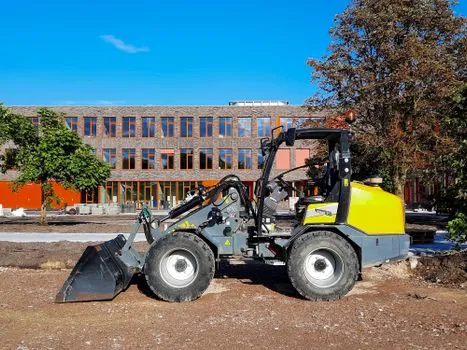
Lane-feet per hour and square metres per hour are suitable for routine road-maintenance production. Volumetric output in m³/h is appropriate only when the operation has a defined cross-section and measurable material quantity. These figures describe specific paving operations and must not be transferred to ordinary gravel-road maintenance.
For gravel maintenance, report at least three quantities: productive lane length, area completed, and required passes. If the object is only to remove ruts or restore a cross-section, cubic metres may be misleading because the displaced material volume is small relative to the length of road treated.
When comparing a grader with a road roller, keep the work packages separate. The grader reshapes and distributes material, while the roller compacts it; a roller rate cannot be added to a grading rate to create a valid combined production figure.
Correct for Speed, Material, and Site Conditions
Low calculated production with the correct width usually indicates a speed or utilization problem rather than a blade-width problem. First record actual travel speed, then confirm whether the machine is working continuously. The operating range cited for road maintenance is 3–9.5 mph (5–16 km/h), and the 3.4 mph example represents a relatively slow shaping pass rather than a high-speed finishing pass [S1][S3].
Material and geometry can require different speeds. The estimator example assigns 2.8 mph to the first two passes, 3.4 mph to the next two, and 5.4 mph to the final two passes [S3]. A wet, uneven, or heavily loaded surface may require a lower speed, while a level and prepared surface may support a higher one.
Do not repair the calculation by raising efficiency when the symptom is material buildup. Grading estimates state that material should not accumulate into piles that the grader must cross, and excess material should be windrowed off the work section for later removal [S3]. Escalate the estimate when the work includes multiple material types, changing cross-sections, or repeated windrow handling that is absent from the basic formula.
Validate the Estimate with Field Measurements
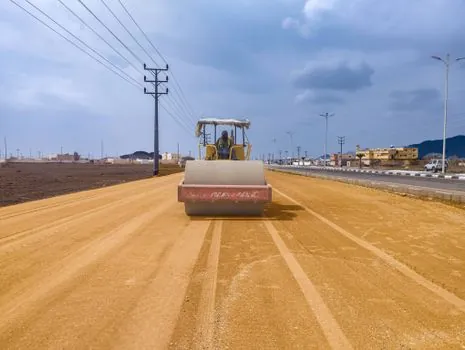
Validate the model with a timed field run. Measure the completed graded length, effective width, average travel speed, passes, and total elapsed time. Then calculate measured area production as completed area divided by productive hours. If the measured rate is materially below the estimate, isolate whether the loss came from travel speed, non-productive time, blade overlap, extra passes, or rework. [S3]
A common arithmetic check is: estimated productive lane-ft/h × elapsed productive hours ÷ passes should reconcile with completed lane-feet within measurement tolerance. For the 5-mile, six-pass example, using the stated speed and efficiency assumptions gives a planned duration of approximately 13.88 hours, which is rounded to 14 hours [S3].
Track two signals for the next estimate: actual productive hours as a percentage of clock time, and average speed for each operation. A move toward 0.70–0.85 efficiency should be checked against actual site conditions rather than assumed from a calculator input [S1].