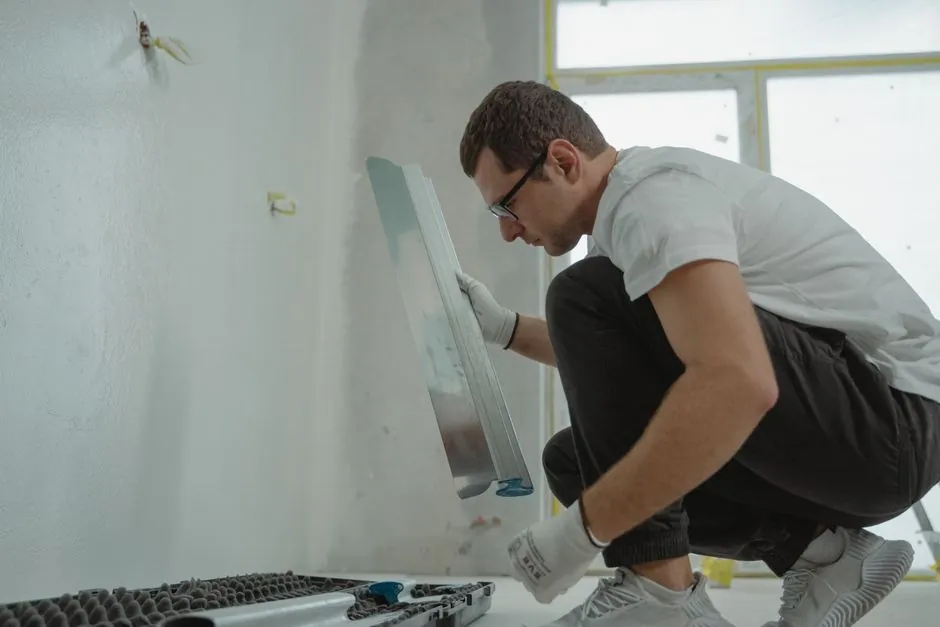
For most construction, marine, and industrial-assembly joints in 2026, MS polymer hybrid sealants have become the default because they bond without primers, cure on damp substrates, accept paint, and contain zero isocyanate [S2][S3].
Silicone sealants still own the high-temperature bracket (typical continuous service to 250°C) and the longest UV life on non-painted facade and glazing lines, while polyurethane sealants keep their place where mechanical load, abrasion resistance, or fuel and oil contact are the governing criteria [S1][S5][S7].
Chemistry and Curing: What the Three Chemistries Actually Do
MS polymer is a silane-terminated polyether that cures by atmospheric moisture without releasing solvents or isocyanates, which is why the cured bead shows no CO2 bubbling on damp concrete [S3][S5].
Polyurethane sealants use isocyanate-bearing prepolymers that react with ambient moisture and can off-gas CO2 during cure, occasionally producing bubbles in thick sections or humid pours [S2][S3].
Silicone sealants are built on a silicon-oxygen backbone with organic side groups, moisture-curing to a rubbery elastomer that is inherently hydrophobic and unpaintable [S1][S4].
Temperature, UV, and Chemical Resistance Limits
Typical silicone sealants tolerate up to 250°C continuous service, well above MS polymer's practical ceiling, which makes silicone the default around engines, ovens, flues, and solar thermal hardware [S1].
MS polymer and facade-grade silicone both deliver strong UV stability, while clear polyurethane sealants can chalk and yellow faster in direct sun, limiting their use in exposed architectural joints unless overpainted [S3][S5].
Polyurethane tolerates fuels, oils, and many solvents better than MS polymer, which is why PU still shows up in fuel-tank sealing, underbody automotive seams, and chemical-tank weather sealing, though pH extremes outside the neutral band can attack the PU backbone [S7].
Mechanical Strength and Joint Movement
Polyurethane sealants carry the highest tensile and tear strength of the three chemistries and are the first choice for structural joints, concrete expansion joints, and load-bearing seams [S2][S7].
MS polymer stays flexible after cure, absorbing movement and vibration without going rigid, which suits transportation, marine deck seams, and container fabrication where cyclic flexing is normal [S2][S5][S8].
Silicone offers the highest elasticity and the widest movement accommodation but trades that for lower cohesive strength, so it is rarely used for semi-structural bonding, with the further limit that it cannot be painted [S1][S4].
Adhesion, Primer Demand, and Surface Tolerance
MS polymer bonds to porous and non-porous substrates without a primer in most cases, can be applied to damp surfaces, and accepts water-based and most industrial coatings after skin formation [S3][S4][S5].
Silicone bonds very well to glass, glazed ceramic, and anodized aluminum with no primer, but porous substrates such as concrete, wood, and brick often need a dedicated silicone primer to reach durable adhesion [S1][S4].
Polyurethane is the most substrate-sensitive of the three: strong on most construction materials with proper prep, but it dislikes water at the interface during cure, which is why PU spec sheets consistently call for dry, primed substrates on tank and silo work [S2][S7].
Decision Matrix: Pick by Governing Criterion
Specifying on temperature: silicone above roughly 120°C continuous, MS polymer in the -40°C to +80°C band, polyurethane in the -30°C to +80°C band for non-fuel service [S1][S5].
Specifying on health, VOC, and overpaintability: MS polymer is label-free, contains no isocyanates, and accepts paint, while PU requires PPE during application because of isocyanate content, and silicone cannot be overpainted at all [S1][S3][S6].
Specifying on mechanical load and chemical contact: polyurethane wins for tensile load, abrasion, and hydrocarbon exposure; MS polymer wins for general-purpose bonding with movement; silicone wins for long-term UV on unpainted glazing and for very high movement joints [S2][S4][S5][S7].
Cost tiers in practice put cheap acetoxy silicone near the bottom of the price ladder, MS polymer in the mid-premium band, and structural-grade polyurethane comparable to premium MS polymer but with added PPE and surface-prep cost on the labor side [S1].
Failure Modes and Constraints Engineers Should Plan For
Cheap silicone sealants (around the bottom retail tier) frequently show mould growth within 6 months in humid interiors and exhibit poor adhesive performance on semi-structural bonds, so they should be limited to non-critical sanitary seams [S1].
Polyurethane failures typically trace to substrate moisture, isocyanate-driven bubbling, or UV-driven chalking on clear exterior joints, and on tank linings to pH excursions outside the neutral band the resin can be chemically attacked [S3][S7].
MS polymer failure modes are fewer but include lower top-end temperature tolerance, slightly slower full cure than aggressive PU grades in cold weather, and somewhat lower ultimate tensile than structural PU, so it is not a drop-in for high-load structural joints [S3][S4][S8].
Standards, Sourcing, and What to Verify on the Datasheet
For structural glazing and weatherproofing work, anchor the spec to ISO 11600 class definitions for joint movement capability, and require the TDS to list tensile strength at break, elongation at break, Shore A hardness, modulus at 100% elongation, and movement accommodation in percent [S2][S4].
For construction sealant procurement, reference the relevant ASTM C920 classes (Type S, Grade NS, Class 25/35/50) for joint movement and confirm the certificate of analysis lists VOC content in g/L, since MS polymer products are routinely specified below 50 g/L for low-VOC projects [S2][S6].
For industrial adhesive selection in B2B catalog work, the practical sanity checks are substrate list, primer requirement, paint compatibility, service-temperature range, and the full-cure time at 23°C/50% RH, which for most one-part MS polymer and silicone sealants falls in the 24 to 72 hour window depending on bead thickness [S1][S4][S5].
For broader material context on how these elastomeric chemistries compare with thermoset polyurethane systems, the polyurethane elastomer reference page maps the same backbone onto cast and molded parts, while silicone rubber covers the cured silicone family in more depth, and industrial adhesive links the chemistry families to substrate-bonding practice.
For adjacent B2B spec decisions, the CSI 07 13 00 vs 07 14 00: Sheet vs Fluid-Applied Waterproofing guide picks the right waterproofing format that pairs with these sealants, and the HART vs Analog-Only Temperature Transmitters: Spec Decision Guide follows the same comparison-first logic for instrumentation specifiers.
Trackable next signals to watch: the 2026 shift toward MS polymer in commercial facade tenders, the continued niche for high-temperature silicone above 200°C in EV battery and solar-thermal assemblies, and any new isocyanate regulatory tightening that would tip the cost equation further toward MS polymer.