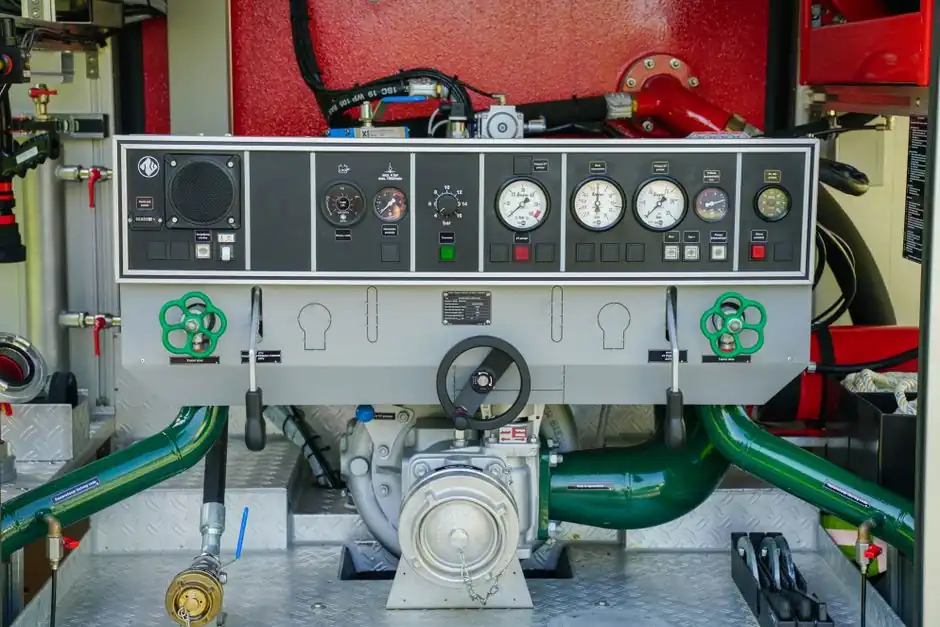
A networked multi-panel fire alarm system can centralize access to panel information while each panel maintains the status and control of a designated area.
The decision is driven by building count, system capacity, geographic spread, monitoring arrangement, and the need for remote event access, not by panel networking alone.
Architecture and operating boundary
A fire alarm control panel receives initiating-device information, monitors system integrity, controls notification and auxiliary equipment, and transmits information needed for a predetermined response sequence [S5].
In a distributed arrangement, each panel maintains status and control for a designated area, while a central location provides access to information from the panel network [S3]. This differs from a server-based architecture, where a server provides centralized monitoring and network integration. Server architectures commonly use Ethernet and BACnet or Modbus, whereas autonomous fire alarm control panels can use Class A or Class B wiring [S2].
The design decision is therefore layered. First determine the life-safety functions required at each local panel. Then define the supervisory, reporting, and integration functions that must survive loss of communications. A server should not be treated as an automatic substitute for local panel control.
Standalone panel criteria
A standalone panel is appropriate when the protected area fits within one panel's capacity, the site has one building or one operating zone, and no central dashboard is required [S2]. Localized panel-based systems remain applicable to small commercial facilities, residential complexes, and retail outlets where centralized campus monitoring and advanced integration are unnecessary [S2].
The panel must still provide the complete local sequence: device supervision, alarm indication, notification-appliance control, fault reporting, and any required transmission channel [S5]. These are panel technologies, not substitutes for the standalone-versus-networked architectural decision.
A standalone design reduces network dependencies, topology, configuration interfaces, and cross-panel failure modes. It is not automatically the lower-life-cycle-cost choice because the building can still need one transmission channel, a monitoring agreement, a local annunciator, and periodic service access [S3].
Networked multi-panel criteria

Networked panels are justified when the project includes several buildings, several protected areas, one panel per floor or location, or a requirement for centralized remote access [S3][S5]. A common topology assigns each panel a defined area, with information and commands exchanged through a network. A single-system view then reduces the need to visit multiple physical sites [S3].
That benefit is conditional: it exists only if local panels retain their required life-safety functions, network failure does not disable notification, and the approved design defines degraded-mode behavior. The server, Ethernet network, or monitoring link must not be placed in a single point of failure for local protection.
Networked systems also create an integration workload. BACnet, Modbus, Ethernet, mass notification, text messaging, email, displays, and voice announcements may all become part of the operating model [S2][S3]. Encrypted communication, authentication, and network segmentation are named controls for managing network dependence and cybersecurity exposure [S2].
Decision matrix: cost, resilience, and integration
These are lifecycle tendencies, not fixed prices, and panel capacity, building separation, and transmission-service terms determine the actual result.
For resilience, the standalone panel has fewer inter-panel dependencies, while the networked design offers continuity after a single panel communication loss if local operation and alternate communication paths are designed for that condition [S3]. A networked fire alarm system provides centralized access to panel information.
For administration and scale, standalone is simpler at one small site. Networked architecture is stronger where multiple panels must be observed through one dashboard, but it introduces configuration consistency, cybersecurity, and system-integration responsibilities.
Applicability by facility and occupancy
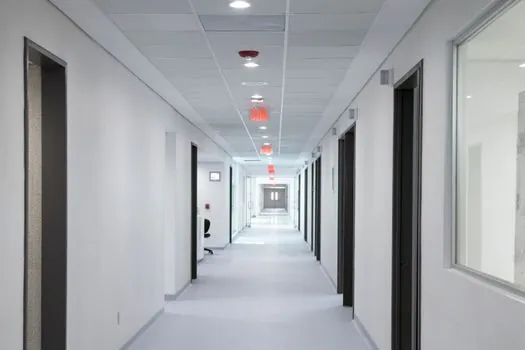
A standalone panel is a practical selection for a small school, store, restaurant, apartment building, or compact warehouse when a single panel has adequate capacity and separate floor or area panels add no required control value [S5]. It is not the strongest choice for a campus, healthcare complex, transportation facility, industrial plant, or multi-building portfolio that needs centralized monitoring, remote access, or building-management integration [S2].
A networked multi-panel design fits large buildings with panels distributed by floor or protected area, multiple warehouses, and buildings under common management [S3][S5]. In an industrial setting, confirm that the architecture separates life-safety operation from analytics and general IT integration. The network must not permit a non-life-safety outage to suppress alarms, trouble reporting, or notification at a local panel.
Mixed systems require an explicit monitoring plan. In a building with an intelligent panel and a conventional panel, a one-way arrangement that reports alarm, trouble, and supervisory signals may leave the conventional system's troubles and supervisories unmonitored at the other end. Forum guidance therefore indicates that both systems need separate monitoring unless the interface relationships fully propagate the required signals in both directions [S4]. This is a design principle, not a substitute for the governing code review.
Failure modes and acceptance tests
Acceptance testing must distinguish local survival from supervisory visibility. Disconnect one panel's communications link and verify that affected local fire-alarm functions continue, that loss of communication is annunciated, and that unaffected panels remain reachable. Repeat the test for a loss of the server or central network segment if that element is claimed as part of the survivability design [S3].
Verify that alarm, trouble, supervisory, and system-off-normal conditions arrive at every required monitoring location. A panel that forwards alarms but not troubles or supervisories has not delivered equivalent monitoring [S4]. If two systems share one radio or cellular modem, confirm that loss or congestion of the shared path is covered by the approved monitoring arrangement.
Check event history and auditability before acceptance. Networked systems can provide historical reports, prior adjustments, and troubleshooting logs through a central dashboard [S3]. Standalone systems have a narrower digital record unless separate event logging is installed. In either case, test credential control, session timeout, configuration-change logging, and restoration after power and communications loss [S2].
Sourcing and integration requirements

Prepare the panel schedule by listing buildings, areas, floors, device counts, notification appliances, auxiliary-control loads, transmission channels, and required central views. Addressable systems should be considered where exact device identification and location reporting are required; conventional systems may remain appropriate where zone-level resolution is acceptable [S1][S5].
For a networked architecture, define the network medium, protocol, addressing, segmentation, authentication, encryption, backup power, and degraded-mode behavior before panel selection. The architecture research identifies Ethernet, BACnet, and Modbus as common server-based integration technologies, while Class A and Class B wiring may support autonomous panel systems [S2]. Compatibility must be confirmed at the exact panel, server, firmware, and protocol levels.
Use the fire alarm control panel component page to organize device-level requirements, and coordinate any connected smoke detector sensitivity or status functions with the panel's approved operating sequence. Do not permit unrestricted remote disablement or sensitivity adjustment merely because the graphical interface exposes those controls [S3].
The final procurement decision should record three trackable items: the number of independently operable local panels, the number and direction of monitoring paths for every alarm, trouble, and supervisory condition, and the documented behavior after loss of each network segment.