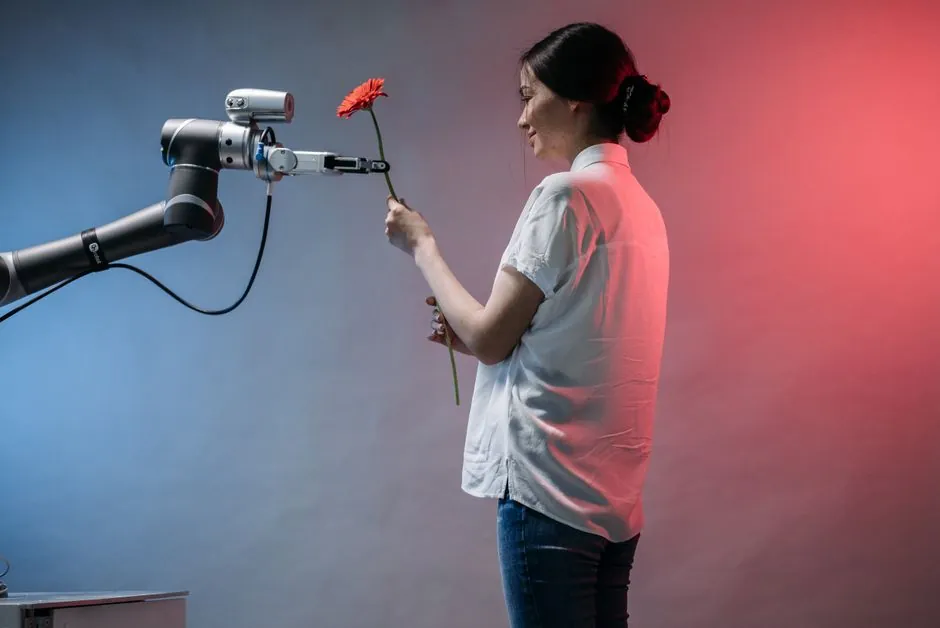
Offline robot programming can return value within one program deployment by validating robot paths away from the production cell, with some welding workflows reducing program adoption from weeks to a single day [S5].
The investment case combines 4 measurable levers: programming labor, robot downtime, collision and rework risk, and the number of production changes each robot can absorb without stopping [S1][S2][S4].
What OLP Changes in the Robot Cell
Robot offline programming moves program development into a computer simulation, where a virtual cell can be checked before commands reach a production robot [S2]. The process begins with a 3D CAD model, continues through toolpath generation and motion simulation, and ends with robot-specific code export [S2].
That workflow targets 3 operating problems at once: production interruption during programming, errors found on physical equipment, and repeated manual path development [S2]. Simulation can expose collisions and singularities before deployment, while exported code is presented as compatible with major robot manufacturers [S2].
For ROI purposes, the relevant output is not a finished animation. It is a verified program that reduces shop-floor trial and error and can be deployed without taking the robot out of production [S2][S5]. The economic value must still be demonstrated with the plant’s own cycle times, labor rates, and downtime costs.
Build the ROI From Four Cost Drivers
A defensible ROI calculation compares the software and implementation cost with 4 quantifiable savings: avoided online programming hours, avoided downtime, avoided rework, and reusable digital work [S1][S4]. RoboDK frames the broader rule directly: reducing cycle time and unnecessary movement improves returns over time, while simulation allows programs to be tested before physical deployment [S4].
The core calculation is:
Annual net benefit = annual labor savings + avoided downtime value + avoided rework and collision cost + software reuse value − annual software and support cost.
Payback period equals the initial investment divided by monthly net benefit. A simple test is whether the avoided cost from one deployment exceeds the license, training, integration, and data-preparation cost. OCTOPUZ states that complex applications can be programmed without disrupting the manufacturing process and that multiple robot brands, configurations, and applications can be programmed together in a virtual environment [S5].
Do not count every minute the robot is technically available as productive time. Count only the downtime that the project demonstrably avoids, the technician hours eliminated, and the rework or collision events prevented. Treating theoretical capacity as cash savings is the most common weakness in robot investment cases [S1][S4].
Compare OLP Against Online Programming
Online teaching and offline simulation differ most clearly in where errors are found and where technicians work [S2][S4]. The comparison should use 4 decision criteria: downtime exposure, engineering control, change frequency, and production-volume fit.
OLP is not automatically superior for every application. A fixed, simple robot motion taught once may not justify a full simulation workflow, particularly if the cell is stable and variant frequency is low [S7]. The economic threshold rises when programs change frequently, paths are complex, errors are expensive, or several robot brands share one engineering workflow [S5].
Choose Software Against Workload and Output
The strongest product match depends on 4 workload variables: geometry complexity, robot-brand diversity, process type, and the expected frequency of new programs [S2][S5]. OCTOPUZ is positioned for path-sensitive weld planning and supports multiple robot brands and configurations in one virtual environment [S5]. Robotmaster targets industrial robot-arm programming with toolpath creation, collision and singularity detection, path optimization, post-processing, and multi-robot coordination [S2].
For multi-brand operations, verify the exact controller syntax and supported robot configurations before purchase; a visual simulation does not by itself prove production compatibility [S2][S5]. For high-complexity applications, assess the supplier’s engineering depth in inverse kinematics and motion optimization, not just the screenshot of a generated path [S2].
Process fit also matters. Welding, cutting, machining, surface finishing, additive manufacturing, inspection, de-burring, dispensing, drilling, riveting, fastening, and pick-and-place are all identified application areas for OLP [S2]. A platform with a strong weld-planning workflow may outperform a general simulation package for intricate seams, while a general CAD/CAM-based tool may serve mixed robot cells better [S2][S5].
Who Benefits and Who Should Not Buy It
OLP is for manufacturers and integrators with 4 conditions: recurring program changes, complex geometry, multiple robots, or a high cost of physical trial and error [S1][S2][S5]. It is especially useful where keeping the robot in production matters more than completing a task once, because offline editing removes much of the disruption associated with online programming [S4][S5].
OLP is not for every robot purchase. Do not add it for a simple machine tending operation with one stable program, limited robot count, and negligible collision risk. In that case, the license and implementation effort may exceed the savings. It is also unsuitable as a substitute for cell acceptance testing, robot calibration, fixture verification, or safety validation. A clean simulation is engineering evidence, not proof that the physical process will produce acceptable parts [S1][S2].
For a mixed evaluation, compare OLP against manual teaching, vendor programming tools, and no dedicated simulation capability. No-code approaches can still require structured controls, and the economic case should distinguish visual authoring from deterministic robot motion, code export, collision checking, and post-processing [S2][S4].
Deployment Workflow and Measurable Payback
An OLP deployment can be evaluated in 4 stages: cell representation, path creation, validation, and code export [S2]. Import the 3D part into a virtual replica of the cell, generate and simulate the toolpath, resolve collisions and singularities, then export the finished program for physical commissioning [S2]. This sequence makes OLP relevant to both new cell design and post-deployment rework.
Measure 5 values before and after implementation: programmer hours per program, robot downtime per program, commissioning attempts, cycle time, and the number of reusable programs or variants [S1][S4]. Robotmaster describes generating production-ready code in minutes, but that claim is only a business fact if the buyer’s own cell, part geometry, controller, and validation requirements support the same result [S2].
The acquisition decision should clear 3 checks: the annual benefit exceeds annual cost, the payback period fits the capital plan, and the savings come from measured operating variables rather than assumed utilization. The package should include training, integration, CAD preparation, and support rather than comparing license price alone [S1].
Failure Modes That Erode the Business Case
Poor cell data can erase the value of simulation, so the geometric model must represent the robot, tooling, fixtures, part, and relevant external axes accurately [S2]. A virtual cell that does not match the physical cell produces false confidence, particularly around reachability, interference, and tool behavior [S1][S2].
Path optimization also has limits. Removing unnecessary movement and reducing cycle time can increase return, but simulation cannot guarantee process quality when the tool, workpiece, speed, and controller behave differently from the model [S4]. Similarly, an offline-programming package that exports unsupported or obsolete controller code creates rework rather than savings, making controller-specific validation mandatory [S2][S5].
Vendor naming and generic feature lists are insufficient procurement evidence. Request a demonstration using one actual part, the intended robot model, the production controller, and the plant’s required measurements. This test exposes unsupported geometry, post-processing gaps, and integration effort before license commitment [S2][S5].
A practical ROI tracker should retain 4 baseline values, including cost per program, downtime hours per change, cycle time, and collision or rework frequency. Review them after 3, 6, and 12 months of operation, then compare realized savings with the original business case. This is the clearest signal for renewal, expansion, or replacement.
The next trackable step is to run one controlled OLP pilot using a real part and actual robot configuration, record the 5 operating measures before and after, and use those results to calculate payback rather than relying on a vendor estimate [S1][S2][S4].