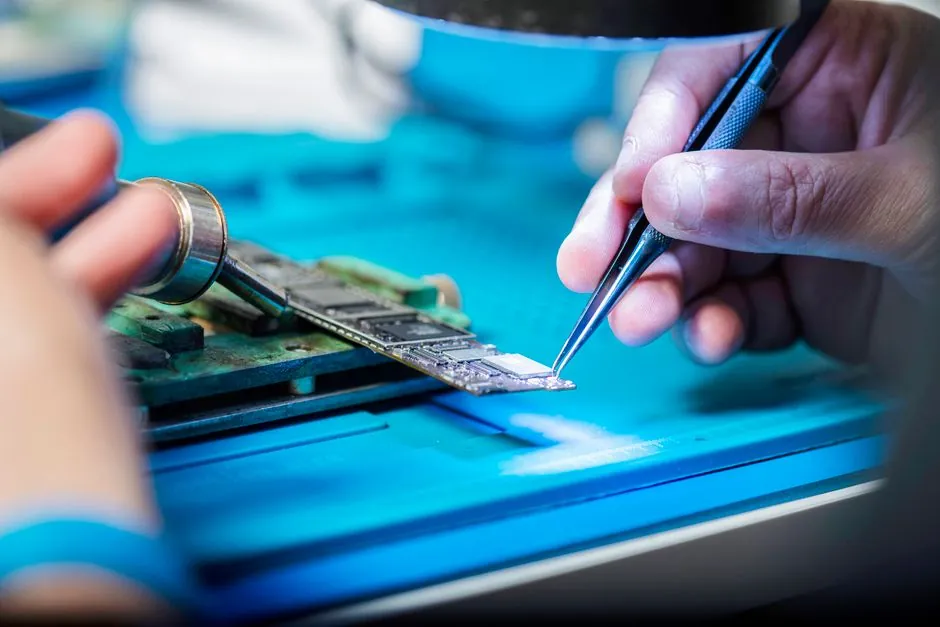
Enterprise OLED procurement resolves to a six-parameter screen: size/resolution, color mode, driver IC plus interface, operating temperature, brightness/contrast, and power consumption [S2]. Each parameter has a hard trade-off against industrial lifecycle, so OEM buyers should rank them against the end product before opening any datasheet [S2].
The market is also consolidating. JDI and OLEDWorks announced plans in early 2026 for a U.S.-based advanced display fab and R&D center targeting defense, automotive, and medical programs, described by the partners as the first of its kind in the Western Hemisphere, with location, scale, and timeline still undisclosed [S1]. For OEMs locked into long qualification cycles, that signals a potential second-source option worth tracking.
How OLED differs from LCD at the procurement level
OLED pixels are self-emissive organic diodes that switch off completely when unpowered, which removes the backlight module and delivers true blacks with a 2000:1 or higher contrast ratio, versus LCD where the LED backlight stays on and "black" is dark gray [S2]. Thinner stack-up, wider viewing angle, and lower weight follow directly from removing the backlight, so mechanical integration often simplifies even when the OLED module itself costs more per square inch [S2][S4].
Industrial OLED and consumer OLED are different animals: consumer parts chase peak nits and refresh rate for short product cycles, while industrial OLED modules are qualified for wider temperature windows, longer supply continuity, and stable driver IC sourcing across 5 to 10 year programs [S2]. Buyers who pull a consumer panel into an HMI build typically discover the gap during EMC or burn-in testing, not during part qualification [S2].
The six core parameters and what to lock down first
Size and resolution should be driven by viewing distance, enclosure constraints, and interface bandwidth, not by "bigger is better"; a 0.96 to 4.3 inch small-size OLED, a 5.0 to 15.6 inch mid-size OLED, and a 17 to 32.0 inch large-format OLED each map to different supply chains and tooling [S2][S4]. Color mode (monochrome, area-color, full-color) shifts driver IC requirements and the burn-in exposure profile, so it is the second decision, not the third [S2].
Driver IC and interface choices (SPI, I²C, parallel, MIPI, eDP) are the most common root cause of late-stage redesigns, because changing the interface after PCB layout forces a new host MCU or bridge IC and a new EMI retest [S2]. Operating temperature and reliability are the lifeline of industrial applications; wide-temperature OLED parts exist as a separate category and should be specified by minimum and maximum operating range with humidity, not by marketing labels [S2][S4]. Brightness/contrast numbers must be measured in candela per square meter at the actual operating temperature, since OLED output drops as the panel warms, and contrast ratio claims without a temperature condition are not comparable across vendors [S2]. Power consumption and supply voltage are the Achilles' heel of battery-powered devices, because peak pixel current on full-white content can be 3 to 4 times the average, so the power tree must be sized to peak, not average, current [S2].
Comparing the main procurement options

Three sourcing routes are common for OLED modules: direct from the panel maker, through an authorized industrial distributor, or via an ODM/OEM that designs in the module. Each route scores differently across the four criteria that drive industrial programs. [S1]
Direct-from-maker purchases give the deepest warranty and RMA support plus the earliest access to PCN notices, but require the OEM to carry qualification, lifecycle management, and obsolescence buffer stock [S3]. Authorized industrial distributors add pre-screened industrial-temp parts, longer lifecycle buffers, and kitting, at a small unit-cost premium, and are the typical channel for defense, medical, and long-life industrial programs [S1]. ODM/OEM routes bundle the display into a custom module or finished assembly and trade away some panel-maker transparency for faster time-to-market and lower integration cost [S2].
Across cost, lifecycle, lead time, and customization, the rough shape is: direct wins on price and warranty at high volume, distributors win on lifecycle and risk for low-to-mid volume industrial runs, and ODM/OEM wins when the display is part of a larger custom assembly and time-to-market dominates the decision [S1][S2][S3].
Burn-in, longevity, and the static-content trap
Burn-in is the predictable failure mode for any OLED running fixed UI elements, and is the reason a hospital bedside display, a kiosk price tag, or a logo bar on signage must be designed around, not around which is the panel spec [S3]. Procurement should require documented mitigation mechanisms, including pixel shifting, logo dimming schedules, and scheduled content rotation, and should request warranty clauses that name burn-in coverage explicitly rather than bundling it into a generic panel warranty [S3].
For fixed-content retail and signage, an external frame buffer and content-rotation policy protect the panel more than any spec change, and the supplier should be scored on willingness to support those workflows [S3]. Procurement checklists should treat the burn-in mitigation plan as a deliverable, with a named test method and a pass/fail threshold, not as a marketing bullet [S2][S3].
Supplier scoring: what separates a qualified OLED vendor from a price sheet
A qualified industrial OLED supplier demonstrates four things: customization capability (FPC layout, cover glass, touch stack, interface mapping), a quality certification system traceable to recognized standards, demonstrable delivery and response speed, and after-sales engineering support that can debug driver IC and EMI issues on the OEM's line [S2]. Authorizations and long-standing franchise agreements, like the JDI and OLEDWorks U.S. manufacturing initiative targeting defense, automotive, and medical end markets, are an early signal of supply-chain resilience that matters more for long-life programs than for one-year consumer cycles [S1].
Price is not a primary scoring axis at the supplier-qualification stage, because total cost of ownership is dominated by qualification cost, field failure rate, and lifecycle buffer stock, not unit price [S2][S3]. OEMs that anchor RFQs to unit price alone routinely pay for it later in EMI redesigns, driver IC changes, and burn-in warranty disputes [S2].
Procurement workflow: from requirements to mass-production release
A defensible OLED procurement flow has five steps: requirements analysis that starts with environment and lifecycle, not the spec sheet; technical parameter screening against the six core metrics; supplier evaluation against customization, certification, delivery, and support; sample testing and validation that includes thermal, burn-in, and EMC at the actual operating point; and mass-procurement release with a documented change-control and obsolescence plan [S2]. Skipping sample validation, or running samples at room temperature, is the most common source of late-stage program slips, because OLED behavior shifts materially with temperature and humidity [S2][S4].
For the broader sourcing strategy, OEM buyers can borrow patterns from LED sourcing from China: 2026 spec-to-supplier qualification map when building a multi-vendor OLED shortlist, since the qualification workflow (spec lock, sample plan, audit, mass release) is structurally similar across display technologies. Teams that already run industrial valve quality standards audits can map the same documentation discipline onto OLED vendor qualification, especially the lifecycle and traceability sections.
Two signals worth tracking into late 2026: the JDI plus OLEDWorks U.S. fab site, scale, and product scope announcement, which will set the practical ceiling on Western-Hemisphere OLED second-source availability [S1]; and any new wide-temperature industrial OLED modules in the 5.0 to 15.6 inch mid-size band, where the supply base is thin and qualification cost is high [S2][S4]. Lock the six core parameters before the first RFQ, and treat burn-in mitigation as a contractual deliverable rather than a spec footnote.
Spec-level background on the components involved: linear guide, crossed roller guide, and pressure transmitter.