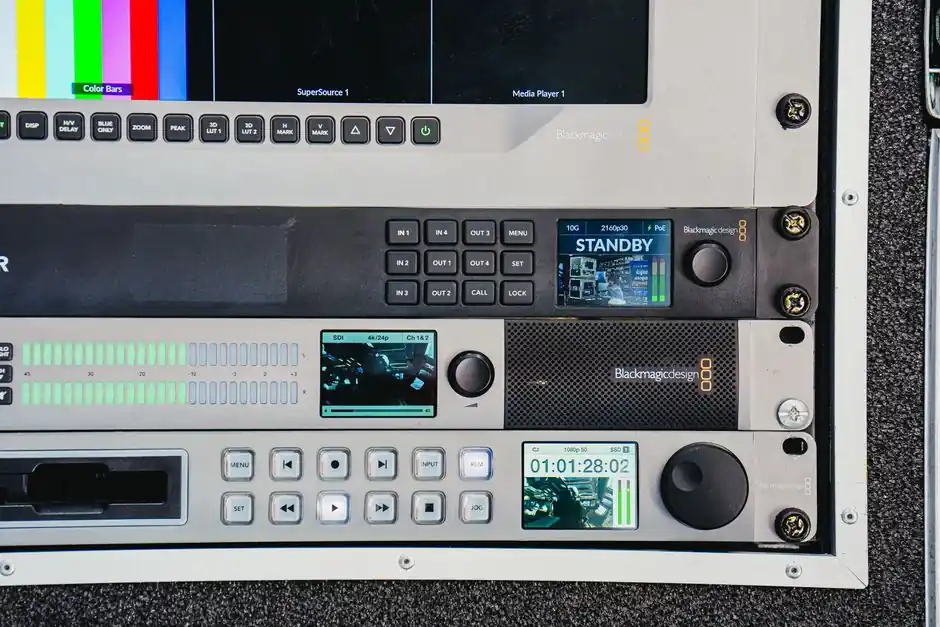
OPC UA PubSub over Ethernet TSN supports multi-vendor controller-to-controller exchange with bounded-latency delivery and precise synchronization [S4][S5].
UAFX defines this path for PLCs, DCS controllers, industrial PCs, and other automation components, while client/server connections remain outside the defined release [S5].
Where OPC UA over TSN fits
OPC UA over TSN combines OPC UA information models and PubSub communication with Time-Sensitive Networking mechanisms for synchronization, scheduled traffic, and deterministic Ethernet delivery [S4][S5].
The architecture is intended for controller-to-controller traffic across mixed-vendor PLC, DCS, and industrial PC systems. UAFX represents each participant as an AutomationComponent with identification, assets, functional entities, and a standard interface for exchanging data through Connections [S5].
The scope is narrower than a universal replacement for every industrial protocol. UAFX currently defines Connections using OPC UA PubSub, including TSN, while Connections based on OPC UA Client/Server are planned for a future release [S5]. Controller-to-device and device-to-device extensions also require separate specification work [S3].
Readiness decision for engineering teams
This is more rigorous than confirming that every device carries the OPC UA or TSN label.
The second gate is conformance evidence. The OPC Foundation's Field Level Communications Initiative completed the initial Release Candidate for OPC UA-based Field eXchange (UAFX) for the controller-to-controller use case [S3].
The third gate is service configuration.
Controller-to-controller specification scope

UAFX defines real-time, multi-vendor Connections using OPC UA PubSub, and
Security is integrated at two levels. With converged IT and OT networks, increased connected devices and cyber risk make reliance on firewalls alone ineffective [S4].
Comparing the main implementation options
OPC UA PubSub over TSN is the strongest fit for deterministic, distributed controller data because it combines publish/subscribe exchange with bounded-latency Ethernet delivery. OPC UA Client/Server remains useful for request-response information access, but UAFX does not yet define its controller-to-controller Connections [S5]. Ethernet-APL addresses field-level physical transport and hazardous-zone operation, while TSN addresses Ethernet timing and traffic control; they solve different layers.
This comparison also prevents a common specification error: Ethernet-APL is not an alternative name for TSN, and PubSub is not interchangeable with Client/Server at the Connection-definition level. Each option must be matched to its defined role [S3][S5].
Traffic engineering and synchronization
Traffic engineering starts with the UAFX Connection model, because process data and SafetyData can be bidirectional or unidirectional and carry different timing and quality-of-service requirements [S5]. The OPC UA information model identifies what is exchanged; TSN mechanisms determine how the corresponding Ethernet frames are scheduled and delivered [S4].
Time-aware shaping is the direct network control point for reducing latency variation.
A 2026 traffic-aware configuration study proposed mapping industrial traffic classes to network configurations according to timing and quality-of-service specifications [S6]. That work supports treating traffic classification as a design discipline: periodic control data, event-driven traffic, bulk transfers, and safety traffic should not receive identical scheduling assumptions merely because they share the same IP network.
Deployment constraints and failure modes
The first failure mode is partial TSN support. A basic TSN implementation does not guarantee the complete synchronization, shaping, and configuration profile required by a multi-controller design [S2]. Mixed clocks, incorrect priorities, omitted stream identities, or inconsistent switch configuration can defeat deterministic behavior even when ordinary OPC UA communication remains functional.
The second failure mode is confusing protocol availability with endpoint readiness. Controllers must implement the relevant OPC UA PubSub behavior, and embedded OPC UA stacks must be integrated with TSN-capable NICs and switching infrastructure [S4]. Product-level interoperability also requires compatible identification information so that each Connection can be checked before exchange begins [S5].
The third failure mode is overextending the specification. UAFX defines PubSub-based controller-to-controller Connections, but Client/Server Connections were still planned for a future release [S5]. Procurement language should state which communication mode, profile, security configuration, and test evidence are mandatory rather than requesting a generic OPC UA over TSN system.
Legacy-network coexistence also needs a migration boundary. Traditional industrial Ethernet, proprietary controller buses, and conventional OPC UA deployments may continue operating alongside a new TSN segment, but deterministic claims apply only within the designed Ethernet domain and its validated configuration.
Standards and procurement evidence

UAFX follows the IEC/IEEE 60802 TSN Profile for Industrial Automation for network convergence [S5]. This is the critical deployment reference for industrial automation, while OPC UA remains based on the OPC UA Framework under IEC 62541 [S3]. These documents address different layers and should be cited separately in design and tender documentation.
The FLC initiative published a 40-page technical paper covering concepts and use cases, completed its initial controller-to-controller Release Candidate in November 2020, and had 27 steering-committee companies and more than 300 experts from more than 60 companies participating by March 2021 [S3]. These figures describe the specification-development effort, not market adoption.
Useful procurement evidence includes the tested hardware and firmware versions, the applied TSN services, the UAFX Connection configuration, synchronization results, latency and jitter measurements, security settings, and evidence of cross-vendor exchange. The broader OPC UA specification context is covered in IEC 62541 Parts Engineers Need for OPC UA, while the industrial profile deployment is detailed in IEC/IEEE 60802-2026 Guides Industrial TSN Deployment.
The next verification milestone is an end-to-end controller test: run the intended PubSub Connections across the proposed switch and endpoint hardware, validate the 60802 profile and time synchronization, measure worst-case latency and jitter under production traffic, and repeat the test with the final firmware and security configuration.