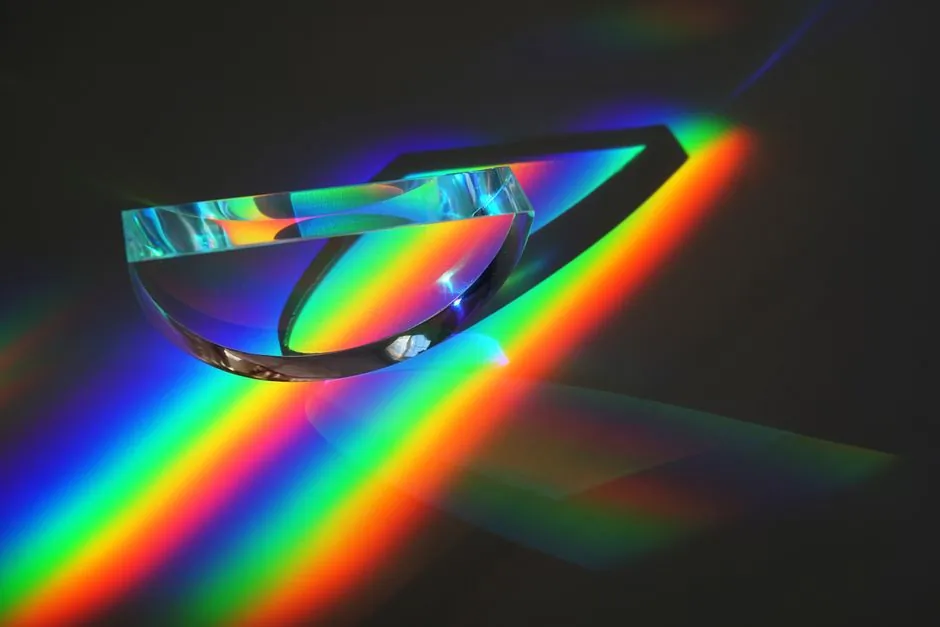
Optical glass for electronics is selected on four measurable axes, with refractive index, Abbe number, transmission band, and thermal/mechanical stability separating viable grades from unsuitable ones for camera modules, laser optics, AR waveguides, and display systems [S1][S3].
Common grades span N-BK7 (n ≈ 1.5168, Vd ≈ 64) for general imaging, fused silica (n ≈ 1.458, Vd ≈ 67) for UV and laser duty, SF11 (n ≈ 1.784, Vd ≈ 25) for high-index achromatic doublets, B270 low-iron crown for visible/NIR covers, and CaF2 (n ≈ 1.43) for deep-UV to mid-IR [S3][S4]. A 99.9% raw-material purity floor and 72+ hour annealing cycles distinguish optical blanks from commodity float glass, with index homogeneity specified to ±2×10⁻⁶ at grade H5 per ISO 12123 [S3].
What Optical Glass Is and Why Purity Sets the Floor
Optical glass is a controlled formulation of silica, alumina, alkalis, and other oxides refined to impurity levels below 10 ppm for absorbers like Fe2O3, with raw-stock homogeneity held tighter than ±2×10⁻⁶ at ISO 12123 grade H5 [S3]. A single surface of coated N-BK7 transmits more than 99% of incident light across 380–780 nm, while commodity float glass loses 8–15% to absorption and scatter at the same interfaces [S3]. The practical consequence for electronics is direct: a camera module, a LiDAR emitter, or a wafer-inspection objective cannot be built on window-glass substrate without losing signal-to-noise, wavefront quality, or laser damage threshold [S1][S3].
The category also extends beyond amorphous oxide glasses to crystalline fluoride windows such as CaF2, which transmit from 0.15 µm to 8 µm and are used where UV excimer lasers or IR thermal imaging must pass through a single optic [S4]. Selecting the right family therefore starts with the wavelength band and the required index-homogeneity class, not with brand or price.
Refractive Index and Abbe Number: The Two Numbers That Drive Design
Refractive index (n) sets focal length and surface curvature, while the Abbe number (Vd) sets chromatic spread across the visible band; both are specified per glass family and indexed in manufacturer catalogs [S1][S3][S4]. Across mainstream electronics grades, n ranges from about 1.43 (CaF2) and 1.458 (fused silica) up to 1.95+ in dense flint glasses, and Vd ranges from about 20 in high-dispersion flints to 95 in low-dispersion fused silica [S3][S4]. A high Vd glass such as N-BK7 (Vd ≈ 64) or fused silica (Vd ≈ 67) produces low chromatic fringing in single-element optics, while SF11 (Vd ≈ 25) is used in negative elements of achromatic doublets to correct color across a wide field [S4].
The key trade-off for electronics designers: high-index glasses shrink element curvature and total track length, which matters for compact phone-camera stacks and AR combiners, but they cost Abbe number, so chromatic correction gets harder as the form factor shrinks [S1][S3]. Doublet and triplet designs therefore pair a low-Vd high-n glass (SF11) with a high-Vd crown (N-BK7) to land a net achromatic system inside a tight housing.
Main Glass Families and Where Each One Fits in Electronics

N-BK7 (or its Chinese equivalent K9) is the default general-purpose borosilicate crown for 350–2000 nm use, with n ≈ 1.5168 and Vd ≈ 64, used in microscope objectives, interferometer windows, projector prisms, and many industrial machine-vision lenses [S3][S4]. Fused silica (synthetic fused quartz) covers deep-UV to near-IR (transmission from 185 nm to 2,000+ nm), holds its figure under thermal load because of its near-zero coefficient of thermal expansion (≈0.55×10⁻⁶/K), and is the standard substrate for high-power laser windows, photolithography optics, and space imaging payloads [S3][S4]. SF11 and similar dense flints deliver n ≈ 1.78–1.95 with Vd in the 20–30 range, used in negative elements of achromatic doublets and in compact high-NA projection lenses where space is tighter than color budget [S4].
B270 is a low-iron crown with high transmittance in the visible and near-IR, frequently specified for protective cover glasses on sensors, display panels, and consumer camera windows where cost and color neutrality outweigh the need for laser-grade purity [S4]. CaF2 is a crystalline fluoride (n ≈ 1.43) transmitting 0.15–8 µm with very low dispersion, used for excimer-laser windows, IR thermal-imaging lenses, and spectroscopic prisms where the band is wider than any oxide glass can cover [S4]. The full comparison, scored against four decision criteria an electronics engineer actually filters on, is shown below.
Transmission Band and Thermal Stability: Where Designs Actually Break
Transmission band is the first hard filter, since oxide glasses roll off below ~350 nm and fluoride crystals like CaF2 extend that to 0.15 µm, while heavy-oxide flint glasses cut off in the near-IR [S3][S4]. For UV laser-based semiconductor inspection or photolithography, fused silica is the only mainstream choice; for 193 nm or 248 nm excimer exposure, CaF2 becomes mandatory because standard crown glasses absorb at those wavelengths [S4]. SCHOTT, Corning, and Ohara publish transmission curves and internal transmittance values per 5 mm or 10 mm thickness, and these curves are the documents an optical engineer benchmarks the design against, not the catalog summary [S2].
Thermal and mechanical stability then decides whether the part survives its operating environment. Fused silica holds figure over temperature swings because its CTE sits near 0.55×10⁻⁶/K, while SF11 and other dense flints expand roughly an order of magnitude more and can drift out of focus in high-power laser or outdoor LiDAR duty [S3][S4]. SCHOTT catalogs segment optical glasses by their application class, including laser optics, machine vision, semiconductor and datacom, and consumer electronics, with recommended grades flagged for AR components, LiDAR/radar, and touchscreens [S2].
Standards, Homogeneity, and How to Read a Glass Catalog
ISO 12123 defines the refractive-index homogeneity classes (H1 to H5 and tighter), MIL-PRF-13830B governs the inspection protocol for finished optical components, and the SCHOTT, Corning, and Ohara catalogs publish refractive index, Abbe number, transmission curves, and CTE per glass code [S2][S3]. A practical filter sequence for electronics procurement is: (1) lock the wavelength band and pick the glass family that transmits it, (2) set the required Vd to control chromatic error within the optical path length the package allows, (3) choose the homogeneity class (H3 or H4 is typical for camera lenses, H5 for laser and interferometric duty), and (4) check CTE and thermal conductivity against the operating environment [S1][S2][S3].
For the broader context of glass material families, the optical glass reference page collects the catalog conventions behind these codes, while glass quartz covers the crystalline end of the same family tree and clarifies when a designer should be selecting fused silica or a single-crystal quartz optic instead of an oxide glass. If the application is a glass cover on a consumer device, the sight glass page is a useful contrast, since sight glasses are process-window components with very different optical tolerances from camera cover lenses.
Limitations and Failure Modes Engineers Hit in Production
Four failure modes recur in electronics-grade optical glass selection. First, index inhomogeneity: a single stria in a camera lens can collapse the wavefront across the aperture and produce fringe artifacts that no DSP can clean up, which is why homogeneity grade is a paid spec, not a marketing line [S3]. Second, thermal drift: high-index flints in outdoor LiDAR or head-up display assemblies shift focus over temperature cycles because their CTE is roughly 7–9×10⁻⁶/K versus ~0.55×10⁻⁶/K for fused silica, so athermalization has to be designed in, not assumed [S3][S4]. Third, laser damage: fused silica is the safe default for multi-kW and excimer systems, while standard crowns will damage at fluences that fused silica absorbs cleanly [S3][S4]. Fourth, contamination: Fe2O3 above ~10 ppm in the raw batch tints the glass yellow-green and shifts white balance in imaging pipelines, which is why a low-iron B270 or a true optical crown is specified for any window in the imaging path rather than commodity soda-lime [S3][S4].
Selection Sequence and Sourcing Signals to Track

A working spec-first filter for a new electronics-optics build: confirm the operating wavelength band, set the minimum Abbe number to control chromatic error, pick the homogeneity class per ISO 12123, lock the CTE envelope, and only then compare suppliers and lead times [S1][S2][S3]. For deep-UV and laser duty, default to fused silica or CaF2; for visible-band consumer imaging, N-BK7 or B270; for compact high-NA optics, SF11-class flints in a doublet with a crown partner [S3][S4]. When the system also needs metrology or 2D inspection, the related optical comparator selection map for shop-floor 2D inspection covers the bench side of the same workflow, and quartz material selection for aerospace is the parallel reference when the optic also has to survive vacuum and radiation.
Trackable signals over the next procurement cycle: SCHOTT, Corning, and Ohara publishing updated transmission and homogeneity data for their AR/laser lines, ISO 12123 revision drafts if any are circulated for comment, and MIL-PRF-13830B inspection updates that move component-level acceptance criteria for homogeneity and scratch-dig [S2][S3]. These are the documents that move first when a new electronics platform (AR waveguides, periscope phone modules, vehicle LiDAR) lands on a glass spec.