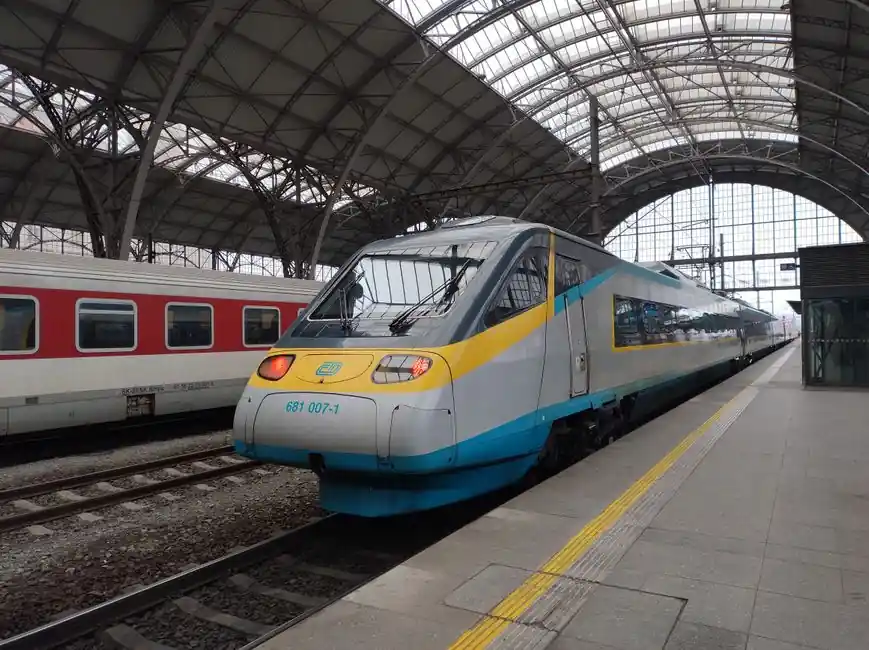
Rail-grade optical glass selection resolves around four measurable parameters, refractive index, Abbe number, transmission band, and thermal expansion, applied across three rail sub-systems: colour-light signalling, trackside infrared/laser detection, and on-board imaging [S2][S3][S5].
The same glass families used in photonics and metrology (BK7, N-BK7, fused silica, dense flint, N-LAK) are specified into UK and European rail networks for Fresnel lens signals, hot-bearing detectors, clearance-gauge laser systems, and LiDAR-style obstacle scanners, with the operating envelope dictated by line-side temperature swings and visible/IR transmission windows [S1][S2][S5].
Core Glass Families and Their Rail Use Cases
BK7 (and N-BK7) borosilicate crown glass is the default rail-signalling blank because it combines a refractive index around 1.5168 with an Abbe number near 64.2, giving low chromatic dispersion for the red/green/yellow aspects of colour-light signals [S5]. SCHOTT's catalogue lists 120+ optical glass types, with BK7-class crowns forming the workhorse group for sight glasses, Fresnel lenses, and observation windows across industrial and transport infrastructure [S1].
Fused silica (synthetic SiO2) is specified for trackside UV and IR detectors because its transmission window opens at 185 nm in UV-grade material and extends past 5,000 nm in IR grades, far wider than BK7's roughly 350-2,000 nm practical band [S5]. For laser gauging vehicles measuring tunnel clearance, fused silica optics survive the high peak-power pulses and the -40 to +85 °C trackside thermal swings better than standard crowns.
Selection Criteria: Refractive Index, Abbe, Transmission, Thermal
Refractive index (n) sets the optical power per unit thickness; in lens material tables, normal-index crowns sit at 1.48-1.54, polycarbonate mid-index at 1.586, and dense flint (H.I. 80) reaches n 1.80 with specific gravity 3.37 [S4]. For rail use, BK7 and equivalent crowns (n ~1.51, Abbe ~58-64) dominate because the modest index is enough to collimate LED and incandescent signal sources through a Fresnel profile without introducing visible colour fringing on the aspect [S2][S4].
Abbe number controls dispersion: a crown glass at Abbe 58 shows minimal chromatic aberration, while a flint glass at Abbe 25 shows strong dispersion, useful for spectrometry-style detectors but undesirable for imaging through a windscreen or periscope [S4]. Trackside hot-box infrared detectors tolerate lower Abbe values because the sensor is single-wavelength, while driver-sight optics require Abbe 55+ to avoid signal-colour shifts at the edges of the field of view.
Transmission and thermal stability follow the ISO 12123 homogeneity grade (H5, refractive index variation below ±2×10⁻⁶ across a blank), and MIL-PRF-13830B for surface quality, both referenced as governing specs for precision optical glass production [S5]. Rail procurements typically call out homogeneity grade, bubble/inclusion class, and a striae limit per ISO 12123 rather than the glass family by trade name.
Where Each Glass Family Fits on a Train or Track
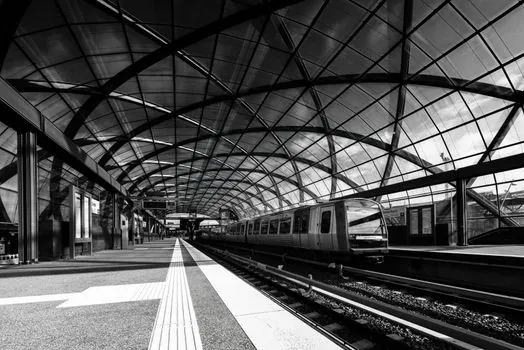
Signalling (Fresnel lens aspects, signal hood windows, light-collecting domes) uses BK7 or equivalent crown, antireflection-coated both sides to push per-surface transmission above 99% across 380-780 nm [S2][S5]. Fresnel lenses on UK colour-light signals focus the source into a near-parallel beam and cut phantom-aspect risk from reflected sunlight, a function that breaks down if the lens material yellows or scatters [S2].
Detection (hot-bearing IR sensors, clearance-gauge lasers, wheel-flat cameras, LiDAR scanners) uses fused silica or IR-grade chalcogenide alternatives, chosen for transmission at the sensor wavelength (typically 1.0-1.6 µm for IR, 905-1,550 nm for LiDAR) and for low thermal expansion so the optic does not drift out of focus across the -40 to +85 °C rail envelope [S2][S5]. Track-integrated hot-box detectors monitor axle-bearing and disc-brake radiation and flag a journal as unsafe when the maximum bearing temperature threshold is reached, optics that have to hold calibration through a decade of weather [S2].
On-board imaging (driver-facing cameras, forward obstacle scanners, in-cab CCTV) tends to combine BK7 or N-LAK elements with aspheric surfaces and multilayer AR coatings; the wider refractive-index range of the N-LAK family (n 1.69-1.85 region) lets designers correct field curvature in compact lenses for cab-mounted cameras. For sight windows and windscreen optics, optical glass is the generic term covering every grade above; sight glass refers more narrowly to the thick, pressure-rated observation windows used in rolling-stock fluid reservoirs, which trade off optical purity for mechanical strength.
Material Comparison on Rail-Relevant Criteria
Comparing BK7 crown, fused silica, dense flint, and polycarbonate on four criteria that matter to a rail specifier: crown glass (BK7) offers Abbe 58-64, transmission 380-2,000 nm, refractive index ~1.51, and the lowest cost per kg; fused silica offers Abbe 67, transmission 185-5,000+ nm, refractive index 1.44, and the best thermal stability (CTE ~0.55×10⁻⁶/K); dense flint (H.I. 80) offers Abbe 25, transmission 380-2,500 nm, refractive index 1.80, and the highest dispersion, so it is restricted to spectrometry and laser sub-assemblies, not signal aspects; polycarbonate offers refractive index 1.586, Abbe 30, and high impact resistance, useful for crew safety eyewear and impact-loaded lens covers but not for high-temperature or UV-exposed trackside optics [S4][S5].
The decision rule in plain terms: pick BK7 (or equivalent crown) for visible-band signal and observation optics where chromatic purity matters; pick fused silica for any wavelength outside the visible band or anywhere the optic sees high peak power or wide thermal cycling; pick dense flint only inside a detector head where a prism or grating needs high dispersion; avoid polycarbonate for outdoor trackside enclosures because its Abbe 30 and lower UV resistance produce visible yellowing and fringe colour shifts over a service life measured in years, not hours [S4][S5].
Limitations and Failure Modes Specific to Rail

The biggest in-service failure for rail optical glass is not breakage but contamination and surface degradation: brake dust, iron oxide from wheel-rail wear, and de-icing salt deposit onto signal lenses and detection windows, scattering the beam and corrupting the sensor's apparent reading. Optical glass tolerates this better than plastic because its hardness (BK7 sits around 5-6 on Mohs) resists micro-scratching, and AR-coated surfaces can be cleaned with standard isopropanol wipes, unlike anti-fog coated polycarbonate which solvent-damages easily [S4][S5].
A second limit is thermal: standard crown glass has a CTE near 9×10⁻⁶/K, so a 1 m signal lens changes length by roughly 90 µm across a 10 °C day, enough to defocus a tight Fresnel aspect or shift a laser alignment by a fraction of a milliradian. For installations that demand sub-pixel stability, fused silica's 0.55×10⁻⁶/K is the practical answer even though it costs more per kg and is harder to grind and polish [S5].
Key standards to consider for a rail procurement include ISO 12123 and MIL-PRF-13830B, supplemented by a project-specific specification for AR coating reflectance. Network Rail-style signal procurement historically demanded striae class 1-2 and bubble class 0-1 for wayside signal lenses, a level of purity that excludes most general-purpose crown glass and forces the buyer to the BK7 or N-BK7 production line [S5].
Trackable Signals and Next Watch-Items
Procurement engineers should also track the quartz material selection rules because fused silica grades overlap with general quartz fabrication in tooling and surface-prep requirements. [S5]
The underlying component specifications are covered under optical comparator.