
Fused quartz softens above 1,650°C, roughly twice the 820°C softening point of standard borosilicate lab glass, and carries a thermal expansion coefficient 5–7 times lower [S1]. That single data point is the reason defense optics, laser windows, and missile radome sub-components are specified against fused quartz grades rather than commodity glass.
The defense buyer is not buying "quartz." Three materially different families compete under that label, each with its own spec sheet, qualified supplier base, and stockpile status: amorphous fused quartz/fused silica, single-crystal cultured quartz, and high-purity processed quartz (HPQ) for semiconductor crucibles and optical preforms [S1][S2][S5]. Treating them as interchangeable is the most common sourcing error on first-time defense programs.
Amorphous fused quartz vs fused silica: where each one wins
Fused quartz is melted from natural crystalline quartz; fused silica is built from synthetic precursors such as chemical-vapor-deposition (CVD) feedstocks, which typically yields fewer metallic impurities and stronger UV transmission [S1]. For IR optics, furnace tubes, and missile-facing windows operating above 1,000°C, clear fused quartz is the workhorse grade. For UV-band laser optics, semiconductor lithography preforms, and any wavelength below ~350 nm, synthetic fused silica is the defensible choice because the lower metal-ion content reduces solarization and fluorescence under high-energy photon flux [S1].
Two variants sit inside the amorphous family. Clear fused quartz transmits UV through near-IR and is specified for viewing windows, lamp envelopes, and photonics housings. Opaque fused quartz is intentionally filled with a controlled distribution of microscopic gas bubbles that scatter IR and diffuse heat, and it is the right pick for furnace insulation, crucible liners, and thermal-shield tiles where heat distribution matters more than optical clarity [S1]. Engineers who specify "fused quartz" without naming clear vs opaque routinely get the wrong billet on the first PO.
Cultured single-crystal quartz: the piezoelectric standard for defense electronics
Single-crystal cultured quartz, grown by a hydrothermal process, is the material that drives frequency-control devices, filters, timers, and resonator elements in military radios, radar timing chains, and inertial navigation oscillators [S5]. Unlike fused quartz, it is crystalline and piezoelectric, which is precisely why the U.S. National Defense Stockpile designated natural electronic-grade quartz crystal as a strategic and critical material after World War II, and why the Defense Logistics Agency still tracks cultured quartz as a strategic input [S4][S5].
Historically, four U.S. producers (Sawyer Research Products, Thermo Dynamics, and two others identified in USGS reporting) grew cultured quartz from lascas feedstock, with Coleman Quartz in Jessieville, AR acting as the only domestic lascas supplier; lascas was oxalic-acid rinsed, deionized-water rinsed, hand-sorted, and shipped in 45 kg (100 lb) bags within 20,000 kg lots [S4]. Seed-crystal supply is the chokepoint: stockpile records in 1995 held 236,513 lb of natural quartz crystal in 11 weight classes from 200 g to over 10,000 g, with the strategic value sitting almost entirely in the heavier classes that can seed autoclave runs [S4]. Program teams that need a multi-year oscillator supply should confirm seed-crystal class availability against current DLA inventory before locking the resonator design.
High-purity quartz and the semiconductor stack: a defense adjacency, not a substitute
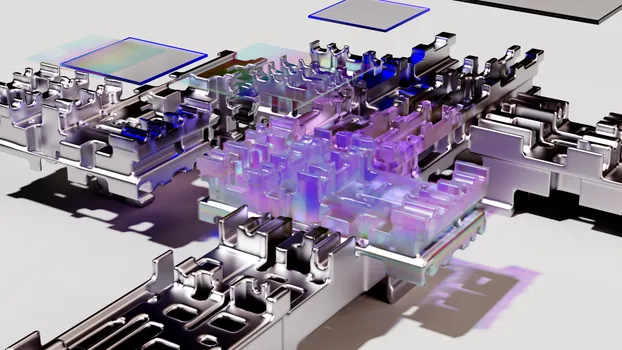
High-purity quartz (HPQ) is a process material embedded in semiconductor wafer production, optical preforms, and fabricated consumables such as quartz crucibles for silicon ingot growth [S2]. North Carolina-sourced HPQ is one of the obscure inputs that sits inside U.S. and ally-controlled value chains for advanced chip making, and it is structurally distinct from the fused quartz used in windows and the cultured quartz used in oscillators [S2].
For a defense program, HPQ matters indirectly: the same HPQ supply that feeds wafer fab also feeds infrared optics, laser gain media, and the photomask substrates that produce radiation-hardened ICs. China does not control the entire semiconductor stack, but Beijing's April 2025 heavy-rare-earth and magnet export restrictions did cause rapid disruption across allied defense and industrial supply chains, and the May 2026 effective cutoff of dysprosium, terbium, yttrium oxide, and gallium to Japan is the most recent reminder that mineral leverage is real [S2]. A program office buying HPQ optics should treat the upstream boule and lascas supply as a Tier-2 risk on the bill of materials, not a Tier-3 commodity.
Decision criteria: which quartz form, against which requirement
The table below lines the three families against the four decision criteria that drive defense selection. The right column is the disqualifier, not the headline property.
Material A is fused quartz/fused silica (amorphous), with continuous-use temperature above 1,000°C, electrical resistivity high, optical transparency from UV through near-IR, and zero piezoelectric coupling. Material B is cultured single-crystal quartz, with lower continuous-use ceiling around 573°C (the alpha/beta phase transition, also called the Curie inversion), strong piezoelectric coupling, optical transparency in the visible and UV with birefringence, and trace seed-crystal supply risk. Material C is high-purity quartz, used as a crucible and preform feedstock rather than a finished structural part, with thermal purity graded at parts-per-billion metal-ion levels and direct exposure to the rare-earth and mineral-leverage volatility described above [S1][S2][S4][S5].
If the part sees thermal shock, specify amorphous fused or fused silica. If the part is a frequency-control element, resonator, or pressure sensor, specify cultured single-crystal quartz against Q-value and angular orientation (typically AT- or SC-cut). If the part is a crucible, ingot-growth liner, or optical preform, specify HPQ with full trace-metal certificate and dual-source lascas. For deeper program context on layered safety spec work, safety glasses for chemical plant duty walks through a similar spec-line discipline that translates well to quartz sourcing documentation.
Limitations, failure modes, and what the spec sheet does not tell you
Fused quartz loses its thermal-shock advantage the moment the part is contaminated with alkali metals during secondary processing, because alkali ions drop the effective softening point and promote devitrification (crystallization) at sustained high temperature. Devitrification starts at the surface and propagates inward, so opaque fused quartz furnace liners rated for long dwell times above 1,200°C should be ordered with documented surface-finish controls [S1].
Cultured quartz loses piezoelectric performance when the resonator operates across the 573°C alpha/beta phase transition, and it is also susceptible to impurity-driven Q-loss when autoclave feedstock drifts outside the lascas spec. That is why the National Defense Stockpile classification persists: it is not nostalgia, it is a documented supply risk against a hostile or restricted mineral pipeline [S4]. Engineers specifying cultured quartz for new designs should pull the latest DLA Strategic Materials entry for cultured/synthetic quartz crystal to confirm current stockpile tier before committing [S5].
HPQ loses its defense relevance the moment the semiconductor stack substitutes an alternate crucible or preform material, but no qualified substitute exists today for high-temperature silicon ingot growth, so HPQ remains a single-point chokepoint that any defense program consuming radiation-hardened ICs inherits by default [S2]. The mineral-leverage risk is upstream of the defense integrator, but it is not outside the program office's responsibility.
Where this leaves a defense spec team
The next move for any active program is three concrete checkpoints: confirm the quartz family on the bill of materials against one of the three columns above, not against the generic term "quartz"; pull the current DLA Strategic Materials page for cultured/synthetic quartz crystal and confirm whether the seed-crystal weight class needed is still in stockpile or has to be grown; and require dual-source lascas or HPQ feedstock on any PO above prototype quantity, given the April 2025 and May 2026 export-control precedents on adjacent critical minerals [S2][S5]. A reviewer can also cross-check analogous layered-defense spec logic in respirator selection for electrical work to see how hazard-tier classification is documented in a defense-adjacent context. Quartz selection is not a procurement task; it is a risk-allocation task, and the program that treats it as such is the one that does not get caught in the next export-control cycle.
For component-level specifications, see quartz material, glass quartz, and advanced material.
