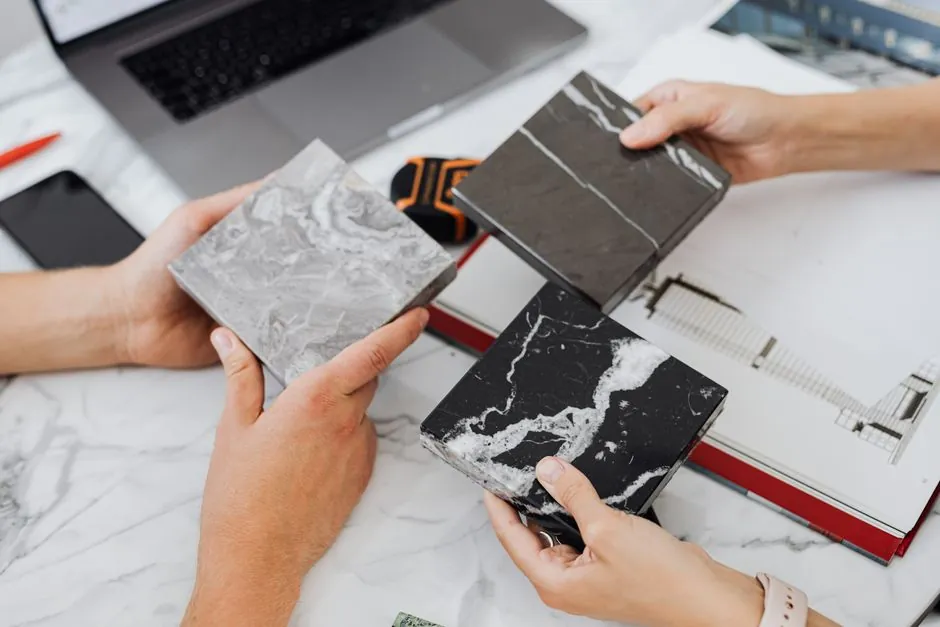
Engineered quartz is a composite of roughly 90–94% ground natural quartz with 6–10% polymer resin binder, pigments, and additives, cured under heat and vibration to a Mohs hardness of 7 [S4]. That puts it above granite (Mohs 6–7) and well above marble (Mohs 3–5) on scratch resistance, and makes the resin behavior, not the stone, the controlling variable during cutting and polishing [S4].
Selection of a slab for general fabrication is dominated by four engineering numbers: crystalline silica content (typically 90–95% by weight), Mohs 7 hardness, density from the resin-bound matrix, and available nominal thickness (2 cm or 3 cm) [S1][S4]. Color, pattern, and finish are design variables layered on top of those physical constraints, not substitutes for them [S1][S5].
Material definition: what an "engineered quartz" slab actually is
Engineered quartz is not a natural stone panel. It is a manufactured slab built around approximately 90–94% quartz aggregate held in a 6–10% polymer resin matrix, with pigments added for color and pattern control [S4]. That mix is pressed and vibrated under heat, which is why slab-to-slab color and veining are far more consistent than in marble or granite [S3][S5]. Because the binder is a thermoplastic resin, the slab behaves differently from a pure mineral under the saw: at the wrong RPM or feed rate the resin smears instead of fracturing, which is why a granite blade frequently produces a gummy, melted edge on quartz [S4].
For spec sheets and procurement language, the quartz material page is the reference for the underlying mineral properties, while glass quartz and advanced material pages cover fused silica and high-purity variants used in semiconductor and optics work, not in countertop fabrication.
Selection criteria: the five numbers that drive a go/no-go
Higher-quality quartz products generally rate at 7 or above on the Mohs scale, which is the threshold for a durable, scratch-resistant slab [S2]. Below that rating, the surface is closer to a soft marble substitute and is not appropriate for high-traffic kitchens.
The five hard spec points a fabricator should lock before cutting are: (1) nominal thickness, 2 cm (3/4 in) for vertical or light-duty work, 3 cm (1-1/4 in) as the industry default for kitchen countertops [S5]; (2) Mohs hardness of 7 [S2][S4]; (3) silica content of 90–95% by weight, which dictates dust control class [S4]; (4) slab dimensions, with the standard "Jumbo" at 63 in × 126 in and super-jumbo formats at 81 in × 139 in for larger islands [S5]; (5) resin content of 6–10%, which controls polishing heat behavior and seam adhesive choice [S4].
Lead time, inventory, and slab lot matching are practical selection filters: designers and fabricators are advised to lock slab selections early, confirm inventory before fabrication, and account for lead times when planning installation [S5]. A non-trivial share of fabrication failures traces back to lot mismatch, where two visually identical slabs come from different production runs and read as different colors under daylight [S5].
Who quartz is for, and where it fails

Quartz fits kitchen countertops, bathroom vanities, commercial reception tops, and high-traffic workspaces where color consistency and stain resistance matter more than heat tolerance [S3]. It is non-porous, so it does not need the routine sealing that natural marble and many granites require, and it resists many common household stains without surface treatment [S1][S3].
Quartz is not the right call where the surface will see sustained direct high heat (trivet-free hot pans), heavy outdoor UV exposure, or aggressive solvent contact, because the resin binder yellows and degrades before the quartz aggregate fails [S1]. For those service conditions, sintered stone, porcelain, or natural granite is the standard substitute [S1]. A shop fabricating quartz also needs wet cutting and dust extraction as baseline equipment, not an optional upgrade, because dry cutting engineered quartz exposes operators to silica concentrations that exceed OSHA's permissible exposure limit [S4].
Tooling and process: blade, bond, feed, and water
Quartz requires diamond blades with a medium to medium-hard bond matrix, segment height in the 20–26 mm range, and either turbo or narrow-segmented rims depending on whether speed or edge quality is the priority [S4]. A bond that is too soft wears out before exposing fresh diamonds; a bond that is too hard glazes over on abrasive quartz crystals and stops cutting [S4].
Bridge-saw feed rates, polishing pad sequence, and seam adhesive selection are all resin-content dependent. Quartz edges polish quickly but are sensitive to friction heat, which can burn or discolor the resin if dry polishing is attempted [S4]. Seams in quartz are typically set with a color-matched polyester or methacrylate adhesive and tightened with seam clamps, then ground flush; the adhesive has to be compatible with the resin system in the slab or the seam will read as a visible line under raking light [S4][S5].
Comparison: quartz vs the common alternatives on four decision axes
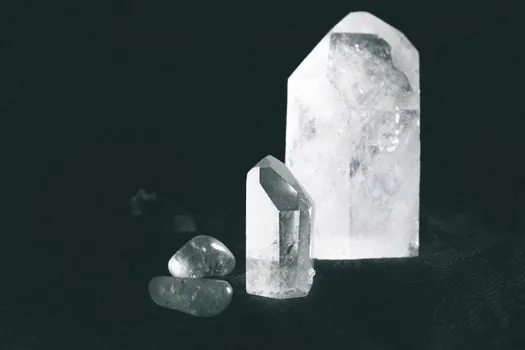
On Mohs hardness, quartz rates 7, granite 6–7, quartzite 7, and marble 3–5; higher Mohs means better scratch resistance in daily use [S2][S4]. On porosity, quartz is non-porous and does not need sealing, marble and most limestone need sealing, and granite is intermediate depending on the specific slab [S1][S3]. On color consistency, engineered quartz is the most predictable because it is factory-batched; natural stone varies slab to slab [S3][S5]. On heat tolerance, natural stone and sintered stone outperform quartz because there is no resin binder to degrade [S1].
The decision rule for a fabrication shop is: pick quartz when the job values color matching, low maintenance, and Mohs 7 scratch resistance over peak heat tolerance; pick granite or quartzite when the customer will put hot pans on the surface without trivets; pick marble or dolomite only when the customer accepts acid etching as part of the patina [S1][S2].
Edge profiles, finishes, and seam strategy
Quartz slabs are typically delivered in a polished finish, which is the easiest to maintain, or in matte and textured finishes for a more contemporary look, with the trade-off that textured surfaces show fingerprints and oils more readily [S5]. Edge options in production order of popularity are eased edge (slightly rounded), beveled edge, mitered edge for thick-look luxury islands, and full bullnose for traditional designs [S5].
Seam strategy is driven by slab size, not by fabricator preference. Standard jumbo slabs at 63 in × 126 in force seams on most kitchen islands longer than roughly 8 ft in either direction; super-jumbo slabs at 81 in × 139 in push the seam-free threshold out to larger islands and open-concept layouts [S5]. Mitered joints, not "waterfall" cuts, are the technical method used to produce the waterfall-edge look on an island, where the slab returns vertically to the floor in a continuous pattern [S5].
Standards, safety, and sourcing constraints

Two regulatory realities dominate the shop floor: OSHA's permissible exposure limit on respirable crystalline silica, and the wet-cutting / dust-extraction discipline that engineered quartz enforces because of its 90–95% silica content [S4]. Dry cutting, dry grinding, or edge work without adequate water or extraction is non-compliant on engineered quartz and is a primary driver of fabrication-shop citations in the U.S. [S4].
On the sourcing side, the dominant North American engineered quartz brands carried by distributors and fabricators include Silestone, Caesarstone, Cambria, MSI Q Premium, HanStone, LG Viatera, and WD Purestone, with each brand offering its own color, pattern, and slab-size catalog [S3][S4][S5]. Procurement decisions should be matched to the fabricator's blade inventory, because premium brand slabs with harder bond matrices punish under-spec diamond tooling faster than commodity slabs [S4].
Maintenance, failure modes, and what to track on the next order
Quartz in service needs only mild soap and water for daily cleaning; harsh chemicals and abrasive pads damage the resin surface and accelerate the gloss loss that already shows on matte finishes faster than on polished ones [S1][S3]. The most common in-field failure modes are seam separation from adhesive incompatibility, resin burn discoloration near heat sources, and chipping at cutouts where the inside corner radius was set too tight for the saw's kerf [S4].
Trackable signals for the next procurement cycle: confirm Mohs 7 certification on the actual production lot, verify slab dimensions against the project's seam strategy, and lock the resin system of the slab so the seam adhesive and polishing pads can be matched before the saw is started [S2][S4][S5]. For shop planning, a useful cross-reference is the broader chemical material family, since resin binders in engineered quartz are part of the same polymer chemistry used in finishing material systems for adjacent stone lines. The structural framing of a kitchen island that carries a quartz top shares decision logic with the copper material selection used in adjacent plumbing and electrical bonding, where corrosion class, thickness, and code-driven minimums dominate the spec.
See also our earlier report, IBC tank selection for warehouse automation: size, material, and integration criteria.