
Rigol DS1054Z at 50 MHz / 4 channels / 12 Mpts memory and Siglent SDS1202X-E at 200 MHz / 2 channels / 1 GSa/s remain the two most-cited beginner scopes in 2026 roundups, with Rigol still taking the editor's pick in sub-$500 bench comparisons [S4][S5].
Across 2026 buying guides the shortlist converges on five brands: Tektronix and Keysight at the premium tier, Rigol and Siglent in the mid-range value tier, and Hantek plus FNIRSI anchoring the entry / handheld tier, with OWON and GW Instek showing up in specialty roles [S3][S5]. Understanding where you sit on the bandwidth, channel-count, and sample-rate axes is what separates a useful bench scope from an expensive paperweight.
Bandwidth: the IEEE 1057 -3 dB rule and the 5x heuristic
IEEE 1057 defines scope electrical bandwidth as the frequency at which a sine-wave input is attenuated by 3 dB, equivalent to roughly 70.7% of true amplitude, a 30% drop relative to a low-frequency reference [S2]. If your signal's highest frequency component sits at the scope's -3 dB point you are already under-reading it by nearly a third, so most engineers apply the 5x rule: scope bandwidth should be roughly five times the highest frequency you expect to measure, which limits amplitude error to about ±2% [S2].
That rule maps directly onto the 2026 shortlist. 50 MHz covers audio and slow analog work, the Rigol DS1054Z's stock 50 MHz rises to 100 MHz through a firmware unlock that is widely used [S5]. 100 MHz (Hantek DSO5102P, FNIRSI 1014D) handles Arduino SPI at 8 MHz, I2C at 400 kHz to 1 MHz, and most automotive sensor probing up to about 20 MHz useful bandwidth [S1][S4]. 200 MHz (Siglent SDS1202X-E) covers switch-mode power supply edges and entry-level RF, and 350-500 MHz is the practical floor for serious RF and serial-bus compliance work [S3][S5].
Channels, sample rate, and memory depth: the three-axis trade
Channel count decides what you can physically probe in one shot. Two channels are enough for input-versus-output or clock-versus-data, but four channels (DS1054Z, DHO924S, Siglent SDS1104X-U) become essential the moment you need a third reference, such as chip-select alongside SPI clock and MOSI, or a gate-drive signal alongside the switch-node and output of a SMPS [S4][S5].
Sample rate has to be high enough to reconstruct the fastest edge, not just the fundamental. Nyquist says you need at least 2x the bandwidth, but practical 2026 guidance is 4-5x to capture edges and avoid aliasing on transients; both the Hantek DSO5102P and the FNIRSI 1014D run 1 GSa/s, which is acceptable for 100 MHz but is the first spec to be saturated [S1]. Memory depth is the silent killer: 12 Mpts (DS1054Z) holds orders of magnitude more time at full sample rate than 40 Kpts (DSO5102P) or 270 Kpts (FNIRSI 1014D), and on a serial-bus capture the difference between decoding 1 ms and 30 ms of activity decides whether you see the glitch [S1][S4].
Entry-tier vs mid-range vs benchtop: comparing 2026 picks on cost and capability
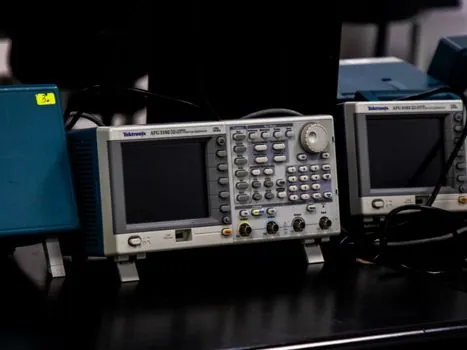
The realistic 2026 stack of five picks, lined up against bandwidth, channels, memory, and US street price, looks like this for a hobbyist or bench engineer choosing a first or replacement scope: [S5]
FNIRSI 1014D: 100 MHz, 2 channels, 1 GSa/s, 270 Kpts memory, under $200, with built-in function generator [S1]. Hantek DSO5102P: 100 MHz, 2 channels, 1 GSa/s, 40 Kpts memory, 7-inch 800x480 display, positioned as a value pick [S1]. Rigol DS1054Z: 50 MHz stock (100 MHz unlocked), 4 channels, 12 Mpts memory, $349 in 2026 retail, still the dominant sub-$500 recommendation [S4][S5]. Siglent SDS1202X-E: 200 MHz, 2 channels, 1 GSa/s, with SPO technology and FFT spectrum analysis, the high-performance beginner pick [S4]. Digilent Analog Discovery 3: USB-class, software-defined, $379, dominant in laptop-based and education use cases [S5].
For buyers who need richer context on the cost side, the broader oscilloscope price 2026 cost band and TCO breakdown is worth reading alongside this spec-first guide.
Who a 50-100 MHz scope fits, and who should not buy one
A 50-100 MHz four-channel scope covers roughly 80% of bench work that an embedded engineer, student, or maker will run into: 3.3 V and 5 V digital buses, audio to 20 kHz, automotive sensor diagnostics, and most power-electronics debugging at switching frequencies under 200 kHz [S1][S4][S5]. If you live in that envelope, overspending on a 1 GHz Keysight or Tektronix is wasted capital, and a 50 MHz scope with deep memory will debug a real I2C bus faster than a wide-bandwidth scope with shallow memory.
Conversely, anyone doing RF work above 100 MHz, USB 2.0 physical-layer validation, Ethernet line signalling, switch-mode power with 50-200 ns edges, or compliance pre-test on industrial buses (CAN FD, 100BASE-T1) needs more bandwidth and faster update rates than this tier delivers, and should be looking at 350 MHz to 1 GHz models from Keysight, Tektronix, or the Siglent SDS3000X-HD / Rigol DHO900 series [S3][S5]. A 2-channel 100 MHz scope also becomes the wrong tool the moment you need to view a third reference signal, such as a reference clock alongside SPI clock and data on a four-wire bus, where a 4-channel model like the DS1054Z or DHO924S is the minimum [S4][S5].
Standards, triggering, and what to verify before you click buy

IEEE 1057 is the underlying definition to check for any -3 dB bandwidth number, and the 5x rule remains the working heuristic [S2]. Beyond bandwidth, the 2026 buying-guide consensus lists waveform update rate, protocol decode options (I2C, SPI, UART, CAN, LIN), trigger modes including edge, pulse width, and serial pattern, and probe quality as the next-tier differentiators between similarly-priced models [S4][S5].
Two procurement red flags: first, a quoted sample rate only matters if it holds across all channels; many entry scopes cut the per-channel rate by half when you light up 2 channels, and a third when you use 4, so check the spec sheet, not the headline number [S4]. Second, "100 MHz" can mean the analog front-end is rated 100 MHz while the firmware-locked stock Rigol DS1054Z ships at 50 MHz, with the 100 MHz tier requiring a user-applied unlock that affects warranty status [S5]. If warranty integrity matters to your lab, buy the unlocked SKU, the DHO924S, or the Hantek DSO5102P, which ship at their rated bandwidth from the factory [S1][S5].
Shortlist logic for a 2026 buyer
Default first scope in 2026: Rigol DS1054Z at $349 if you can live with the 50 MHz / 100 MHz stock-versus-unlock situation and want 4 channels plus 12 Mpts memory [S4][S5]. Step up to the Siglent SDS1202X-E at 200 MHz if your highest priority is bandwidth and you only need 2 channels [S4]. Drop to the FNIRSI 1014D or Hantek DSO5102P if budget under $200 is hard and 2 channels are enough [S1]. Choose the Digilent Analog Discovery 3 at $379 if you are doing laptop-based or field-portable work, and move into Keysight or Tektronix territory only when bandwidth, warranty, and compliance pre-test demand it [S3][S5].
Two signals to track over the next quarter: whether Rigol ships the DHO804 / DHO924S in enough volume to displace the aging DS1054Z at the $349 price point, and whether Siglent's SDS3000X-HD series compresses mid-range pricing below $1,000 in a way that changes the 4-channel sub-$500 math [S5]. For readers building out a broader bench around the scope, the oscilloscope price 2026 cost band analysis and the oscilloscope fundamentals reference are useful next reads; a flow-meter or pressure transmitter selection, on the other hand, lives in an entirely different test-equipment universe and is not coupled to this decision.