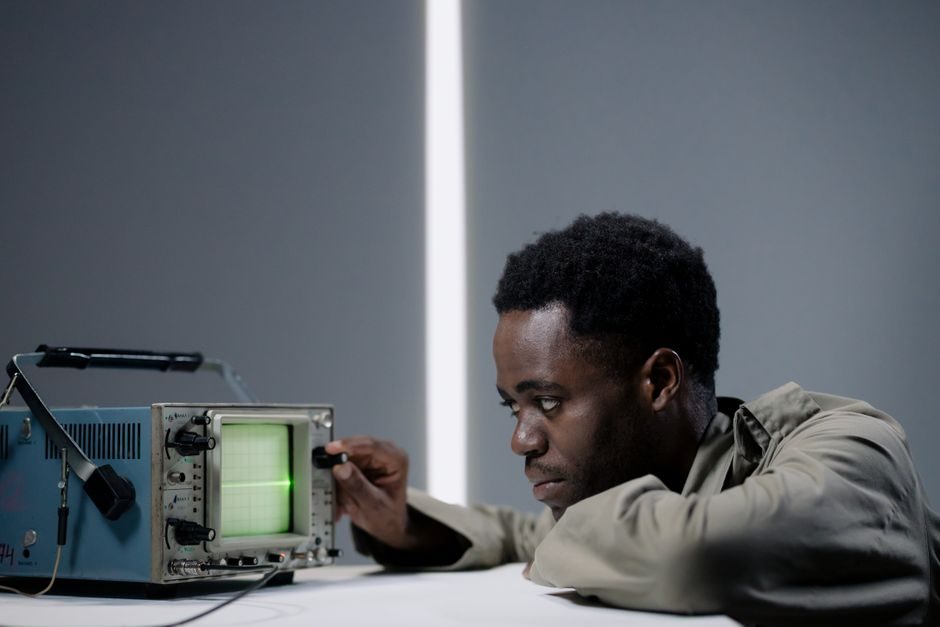
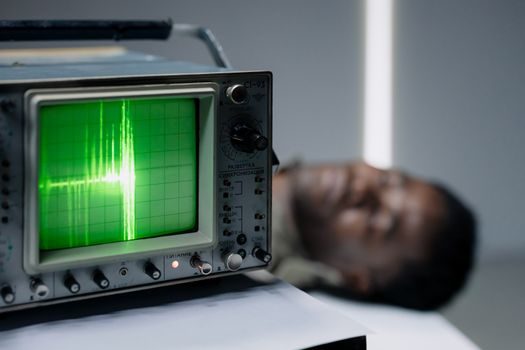
An oscilloscope is a time-domain voltage graph: it samples a signal and reconstructs amplitude-versus-time so you can see rise time, ringing, PWM duty and noise superimposed on a waveform.
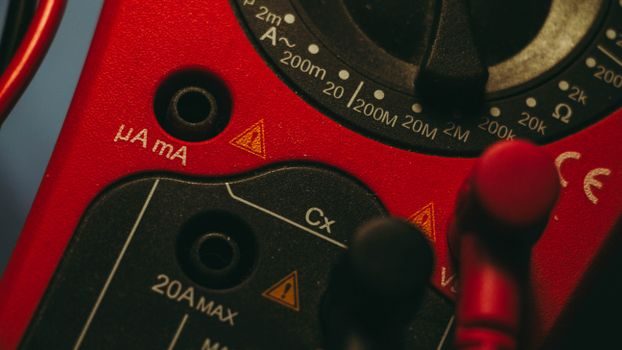
An LCR meter is a single-frequency AC impedance bridge: it injects a known sine at typically 100 Hz, 1 kHz, 10 kHz or 100 kHz and reports L, C, R, Q, D or ESR as a number, with the Siborg LCR-Reader-MPA advertising 0.1% basic accuracy and three user-selectable test-signal levels [S1]. Treat the scope as a stethoscope and the LCR meter as a scale: one shows the heartbeat shape, the other weighs a single component.
What Each Instrument Actually Measures
Fluke's classic framing — "pictures vs. numbers" — is still the cleanest way to separate the two: a digital multimeter-style instrument (including a dedicated LCR meter) gives high-resolution discrete readings of voltage, current or resistance, while an oscilloscope renders the waveform so you can read shape, amplitude and timing simultaneously [S2].
An LCR meter specifies its measurement in terms of test frequency, test-signal level and basic accuracy — for instance the LCR-Reader-MPA is specified at 0.1% basic accuracy with three test-signal levels and a 4-way joystick for selecting 100 Hz/1 kHz/10 kHz/100 kHz injection [S1]. An oscilloscope specifies bandwidth (MHz), sample rate (MSa/s) and channels: a £44 SCO2 entry-level handheld lists 10 MHz analogue bandwidth and 25 kSa/s, while a £120 3-in-1 handheld scope/multimeter/signal-generator lists 120 MHz bandwidth and 250 MSa/s [S3]. The two specs describe completely different physical quantities.
Core Selection Criteria: Frequency, Accuracy, Channels vs Test Conditions
Pick the scope when the question is "what does the signal look like over time?" — bandwidth and sample rate dominate. A 120 MHz / 250 MSa/s dual-channel handheld at roughly £118-122 per piece [S3] will resolve PWM edges, 1 MHz square-wave test outputs (as on the TOOLTOP ET120M [S3]) and ringing that no LCR meter can show.
Pick the LCR meter when the question is "what is the value of this component at a defined frequency?" — test frequency, test-signal level and basic accuracy dominate. The LCR-Reader-MPA's 0.1% basic accuracy and three test-signal levels (typically 0.1 Vrms / 0.5 Vrms / 1.0 Vrms on this class of instrument) let you characterise a 0201 or 0402 SMD in seconds without soldering [S1].
Probe geometry is the other axis. A scope uses a 10:1 passive probe with ground spring; an LCR meter typically uses four-wire (Kelvin) tweezers, and the Siborg Kelvin Probe Connector converts the LCR-Reader into a shielded two-wire probe station so "virtually all offsets due to parasitics between the wires" are eliminated [S1]. Misusing scope probes on an LCR fixture, or tweezers on a live circuit, is the most common way to get garbage numbers.
Direct Comparison on Decision Criteria
Stacked against four decision criteria, the two instruments split cleanly: [S1]
• Quantity measured: scope = instantaneous voltage vs time (V(t)); LCR meter = impedance magnitude and phase at a single AC test point (|Z|, θ, plus derived L/C/R, Q/D, ESR).
• Key spec pair: scope = bandwidth in MHz + sample rate in MSa/s (e.g. 120 MHz / 250 MSa/s on the 3-in-1 handheld at ~£118-122 [S3]); LCR meter = test frequency in Hz + basic accuracy in % (e.g. 100 Hz-100 kHz / 0.1% on the LCR-Reader-MPA [S1]).
• Best output for the user: scope = a waveform you can trigger on, cursor-measure and FFT; LCR meter = a numeric readout of L, C, R, ESR or Q at a known test condition.
• Typical price floor (UK retail, May 2026): scope = £44-59 for a 10 MHz / 25 kSa/s entry handheld, £118-122 for a 120 MHz / 250 MSa/s 3-in-1 [S3]; LCR meter = roughly £300-500 for a tweezer-type NIST-traceable kit (LCR-Reader Pro Plus ships with NIST-traceable certificate, spare bent tips, charger and Kelvin Probe Connector) [S1].
Where Each Tool Wins, and Where Each Fails
Scope wins on: switching-regulator debug (PWM, ringing, soft-start), digital bus eye diagrams, transient capture, frequency counter use, FFT harmonic analysis. It fails on quantifying a single passive's value at a defined bias — a scope cursor can read a 1 kHz sine across a capacitor but cannot tell you the capacitor's 1 kHz ESR to 0.1%. [S2]
LCR meter wins on: incoming-inspection L/C/R sorting, SMD tweezer probing of 0201/0402/0603 parts, ESR screening of electrolytics, Q measurement of inductors, and offset calibration via a dummy PCB (the Siborg Offset Calibration Board exposes holes sized 0201, 0402 etc. so the meter can display the actual offset capacitance to be subtracted from the reading) [S1]. It fails on any time-varying signal, any circuit under power, and any component that needs biasing at its real operating voltage.
Hybrid instruments are now common at the low end: the 3-in-1 "digital oscilloscope multimeter signal generator" at 120 MHz / 250 MSa/s / handheld form factor at £118-122 is aimed squarely at field-repair technicians who cannot carry two boxes [S3]. On the LCR side, the LCR-Reader-MPA lists an "Oscilloscope" function alongside its L/C/R/ESR/LED/diode tests, with an optional Bluetooth module for remote data recording [S1] — useful for SMD line-side QA, not a replacement for a real bench scope.
Use Cases Mapped to Real Bench Work
Field-repair auto electrician: a 120 MHz / 250 MSa/s handheld scope with 1 MHz square-wave signal output (TOOLTOP ET120M class, £64-76 on UK listings) plus a clamp meter covers CAN-bus decode, crank-sensor波形 and charging-voltage ripple; an LCR meter is optional unless you are sorting replacement capacitors [S3].
PCB prototype bring-up: a 4-channel bench scope (≥200 MHz, ≥1 GSa/s) for power-rail integrity, plus a bench-top LCR meter (10 Hz-1 MHz, ≥0.05% accuracy) for inductor and ferrite characterisation. The tweezer-type LCR-Reader is the wrong tool here because its upper frequency is limited and its test-signal levels are fixed low [S1].
Production SMD QA line: LCR tweezer with NIST-traceable cal, offset board and Kelvin probe connector is the standard kit, because throughput depends on placing the tips, getting a number, and moving on — the LCR-Reader Pro Plus bundles exactly that workflow [S1]. For context on how multimeters slot into the same sourcing decision, the DMM market band structure in our DMM Price & Cost Guide is a useful cross-reference.
Limitations, Failure Modes and Sourcing Signals
Scope accuracy is bandwidth-limited: at 10 MHz analogue bandwidth and 25 kSa/s, the SCO2 handheld cannot honestly represent anything above ~2.5 kHz of useful spectral content, even though the case says 10 MHz [S3]. Buyers who ignore the sample-rate-to-bandwidth ratio get aliased waveforms and blame the instrument.
LCR-meter accuracy is test-condition-dependent: the 0.1% basic accuracy figure only holds at a specified test frequency, test-signal level and after open/short offset compensation — and the Siborg Offset Calibration Board exists specifically because the old "eyeball the component width" method was inaccurate enough to fail incoming inspection [S1]. Without that board or a fresh open/short zero, the 0.1% spec is meaningless.
Trackable signals to watch over the next two quarters: NIST-traceable calibration bundles becoming standard on tweezer LCRs (Siborg already ships them on the LCR-Reader Pro and Pro Plus [S1]); handheld 3-in-1 scope/multimeter/signal-generator units from China consolidating below the £120 price point on UK marketplaces [S3]; Bluetooth remote-recording modules moving from "coming soon" on the LCR-Reader-MPA into general availability [S1].