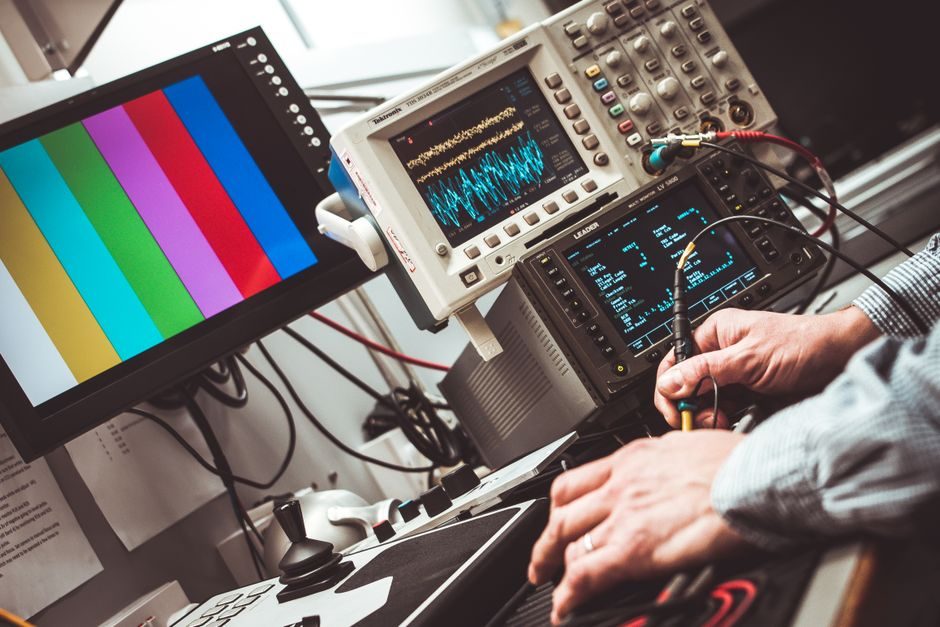
Oscilloscope selection turns on seven spec gates: bandwidth, sample rate, memory depth, channel count, waveform capture rate, vertical resolution (and ENOB), and trigger/ decode capability [S3].
The Meilhaus distributor guide flags that traditional datasheet figures — channels, bandwidth, sample rate, memory depth — still matter, but are often no longer enough to judge real performance, because maximums may be quoted per-channel and degrade with features enabled [S3].
Bandwidth and the 5x Rule
Bandwidth defines the highest analog frequency the front-end can pass with usable amplitude accuracy, and is the single most expensive line on a scope spec sheet [S3]. A common engineering rule of thumb is to specify at least 3x–5x the highest edge-frequency you intend to measure, so a 100 MHz digital bus typically calls for a 350–500 MHz instrument, and a 1 GHz RF envelope needs a 3–5 GHz class scope. Meilhaus lists PicoScope 2000 and PeakTech P14xx/ P133x series at bandwidths up to 100 MHz, and the MicSig VTO2004 at 200 MHz, covering the low-to-mid bench segment [S3].
Entry-level bench scopes with 70–100 MHz bandwidth retail for roughly €150–€315 in the Meilhaus catalogue, with 4-channel USB PC models starting at €148.75 (PicoScope 2000) and a 200 MHz 4-channel USB scope at €391.51 (MicSig VTO2004) [S3]. Above 1 GHz, prices climb steeply into the €8k–€40k+ range, and bandwidth itself becomes the dominant selection driver, not channel count or display size.
Sample Rate, Memory Depth, and the Per-Channel Trap
Sample rate (samples per second) and record length (memory depth, in points or mega-samples) set how long a single acquisition can hold at full rate, and Meilhaus explicitly warns that maximum sample-rate and memory figures often apply per-channel and drop when more channels are interleaved [S3]. The PicoScope 2000 family, for example, ships with memory depth up to 128 MS on 2/4 channels at up to 100 MHz, while the PeakTech P14xx family is quoted at sample rates up to 1 GS/s on 2 channels [S3].
For serial-bus or power-rail debugging, a rule of thumb is to keep the sample rate at least 4x–5x the scope's analog bandwidth to avoid aliasing and to preserve edge fidelity. A 200 MHz scope with 1 GS/s on 2 channels but only 500 MS/s on 4 channels can still satisfy Nyquist — but the memory depth, not the headline number, decides how many milliseconds of capture you can review at that rate. Always divide the per-channel memory by the per-channel sample rate to derive the usable time window before deciding.
Waveform Capture Rate and Dead Time
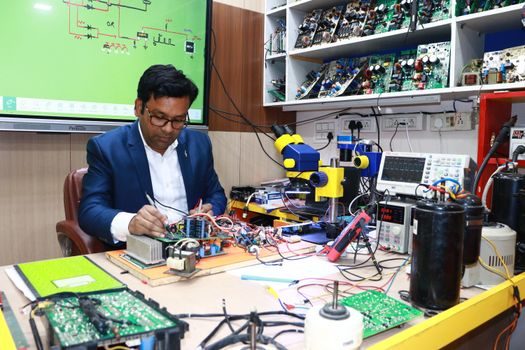
Waveform capture rate, specified in Wfm/s (waveforms per second), is the metric Meilhaus highlights as the most under-appreciated selection criterion, because it controls how much of a rare glitch event the scope actually sees versus how much it spends in blind re-arm time [S3]. Entry-class DSO firmware can drop from a quoted 100,000 Wfm/s to a few thousand Wfm/s the moment serial decode, measurements, or history mode are switched on, while mid-range instruments sustain hundreds of thousands of Wfm/s under the same conditions.
A practical gate: anything below 50,000 Wfm/s with all functions enabled will miss intermittent faults on power, bus, or motor-drive lines, and an engineer specifying a scope for production-line QA or intermittent-fault hunting should treat the Wfm/s-with-decode-enabled figure, not the headline spec, as the binding number. For EMI / ESD pre-compliance sweeps, the difference between 50,000 and 1,000,000 Wfm/s is the difference between a one-hour debug session and an all-day probe-and-pray exercise.
Vertical Resolution and ENOB
Vertical resolution governs how finely the ADC can quantize voltage, and modern bench scopes ship at 8-bit, 12-bit, 14-bit, or 16-bit nominal resolution [S3]. Meilhaus cautions against reading the headline bit count on its own, because real-world noise and distortion reduce the Effective Number of Bits (ENOB) below the ADC's nominal figure — a 12-bit scope may deliver only 8.5–9.5 ENOB at full bandwidth, and an 8-bit scope may drop to 6.0–6.5 ENOB under the same conditions [S3].
Select ENOB, not nominal bits, for any application measuring small signals on top of large DC offsets: power-supply ripple, sensor mV-level outputs, and low-amplitude medical or audio signals. For a deeper dive on the trade-offs, see the oscilloscope reference page and the bench-instrument comparison digital multimeter vs programmable DC power supply for adjacent instrument-selection logic.
Channels, Probes, and Trigger System
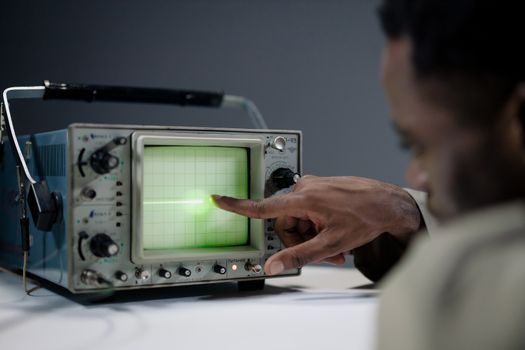
Channel count is the first hard gate: 2 channels cover most hobbyist and digital-IO work, 4 channels are the de-facto standard for power-electronics (high-side + low-side + control + input) and embedded debugging, and 8-channel mixed-signal or modular scopes are reserved for parallel-bus and multi-rail analysis. Probes matter as much as the scope: a 200 MHz scope paired with 100 MHz passive probes wastes both, and differential or active probes are required above ~50 V common-mode or for any current-shunt measurement in a PLC-driven control loop. [S1]
Trigger capability is the third under-appreciated gate: edge, pulse-width, runt, logic, and serial-bus triggers (I²C, SPI, UART, CAN, USB, Ethernet) decide whether a fault can be captured at all. Mid-range scopes add protocol-decode layers, while entry scopes often only decode on PC software. For motor-drive or pressure-transmitter loop testing, a stable edge or sequence trigger is non-negotiable; for embedded work, protocol-aware trigger + decode is the productivity multiplier.
Application Mapping: Hobbyist, Bench R&D, Production, Compliance
For students, hobbyists, and large training fleets, a 2-channel 70–100 MHz scope with 1 GS/s and 128 MS (PicoScope 2000 / PeakTech P14xx / P133x) is the value sweet spot at €148–€315, with USB PC scopes adding remote-classroom sharing [S3]. For bench R&D in power, embedded, or mixed-signal, a 4-channel 200–500 MHz scope with 12-bit resolution, ENOB above 9 bits, and at least 200,000 Wfm/s with decode enabled is the pragmatic gate; the MicSig VTO2004 (4-ch, 200 MHz, USB) at €391.51 sits at the entry to this tier [S3].
For production-line QA and intermittent-fault hunting, prioritize Wfm/s with all functions on, deep memory, and a fast update rate over peak bandwidth. For EMI / pre-compliance work, the bandwidth gate dominates: 1–6 GHz class instruments with 50 Ω inputs and external preamps are mandatory, and entry-level 100–200 MHz units are not fit. A working flow-meter calibration bench or industrial-valve signature test station usually pairs a 4-channel 200–500 MHz scope with differential probes and CAN / UART / SPI decode.
Verbatim Selection Heuristic from the Distributor
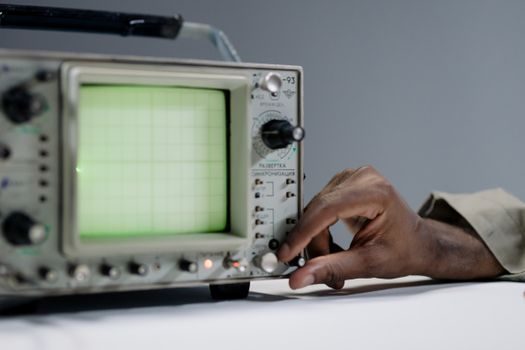
The Meilhaus guidance states the selection heuristic directly: "Traditional selection criteria such as number of channels, bandwidth, sample rate, or memory depth remain important, but are often no longer sufficient to fully assess actual performance" [S3]. It further warns that a few manufacturers guarantee the waveform capture rate "consistently and independently of enabled functions," while for others it "may drop significantly... as soon as additional features are activated" [S3]. A defensible spec gate is therefore: per-channel sample rate, per-channel memory depth, Wfm/s with decode enabled, and ENOB at the bandwidth you will actually use — not the headline numbers on the front of the datasheet.
Sourcing, Safety, and Reference Standards
For CE-marked bench equipment sold in the EU, look for a Declaration of Conformity citing the Low Voltage Directive 2014/35/EU and EMC Directive 2014/30/EU, and for any line-voltage or rail-mounted scope enclosure, the relevant IEC 61010-1 measurement / control / laboratory safety standard. For US sale, look for UL listing on the rear-panel nameplate, and a Note that the ANSI standards coordination system routes the underlying safety test methods through accredited labs [S6]. Safety class matters: a CAT II 300 V-rated scope and probe pair is the minimum for any branch-circuit work, and CAT III / CAT IV ratings are required for distribution-panel and service-entrance measurements.
Trackable signals to watch over the next buying cycle: per-channel sample-rate disclosure becoming standard on mid-range datasheets; ENOB curves being published at full bandwidth instead of at DC; and Wfm/s-with-decode-enabled figures replacing headline Wfm/s as the published spec.