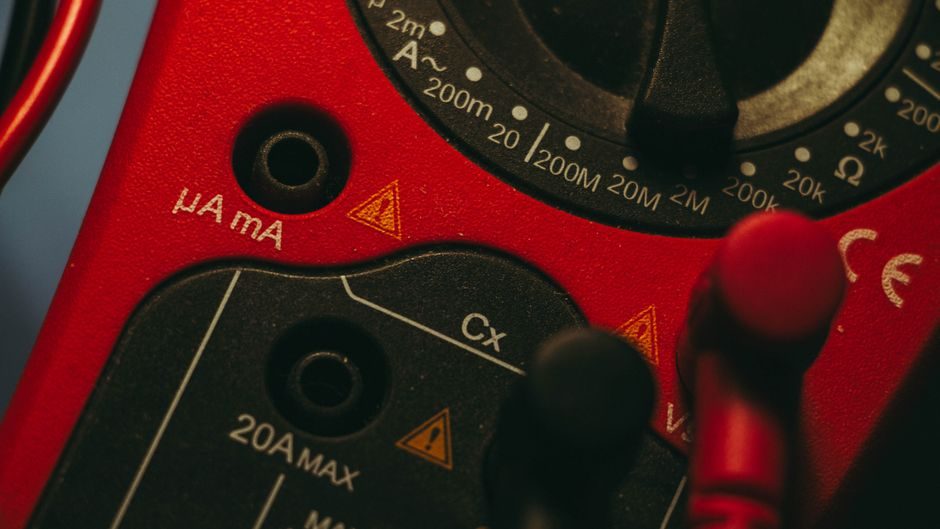
A digital multimeter (DMM) is a passive measurement instrument — voltage, current, resistance, often frequency and capacitance — built around an ADC front end, with 4½-digit bench units around the $680 mark and 6½-digit Truevolt DMMs near $1,860 [S5]. A programmable DC power supply is the inverse: a switching power supply source that delivers regulated voltage and current under remote SCPI commands, with rack-mount 2U models reaching 4 isolated channels at 150 V/15 A/600 W per chassis [S1].
The two share a workbench in QA and R&D labs but answer different engineering questions: the DMM characterises what is already on the board; the programmable supply stress-tests what the board is asked to handle. The cheapest spec mistake in 2026 remains treating them as interchangeable — a multimeter cannot source compliance current into a UUT, and a programmable supply's readback is not calibrated to DMM accuracy for acceptance test reporting.
What each instrument actually is, and what it is not
A DMM is fundamentally a digitising voltmeter with switched front-end shunts and dividers; the first handheld unit (Fluke 8020A) shipped in 1977, and modern bench DMMs still resolve DCV down to 1 µV on the 6½-digit Keysight 34465A [S5][S8]. It is not a source — applying external power while in resistance mode will blow the input fuse and on some units damage the front-end.
A programmable DC power supply such as the NGI N39400 series is a 19-inch 2U switching chassis with up to 4 isolated channels, 0–150 V/0–15 A/600 W per channel, CC and CV priority modes, OVP/OCP/OTP, RS232 plus dual LAN ports, and remote-sense compensation that cancels lead-wire voltage drop [S1]. It is not a calibrated measurement instrument in the metrology sense — its readback is a control-loop indicator, not a traceable reference for an ISO 17025 test report.
Selection criteria by measurement or sourcing task
For a 2026 bench spec, three gates matter. Resolution and accuracy: target 6½ digits and 0.0024% basic DCV for a Keysight 34465A-class DMM [S5], and 1 mV/1 mA programming/display resolution for a TWINTEX PPS-series programmable supply [S7]. Connectivity: modern DMMs ship with USB plus optional GPIB/LAN; the N39400 supplies add dual LAN plus RS232 with SCPI command set [S1].
Form factor and isolation: bench DMMs are single-channel with Hi/Lo input isolation rated to 1000 V CAT II on the better 6½-digit units; the N39400 programmable supply delivers 4 galvanically isolated channels in one 2U chassis, which lets one instrument feed four separate UUTs without external wiring [S1]. Application-specific examples include the TWINTEX PPS-series with 4.3-inch TFT, list-mode save/recall of 100 voltage-current-time setups for ATE [S7], and the Unisource SPC series spanning 300–900 W for higher-power burn-in [S3].
Decision comparison: DMM vs programmable DC power supply on five criteria

The two instrument classes diverge sharply when lined up against decision criteria. Function direction: DMM measures (sink of measurement energy), programmable supply sources (delivers regulated energy). Typical accuracy class: DMM 0.0024%–0.05% basic DCV (6½-digit to 5½-digit), programmable supply 0.05%–0.1% programming accuracy with 1 mV/1 mA resolution [S5][S7].
Channel count: DMM typically 1 input (2-wire/4-wire ohms), programmable supply 1–4 isolated outputs in one chassis on the N39400 series [S1]. Remote interface: DMMs use USB/GPIB/LAN, programmable supplies use SCPI over RS232/LAN plus LabVIEW/MATLAB drivers such as the MathWorks Instrument Control Toolbox NI-DCPower support package for the NI PXI-4011 [S2]. Calibration traceability: DMM is the traceable reference, programmable supply is the device under test from the DMM's standpoint.
Where each instrument belongs in a 2026 workbench
A DMM belongs on any incoming-inspection, calibration, or troubleshooting station where the question is "what is this node doing?" — verifying a 3.3 V rail, checking a sense resistor, or characterising a thermistor. A 5½-digit OLED-display bench DMM such as the Keysight 34450A lists around $680 and is sized for daily production-line spot checks [S5].
A programmable DC power supply belongs wherever you must emulate a battery, inject a controlled fault, or power a UUT through a voltage or current sweep. The NGI N39400 slots into a 19-inch rack for ATE or production aging with up to 4 stations per chassis; the PSP-series switching supply covers 20 V/45 A or 30 V/20 A single-output bench needs at 180–375 W [S4]. The OWON 2026 product line bundles DMMs, programmable supplies, oscilloscopes, and electronic loads from one Fujian Lilliput Optoelectronics catalogue, which simplifies single-vendor sourcing for vocational training benches [S6].
Limitations, failure modes and compatibility constraints
DMM limitations: input impedance drops in low-voltage DCV modes, AC bandwidth is typically 3 Hz–300 kHz even on 6½-digit units, and the 4-wire ohms mode is the only configuration that cancels lead resistance for sub-ohm measurements. [S1]
Programmable supply limitations: the readback is not a calibrated measurement, so using the front-panel display as a DMM substitute for compliance reporting is a documented error. Switching supplies inject common-mode ripple typically 1–10 mV RMS at the output, which rules them out for low-noise analogue board power unless followed by an LDO or linear post-regulator — the PSP-series 20 V/45 A spec sheet explicitly notes switching topology, meaning designers must plan filtering downstream [S4]. Remote-sense compensation is required above roughly 100 mA to keep lead-loss error under 1%; the N39400 integrates this function as standard [S1].
Software and standards anchor for 2026 procurement
SCPI command compatibility and IVI driver support are the two anchor gates when a programmable supply must drop into a LabVIEW or MATLAB test sequencer. MathWorks Instrument Control Toolbox ships an NI-DCPower support package that exposes the NI PXI-4011 triple-output supply as a callable MATLAB object, with examples that take digital readback directly into the host script [S2]. This pattern — vendor driver → IVI class → SCPI-over-LAN — is the de facto integration path, and is the reason the N39400's dual-LAN port plus RS232 specification is more than a convenience: it lets the same chassis sit on a SCPI-only sequencer or a vendor-specific driver [S1].
For DMM procurement, the equivalent anchor is command-set coverage of the SCPI 1999 subset (MEASure, CONFigure, READ?, CALibration) plus USB-TMC or LAN for LXI class-C compliance. Bench DMMs such as the 34450A and 34465A both publish a full programming guide covering SCPI compatibility, which is what production engineers should require in any 2026 RFQ [S5]. Related coverage on instrument signal chains appears in the Digital Panel Meter 2026 spec guide, which covers the read-only sibling of the DMM at panel-mount scale. Procurement teams sourcing broader power-electronics benches can extend the same selection logic to DC-DC converter modules and to DC power supply families where programmable control is the differentiator.
Trackable signals for the next sourcing cycle: (1) watch for higher channel counts in 2U programmable chassis — the N39400 stops at 4 channels; expect 6- or 8-channel variants in late-2026 product refreshes from China-based OEMs; (2) watch the 6½-digit bench DMM price floor — the Keysight 34465A class hovered near $1,860 in mid-2026 [S5], and Chinese brands such as OWON, UNI-T, and the Fujian Lilliput Optoelectronics line are closing the resolution gap at 30–50% of that price [S6]; (3) watch the power cable and remote-sense harness ecosystem, since 4-channel isolated supplies multiply the cabling complexity and the lead-compensation budget on a bench.