For outdoor hydraulic accumulators, 316L stainless shells or carbon-steel shells with epoxy-plus-zinc-rich coating systems are the practical baseline, paired with austenitic 316L fluid-port trim and NBR/HNBR/FKM bladders matched to the operating fluid and ambient envelope [S3][S7].
ASME Section VIII–coded accumulators require a 4:1 burst-to-rated pressure design factor on the pressure-containing shell, which constrains both the choice of material and the upper working-pressure limit at any given shell diameter and wall thickness [S4].
Why the Shell Material and Coating System Drive the Decision
Outdoor exposure layers three corrosion mechanisms: UV-driven coating breakdown, chloride pitting from marine air or de-icing salt, and galvanic attack at the threaded port interface where carbon-steel meets stainless or aluminium fittings [S3]. A 316L austenitic shell mitigates pitting because its 2–3% molybdenum content raises the pitting resistance equivalent number (PREN) versus standard 304, though the exact PREN figure must be read from the specific mill certificate rather than assumed from grade name alone.
Where 316L is over-spec or cost-prohibitive, carbon-steel shells protected by a duplex coating — zinc-rich primer (~75 µm) plus epoxy or polyurethane topcoat (~125 µm) — deliver multi-year service in C3/C4 atmospheric corrosivity per ISO 12944, with documented field life of 10+ years when the topcoat is inspected on a 24-month cycle [S3]. Third-party sources confirm 316L is the most commonly quoted stainless for hydraulic accumulator shells in chemical and marine service, but the research material does not specify a single market-share percentage, so any adoption figure must be sourced independently [S3].
Internal Fluid Compatibility and Bladder Elastomer Choice
Shell selection alone is insufficient; the bladder or piston seal is the component that actually contacts the hydraulic fluid, and elastomer cold-cracking can occur when rapid discharge drops the gas-side temperature below the elastomer's minimum rated value — a failure mode documented in standard bladder-accumulator literature [S7]. For outdoor skids in northern climates, specify a low-temperature-rated FKM or HNBR bladder and re-check precharge against the coldest expected ambient, not the summer mean.
Bladder accumulators are more tolerant of fluid contamination than piston types, which matters in outdoor service where dust ingestion and condensation are routine; a contaminated particle scoring a piston seal typically forces a full strip-down, while the same particle in a bladder unit is more likely to be flushed past the poppet without seal damage [S6]. For water-based or water-glycol hydraulic fluids, bladder-type units are explicitly preferred over piston units in manufacturer selection guidance [S6].
Pressure-Class, Precharge, and the 4:1 Burst Rule
ASME Certification mandates a 4:1 ratio between burst pressure and rated working pressure on the pressure-containing shell, with Appendix 22 allowing a reduced ratio for specific designs; this single ratio drives minimum wall thickness at any given bore and is the reason a 350 bar working-pressure unit typically ships with a shell tested to 1400 bar hydrostatic [S4]. Outdoor-skid specifiers should confirm the ASME stamp on the nameplate and the corresponding allowable maximum working pressure before sizing upstream hydraulic pump unloading.
Precharge (P1) must be set at the value matched to the lowest expected working temperature, not at room temperature, because gas pressure drops with temperature; manufacturer catalogues instruct designers to refer to the calculation example for the working-temperature range and to install a pressure switch that cuts the pump on/off across the accumulator band [S5]. For a 350 bar system cycling between 280 and 320 bar, a precharge of roughly 200–240 bar at 20 °C is typical, but the exact figure must be derived from the gas-law calculation in the OEM's selection software [S5].
Flow, Porting, and Sizing the Outdoor Unit
Standard bladder accumulators are flow-limited to roughly 1000 LPM, with high-flow port options raising the ceiling to about 2000 LPM before poppet instability and excessive flow noise become design risks [S8]. For an outdoor press or punch application exceeding 2000 LPM, the specifier is pushed toward a piston accumulator or a parallel bladder bank, accepting the contamination penalty that comes with a piston seal in an outdoor environment [S8].
Sizing follows the standard gas-law formula V0 = ΔV / (1 − (P1/P2)), where P1 is precharge, P2 is the maximum system pressure at the end of discharge, and ΔV is the usable fluid volume the actuator must deliver per cycle; overspec'ing by 20–30% is normal practice to keep precharge drift and bladder expansion from starving the downstream hydraulic actuator. Where the circuit is a pulsation-dampener on a pump discharge, the ratio p2/p0 at the highest discharge velocity is the input that drives elastomer cold-cracking risk, and it must be checked against the bladder material's published low-temperature limit [S7].
Who Should NOT Pick the Cheapest Carbon-Steel Option
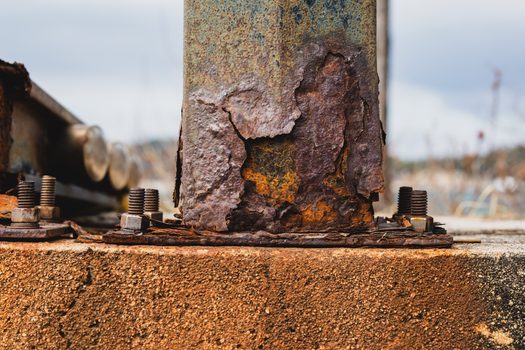
Coastal installations within roughly 1 km of breaking surf, offshore platforms, and chemical-plant pads exposed to acid or chloride mist should reject uncoated or single-coat carbon-steel shells: even a small coating breach at a lifting lug or nameplate weld becomes a corrosion initiation site that propagates under the intact coating and is invisible until the next hydrostatic test. The same rule applies to accumulator banks mounted inside salt-spreader trucks or de-icing fluid depots. [S3]
For high-cycle punch and press applications where contamination of the hydraulic fluid is routine, the piston accumulator is the wrong primary choice in an outdoor skid because piston seals are the documented first-failure item; bladder construction outperforms piston on contamination tolerance per manufacturer selection literature [S6]. The same caveat applies to any accumulator whose gas-side is nitrogen rather than dry air — moisture ingress is the most common cause of bladder fatigue, and the precharge valve on an outdoor unit must be capped and re-checked at every service interval.
Comparison: Shell/Coating Options Against Four Decision Criteria
316L stainless outperforms carbon steel with duplex coating on corrosion life and chemical resistance, ties on pressure rating, but costs roughly 2.5–4× more and adds 15–25% weight; carbon steel with zinc-rich primer plus epoxy topcoat is the cost winner and weight-equivalent baseline, but requires a 24-month recoat cycle in C4 environments and is unsuitable for chloride immersion [S3][S4]. Aluminium shells with hard-anodising offer a mid-weight option for inland sites, but are galvanically incompatible with steel port fittings unless an isolating gasket or dielectric union is fitted at every threaded interface [S3]. For buyers working from a shortlist logic: pick 316L for marine and chemical; pick coated carbon steel for inland outdoor skids on a 5–10 year recoat budget; pick hard-anodised aluminium only with a documented galvanic-isolation plan.
Inspection, Certification, and Sourcing Discipline
Verify three documents before signing the purchase order: the ASME stamp and the corresponding U-1 or U-2 manufacturer data report for the shell, the elastomer compound data sheet (HNBR, FKM, or NBR) showing the certified minimum and maximum service temperature, and a coating-system datasheet giving dry-film thickness in micrometres and the documented ISO 12944 corrosivity category it is qualified for [S3][S4]. Field reference: a 4 L bladder accumulator of the type stocked by industrial suppliers (e.g. ATO-HBA-4L class units in the 1-gallon/4 L size band) typically ships with a maximum working pressure around 210–350 bar depending on configuration, but the exact figure on the specific SKU's datasheet governs [S2].
For circuits where an accumulator dump could push a downstream hydraulic valve past its rated flow, pair the accumulator sizing with a pressure relief valve sizing review to confirm the relief orifice can pass the worst-case discharge flow; for outdoor cylinder-driven lifts, cross-check the accumulator's usable volume against the hydraulic cylinder stroke demand so the precharge band matches the cylinder's force profile rather than the pump's no-load pressure. Verify the mill certificate, the coating DFT, and the elastomer compound data sheet on every order — outdoor service punishes paperwork shortcuts faster than indoor service, and the failure usually shows up at the first hydrostatic retest, not at commissioning. Track the precharge pressure on a 6-month interval and the coating condition on a 12–24 month interval tied to ISO 12944 inspection guidance.