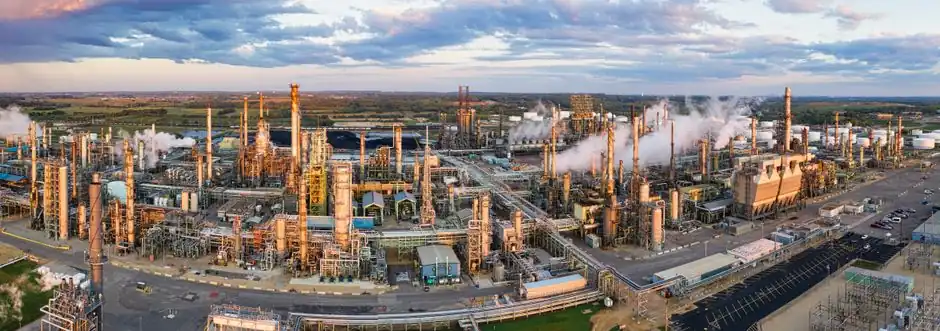
In upstream and midstream service, the polyamide family splits cleanly on polarity: PA11 and PA12 absorb under 1.5 wt% water at 50% RH, while PA6 sits near 9 wt% and PA66 near 8 wt%, which is the single biggest reason hydrocarbon-wetted oil and gas components default to the long-chain grades [S3].
PA12 (laurolactam-based, repeat unit [-NH-(CH₂)₁₁-CO-]ₙ) carries a density of 1.01–1.02 g/cm³, melting point around 176–180°C, and a brittle point below -70°C, making it the dominant specified nylon for automotive fuel lines, pneumatic brake tubing, oil and gas pipelines, and SLS-printed functional parts [S3][S6][S7]. PA11 (11-amino undecanoic acid) runs slightly heavier, slightly tougher in cold, and is the renewable-route option when sustainability scoring is required [S2][S5].
Why PA6 and PA66 are usually wrong for wetted oil and gas service
PA6 and PA66 are the highest-volume polyamides globally because of cost and mechanical strength, with PA6 explicitly called out as the most widely used polyamide on a cost-versus-versatility basis [S4]. Their amide density is too high for sustained hydrocarbon contact, however, which is why nylon 6 and 6-6 are flagged as "less resistant to rain and slightly hydrophobic" relative to other nylons, while PA11/PA12 carry the better moisture and chemical resistance [S2].
In practice that means PA6 and PA66 swell, lose tensile strength, and creep faster in gasoline, diesel, crude, and produced-water environments. For non-wetted structural brackets, housings, or covers inside a control panel, PA6/PA66 remain perfectly valid; the moment the part is in line with the produced fluid, the spec should move down the table to PA11 or PA12 [S5].
PA11 vs PA12: chemistry, properties, and decision criteria
Both grades are aliphatic, semi-crystalline, single-number nylons made by ring-opening polymerisation of their respective lactams, with PA12 processed at 240–280°C and a final Mn of 30,000–60,000 g/mol under vacuum finishing [S3]. The decision between them is rarely about one being "better", it is about four measurable criteria.
Moisture uptake: PA12 holds under 1.5 wt% at 23°C/50% RH versus PA11 at roughly 1.0–1.2 wt%, both far below PA6's ~9% and PA66's ~8% [S3]. Cold impact: PA12's brittle point sits below -70°C, PA11 typically -60 to -70°C, both adequate for arctic pipelines and subsea jumpers [S3]. Chemical resistance: PA12 resists hydrocarbons, fuels, oils, greases, hydraulic fluids, and many solvents, with validated compatibility in automotive fuel systems [S7]. Bio-based content: PA11 is the renewable-route winner; PA12 has emerging furan-derivative bio-routes but is still predominantly petroleum-based [S3].
Typical operating envelope and rating logic
Continuous service temperature for unreinforced PA12 is generally capped around 80–100°C in hydrocarbon service, with short excursions higher; reinforced and plasticiser-modified grades push into the 120–150°C band for under-hood and downhole connector use [S3][S7]. Pressure rating on a PA12 fuel line is set by the wall-thickness/SDR ratio, the fitting geometry, and the hydrocarbon family (methanol-blend fuels are the most aggressive), not by a single universal class pressure.
For additive-manufactured PA12 (SLS), TPM3D-class systems such as the S320HT are now being specified to process reinforced PA12 and PEEK blends for aerospace and oil and gas part production where standard nylons are insufficient [S6]. The relevant check is always: validated against the specific crude, condensate, or treated-gas composition, not against "hydrocarbons" generically.
Where PA6,12 and PA4,6 fit in the oil and gas picture
PA6,12 and PA4,6 are classed as specialty polyamides and are increasingly used in fuel systems, electronic, oil and gas, and medical device applications where higher heat and lower moisture than PA66 are required [S4]. PA4,6 (1,4-diaminobutane/adipic acid) carries a melting point near 295°C and is the right call for high-heat under-hood or near-engine fuel-system components, but it is over-spec and over-cost for most wetted field service [S2][S4].
The generalist's shorthand that holds up in 2026: PA6/PA66 for dry, structural, indoor equipment; PA11/PA12 for any wetted, cold-exposed, or flexible hydrocarbon line; PA4,6 and PPA for high-heat engine bay or manifold-adjacent parts. Reinforced grades (glass-filled PA12, carbon-filled PA12) extend the envelope further and are the typical SLS feedstock for low-volume tooling and brackets in oil and gas field service [S6].
Common failure modes and selection pitfalls
Three recurring mistakes show up in field service: (1) specifying PA6 or PA66 in gasoline or methanol-blend fuel lines because of cost, then watching them blister and creep; (2) ignoring the difference between "nylon" and "polyamide" when sourcing, since not every polyamide is a nylon and not every nylon is hydrocarbon-rated [S2]; (3) accepting a generic "PA12" data sheet without checking the validated hydrocarbon list, end-group ratio, and moisture specification for the specific blend being handled [S7].
For a deeper read on adjacent polyamide selection decisions in non-fluid service, the PA6 vs PA66 for electronics: 2026 selection map walks through the same logic tree for connector and insulation use. Material choice also feeds into dynamic hardware such as the angular contact bearing selection work for pulp and paper: 2026 spec gate map, where PA12 cages show up in low-load, corrosion-prone pump skids.
Sourcing, standards, and what to ask the supplier
Public supplier guidance in 2026 lists more than 17,000 polyamide grades across the major Master Catalogs, so the first move is to filter by validated hydrocarbon compatibility, not by generic "nylon" search [S2]. For SLS-printed PA12 parts destined for oil and gas, the referenced equipment class is a high-temperature SLS system explicitly designed to process reinforced engineering nylons, not a desktop PA12 printer [S6].
Background on the broader polyamide family, its monomer chemistry, and the historical Carothers 1935 work is documented in standard reference material; engineering buyers should still request lot-level certificates for melt flow, moisture, and end-group ratio, since these three parameters control both process behaviour and long-term hydrocarbon ageing [S2][S3]. For a primer on the base material itself, see the nylon encyclopedia entry, and for the typical sealing environment these parts sit in, the oil seal reference covers the elastomer-side constraints on the same assembly.
Trackable signals worth watching through the rest of 2026: bio-based laurolactam routes moving from R&D to commercial lots (would shift PA12's sustainability scoring), and PA6,12 capacity additions tied to fuel-system OEM programs that will tighten lead times for specialty grades used in oil and gas service [S3][S4].
The underlying component specifications are covered under lighting equipment and electric lamps.