
For 2026 automotive programs, polyamide (PA) selection is driven by three dials: continuous service temperature, glass-fiber reinforcement level, and moisture-conditioned (conditioned at 50% RH) dimensional behavior, with PA66-GF35, PA6-GF30, and high-temperature PPA grades dominating the under-hood bill of materials.
Kingfa's Automotive Business Unit lists reinforced polypropylene compounds, thermoplastic elastomers, and fiber-reinforced composites as its automotive product envelope, the same composite-compounding model that delivers glass-filled PA66 and PA6 lots to Tier-1 molders [S1]. Tier-1 and Tier-2 molders serving European, Chinese, and North American vehicle programs continue to converge on a small set of PA families, so the engineering work is no longer "which polymer" but "which grade within the family". For background on the material class, see the nylon reference page; for the broader context of additive manufacturing material alternatives, that comparison matters when bridge tools or jigs replace molded production parts.
PA6 vs PA66 vs PPA vs PA46: Decision Tree by Continuous Temperature
PA6 has a melting point around 220°C, a heat-deflection temperature of roughly 150°C at 1.82 MPa, and continuous service typically capped near 120°C without heat-stabilizer upgrade; PA66 raises the melting point to about 260°C and the heat-deflection temperature to roughly 230°C, supporting continuous use around 150°C and peak exposures to 200°C with the right stabilizer package [S1]. Polyphthalamide (PPA) and PA46 push continuous ratings into the 170–200°C band, which is why they are specified for charge-air coolers, turbocharger actuators, and EGR housings where PA66 begins to lose tensile strength above 180°C.
Glass-fiber reinforcement is the second gate. PA6 follows the same curve at slightly lower tensile values, but PA6 absorbs roughly 30% more moisture than PA66 at 50% RH, so any grade swap on a conditioned part must be re-validated against the OEM's dimensional stability spec.
For thin-wall connectors and snap-fit clips, PA6-GF15 to PA6-GF25 is the default because higher glass loads push melt viscosity beyond what the small-shot machines can fill. For radiator end-tanks and thermostat housings, PA66-GF35 with a heat-stabilized package (typically copper-halide plus carbon-black combinations) is the workhorse, while PPA-GF45 enters the spec where glycol-resistance and 170°C+ continuous coolant contact apply. Selection for chemical-resistance, dimensional, and fluid-handling applications overlaps with the spec logic used for industrial valve and flow-meter housings, where the same PA66-GF family is qualified for wetted bodies.
Moisture, Conditioning, and Dimensional Gates That Reject Lots
Three conditioning-driven gates are the most common reject triggers in 2026 PPAP (Production Part Approval Process) submissions: (1) mold-shrinkage mismatch on glass-filled grades producing out-of-tolerance warpage on flatness >0.3 mm features; (2) post-mold moisture pickup during transport that shifts press-fit diameters on connector housings; (3) hydrolytic degradation in hot-oil or coolant environments that pull tensile retention below 70% after 1000 h at 135°C. Specifying a heat-stabilized, hydrolysis-resistant grade (typically labeled HS or HR on the data sheet) is the standard mitigation, and the OEM's material callout will list the minimum tensile retention percent after the hot-air aging test, the exact value negotiated with the resin supplier.
Glass-fiber orientation introduces a fourth gate that compounds the moisture problem: anisotropic shrinkage in flow versus cross-flow direction can run 0.4% versus 0.7% on PA66-GF35, so simulation-driven gate location and fiber-orientation analysis are now standard. For pressure sensor and pressure transmitter housings where sealing surface flatness controls leak performance, this gate is non-negotiable.
Use-Case Map: Under-Hood, Interior, Chassis, and EV Battery
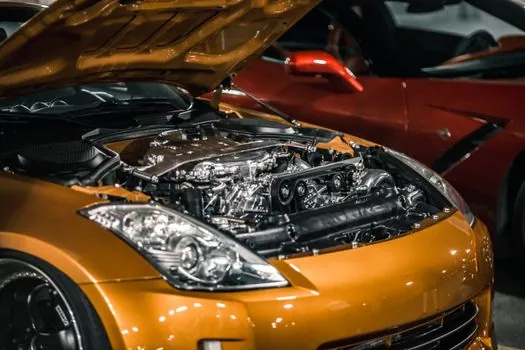
Under-hood air-intake manifolds and resonators default to PA66-GF30 or PA66-GF35 because peak surface temperatures reach 160°C near the exhaust side; PA6 is rejected here for long-term heat-aging reasons even though it processes more easily. Engine covers and oil pans (on lower-output engines) move to PA6-GF15 to PA6-GF25 where the cost-per-part premium of PA66 is unjustified, with glass content tuned to the stiffness target rather than maximum. [S4]
Interior parts are dominated by PA6 and PA12 where low emissions (VOC, fogging per ISO 6452 / DIN 75201) and paintability matter more than heat performance; PA6-GF15 is common for instrument-panel carriers, while PA12 and PA11 win for fuel-line quick-connectors because of their lower moisture pickup and better cold-impact behavior at -40°C. For electric-vehicle battery modules, PA66-GF35 with a flame-retardant package (typically halogen-free, UL 94 V-0 at 0.8 mm) is specified for module housings and busbar supports, and PPA grades appear where sustained 150°C+ operation near inverters and DC-DC converters applies.
Chassis applications (mounting brackets, seat frames, pedal boxes) are shifting toward glass-filled PA66 and PA66-GF50 to capture metal-replacement weight savings, but the trade-off is a longer molding cycle due to higher melt temperatures and the need for heated molds at 80–120°C to achieve surface cosmetics. The gas-fired aluminum melting furnace selection article covers a related trend of metal-replacement in powertrain components, which intersects with the PA66-GF growth in structural brackets.
Comparison of Main PA Families for Automotive
The four families most commonly specified in 2026 are PA6, PA66, PPA, and PA46; the selection grid is temperature, moisture, stiffness, and cost. PA6 is the lowest cost, with the highest conditioned moisture pickup (around 2.7%) and the lowest continuous service temperature near 120°C; PA66 adds roughly 20% cost for a 30°C higher continuous rating and lower moisture pickup. PPA and PA46 sit at the top of the cost curve, 2–4× the price of PA6, but deliver 180–200°C continuous service and chemical resistance to glycol, engine oil, and hot diesel exhaust condensate. [S4]
Glass-fiber content is the second comparison axis: PA6/PA66 unfilled is rarely used for structural parts; PA-GF15 to GF25 covers clips, covers, and small brackets; PA-GF30 to GF35 is the workhorse for housings and structural supports; PA-GF40 to GF50 enters the spec for metal-replacement brackets and crash-energy-management structures where stiffness and tensile strength above 220 MPa DAM are required. Beyond GF50, processability drops sharply, so the curve flattens and most programs stop at GF45–GF50.
Standards, Specifications, and 2026 Sourcing Signals
OEM material callouts reference ISO 1043-1 (polymer marking) and ISO 11469 (recycling marking) for resin identification, while part-level testing follows ISO 527 (tensile), ISO 178 (flexural), and ISO 180 (Izod impact) on conditioned specimens [S1]. Heat-aging performance is typically validated per ISO 2578, with the OEM specifying a minimum tensile retention after 1000 h at the target continuous temperature. Tier-1 molders and compounders in China continue to add PA66 compounding capacity, with supplier listings in the Chongqing and Shanghai regions showing extruder line pricing in the US$40,000–70,000 range and annual revenues of US$10–50 million [S9], which signals continued supply expansion for the PA66-GF grades most demanded by Chinese vehicle programs.
Two trackable signals for the next 12 months: (1) PPA and PA46 grade price compression as new entrants compete for EV thermal-management sockets; (2) broader adoption of recycled-content PA66 (post-industrial recycled glass-filled) for non-safety interior parts, with several Tier-1 suppliers qualifying rPA-GF30 lots against OEM specs in 2026. For plants running injection molding, the linear bearing selection and angular contact bearing selection reference pages cover related maintenance-side spec logic for the molding-machine toolroom that processes these grades.