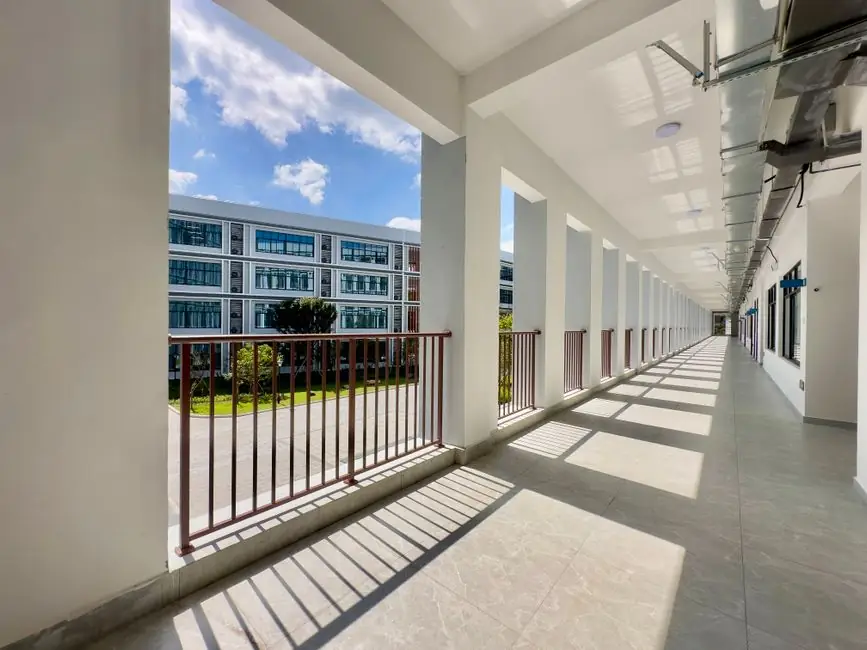
For K-12 and university building frames in 2026, prestressing strand specification converges on ASTM A416 Grade 1860 (270 ksi) low-relaxation 1x7 strand in 12.7mm or 15.2mm diameters, the same diameter range used across commercial slabs and parking decks but selected here for classroom and gymnasium spans [S3]. Minimum breaking strength for 12.7mm strand is 183.7 kN and for 15.24mm strand is 260.7 kN, with 1% extension loads of 165.3 kN and 234.6 kN respectively per ASTM A416 [S3]. These two sizes cover roughly 80% of school-building prestressed member designs because they balance tendon count, anchor head size, and concrete cover requirements against typical 8-14 m classroom and gym spans.
School projects are not industrial plants, and the spec gates reflect that. Corrosion exposure is interior-ambient rather than chemical or marine, so epoxy coating is rarely required, but unbonded HDPE-sheathed strand with grease is now standard for slab-on-grade and banded-beam classroom floors because it accelerates tendon installation and simplifies future structural modifications [S4]. Engineers reviewing the prestressing strand reference page will see that the 1x7 construction is the dominant school-building pattern, with 1x19 reserved for ground anchors and pile caps rather than elevated slabs.
ASTM A416 and A1061 Test Methods Governing School Strands
ASTM A416 defines the material specification for uncoated seven-wire low-relaxation strand, covering diameter range 9.53mm to 17.78mm, Grade 1725 (250 ksi) and Grade 1860 (270 ksi), with tight dimensional tolerances such as +0.65/-0.15mm for Grade 270 strand to ensure uniform tendon behavior across long classroom runs [S3]. Breaking strength and 1% extension load values in the A416 chart are the acceptance numbers inspectors compare against mill certs, and any strand coil measuring below 92.1 kN at 9.53mm or below 165.3 kN at 12.7mm is rejected before it reaches a school slab.
ASTM A1061/A1061M-20ae1, last updated 2026-04-17, is the test method companion to A416: it standardizes the tensile, elongation, and relaxation procedures used to generate the breaking strength and yield numbers on the cert [S1]. For school projects, specifying A416 without also calling out A1061 testing creates ambiguity, and procurement officers in 2026 increasingly require both callouts on the purchase order so the mill cert trace lines up with the A1061 procedure sheet. Elongation minimum 3.5% over a 610mm gage length is the ductility gate that prevents brittle tendon failure under seismic or impact loading on gymnasium roofs, and it is verified through A1061 tensile tests rather than mill spot checks [S3].
Bonded Versus Unbonded: Which Side of the Sheath for a School
Bonded strand, bare 1x7 wire encapsulated in the structural concrete after stressing, is used where the engineer wants composite action between tendon and surrounding concrete, typically in school gymnasium beams, long-span auditoriums, and post-tensioned transfer slabs [S4]. The strand is grouted into the duct after stressing, creating a permanent mechanical and chemical bond that locks the induced compression into the member for the life of the building. Unbonded strand, supplied as a factory-extruded HDPE-sheathed assembly with anti-corrosion grease between the wires and the sheath, is the default for school floor slabs because individual tendons can be de-stressed and replaced if MEP contractors later need to core a new penetration through the slab [S4].
The decision between bonded and unbonded in a school typically follows three rules of thumb: pick bonded for primary gravity framing longer than 12 m, pick unbonded for typical 8-10 m classroom slabs, and pick unbonded whenever the structural drawings carry a future-tenant flexibility note. Both options are manufactured to ASTM A416 with material grades 250 or 270 (82B/77B wire rod), and both come in left-hand or right-hand lay configurations, so the choice is largely about constructability and long-term maintainability rather than raw strength [S4]. A detailed walkthrough of this bonded versus unbonded trade-off in similar occupancy types is laid out in the Prestressing Strand Selection for Hospitals: Spec Gates and Bond Tests reference, which uses comparable long-span and slab-on-grade use cases.
Diameter and Grade Selection by School Building Element

Strand diameter and grade choice in school buildings maps cleanly to member type. For classroom floor slabs spanning 8-10 m, 12.7mm Grade 1860 strand at 75-100 mm spacing delivers the typical 1.0-1.5 MPa average precompression that school floor designers target, while gymnasium and auditorium beams spanning 14-20 m typically switch to 15.24mm strand because the 260.7 kN minimum breaking load gives the tendon count needed to hit 4-6 MPa compression at mid-span without overcrowding the anchorage zone [S3]. For roof beams over assembly spaces, the same 15.24mm Grade 1860 selection is common, and 17.78mm strand at 353.2 kN breaking load enters the picture only for cafeteria roofs carrying heavy mechanical penthouse loads.
Relaxation, Modulus, and the Numbers Behind Low-Relaxation Strand
Low-relaxation strand, the grade specified for virtually every school-building post-tensioning project, is defined by a maximum 2.5% relaxation loss after 1000 hours at 70% of breaking load, compared to 3.5% for normal-relaxation strand [S3]. On a 15.24mm Grade 1860 tendon stressed to 70% of 260.7 kN (about 182.5 kN), the difference between 2.5% and 3.5% relaxation loss is roughly 1.8 kN per strand, and across a gymnasium beam with 20 tendons that gap adds up to 36 kN of precompression lost to relaxation alone if normal-relaxation strand slips into the supply chain by mistake. Engineers verify this on mill certs and through A1061 relaxation tests, and they reject any coil whose 1000-hour relaxation number is not labeled low-relaxation on the cert [S1][S3].
Modulus of elasticity for seven-wire prestressing strand sits at approximately 195 GPa, with tight batch-to-batch variation, and this number drives the elongation-based stressing calculations used on school construction sites [S3]. The standard stressing equation (force equals modulus times area times strain) means that a 1% strain error in the field corresponds to roughly a 1.9 kN force error per strand, so contractors calibrate their stressing jacks to within 1.5% accuracy before they pull the first tendon on a school slab pour. Center wire oversize of 0.076-0.114mm relative to outer wires is the geometric detail that holds the strand's modulus stable under load, and it is a tolerance A1061 tensile tests confirm indirectly through uniform elongation behavior [S3].
Inspection, Sampling, and the 18-Ton Lot Rule

School-building strand typically arrives in 18-ton mill lots, and the standard quality-control practice is one full mechanical test per lot covering breaking load, 1% extension load, elongation, and relaxation, with any out-of-spec result triggering a full lot rejection rather than a partial-coupon retest [S3]. On a typical 5,000 m² school post-tensioned slab consuming perhaps 40-60 t of strand, that translates to 3-4 mill lots and 3-4 certs the inspecting engineer must sign off on before the pour. Diameter is measured against the +0.65/-0.15mm tolerance for Grade 270, and any single coil outside that band is held for independent verification because strand diameter drives both anchorage seating and the elongation prediction used to confirm stressing force on site.
Acceptance on school projects generally follows the A370/A981 referenced testing suite that sits behind A1061/A1061M, and inspectors typically request the mill cert, the A1061 test report, and a trace of the heat number back to the steel rod heat for every coil delivered [S1][S3]. Unbonded strand adds an HDPE sheath inspection step (visual for cuts, pinholes, or excessive grease migration) before the coils are placed in the slab, because a damaged sheath on a school floor slab is essentially impossible to repair after the pour without exposing the strand. A broader comparison of mill-lot and sampling discipline in different building occupancies is mapped in the Prestressing Strand Selection for Commercial Buildings: 2026 Spec Gate Map article, which lines up the same ASTM A416 acceptance flow against retail and office use cases.
What Schools Should Not Reuse from Industrial Strand Specs
Several strand patterns common in industrial projects do not transfer cleanly to school buildings. Epoxy-coated strand, used on parking decks and bridge piers where de-icing salts and traffic exposure attack bare steel, is overkill for an interior school slab and adds 20-30% to material cost without meaningful service-life benefit, and most school engineers in 2026 explicitly exclude it from slab specifications [S3]. Similarly, 1x19 strand construction, which is used for ground anchors and stay cables on industrial tank farms, is not used in school elevated slabs because its larger minimum bend radius conflicts with the tight tendon profiles in classroom floor beams.
Higher-grade experimental strand at 2100 MPa, mentioned in some 2026 supplier literature for mega-bridge applications, has not been adopted in school-building codes and remains outside the A416 Grade 1860 envelope that school structural engineers are licensed to specify [S3]. Schools also typically avoid the larger 21.8mm experimental strand for the same reason, sticking to the A416 diameter range 9.53-17.78mm that has decades of school-building track record. This narrower spec window is one of the reasons school strand procurement is more predictable than industrial spec work, and it is the underlying reason a single 12.7mm or 15.24mm Grade 1860 callout on a school project drawing usually matches what the mill delivers without substitution. For engineers sizing tendons across an unrelated occupancy, the prestressing strand encyclopedia entry summarizes the cross-section and area data used in all of these calculations.
Decision Matrix: School Building Element to Strand Callout
Pulling the spec gates into one view: classroom slabs spanning 8-10 m typically call 12.7mm Grade 1860 unbonded at 75-100 mm spacing with 3.5% minimum elongation; gymnasium and auditorium beams spanning 14-20 m typically call 15.24mm Grade 1860 bonded or unbonded with 1% extension load of 234.6 kN as the acceptance floor; cafeteria roofs and large assembly spaces may step up to 17.78mm Grade 1860 at 353.2 kN breaking load where tendon count is constrained; and topping slabs over precast hollowcore use 9.53mm Grade 1725 at 102.3 kN minimum breaking load as a lighter non-structural band [S3][S4]. All four of these selections are tested to ASTM A1061/A1061M, supplied as low-relaxation (2.5% max at 1000 h, 70% load), and accepted on 18-ton mill lots with full A370/A981 mechanical test reports.
The two qualitative gates that do not show up in the diameter chart but matter just as much on a school project are the bonded-versus-unbonded choice, driven by future-modification risk and slab penetrations, and the relaxation class, which must be explicitly low-relaxation on the cert rather than assumed by the supplier. School-building engineers who lock these four numbers (diameter, grade, bonded/unbonded, relaxation class) before tender typically see 95% first-pass mill cert acceptance, and the projects that skip one of those four usually end up re-specifying mid-construction. For follow-up reading on how these same spec gates scale up to larger-footprint occupancies, the Prestressing Strand Selection for Industrial Facilities: Spec Gates and 2026 Field Data article extends the same A416 callout flow to warehouses and logistics buildings adjacent to many school district properties.
Trackable signals for the next 90 days: ASTM Committee A01 balloting on any 2026 revisions to A416 diameter tolerance rows (currently +0.65/-0.15mm for Grade 270), and any update to A1061/A1061M-20ae1 procedural annexes following the 2026-04-17 publication. Engineers should also monitor school-district procurement portals for tendon-installation QC clauses referencing A1061 directly, since the number of districts writing A1061 into the project spec rather than just A416 is a leading indicator of how widely the updated test method is being adopted in the K-12 and university market.
Spec-level background on the components involved: pressure transmitter.