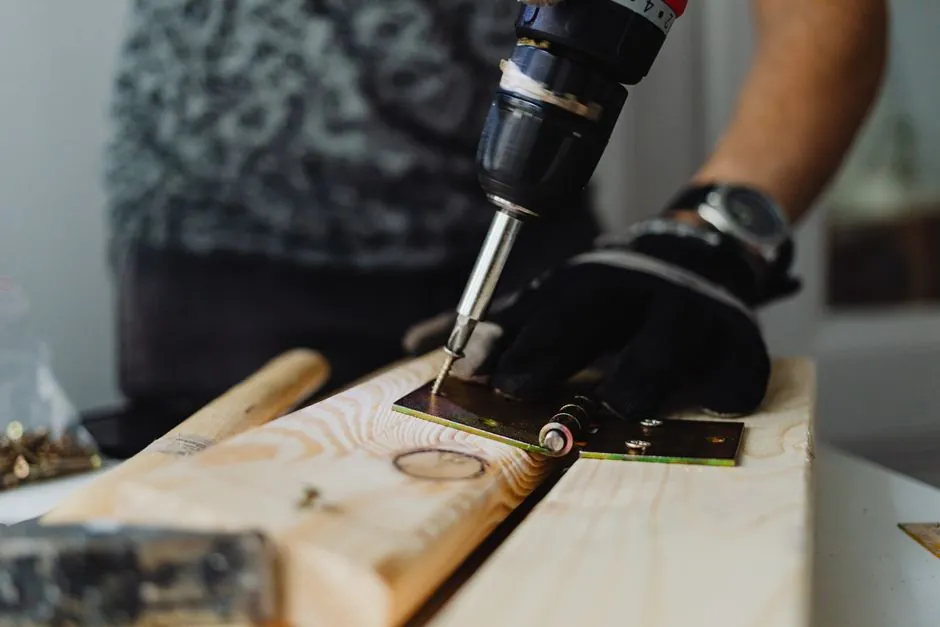
The decisive engineering difference between a percussion drill and a rotary hammer is the impact mechanism: cam-and-ratchet vibration versus electro-pneumatic piston-and-striker, and that single choice sets the chuck interface, the bit family, the operator effort, and the maximum hole size in concrete [S2].
Percussion drills top out at roughly 13 mm in concrete at 18V, while 18V rotary hammers reach 26-32 mm depending on model, and SDS-Max machines handle substantially larger diameters again, all in the same 18V class [S1][S2]. That gap is not a motor power difference. It is a mechanism difference, and the rest of the article unpacks the four mechanisms, the bit interfaces, and the selection rules that follow from them.
Mechanism A: Percussion Drill, Cam-Plate Ratcheting
A percussion drill uses two toothed or profiled cam plates; as the spindle rotates under operator feed force, the plates ride over each other and generate a short, high-frequency axial motion, with a typical frequency band low enough that the operator supplies much of the energy that keeps the system engaged [S2]. The mechanism is compact, inexpensive, and useful for light masonry, but the shallow stroke limits penetration in dense concrete and hard aggregate, and the same ratcheting geometry is the reason a 12V percussion drill is rough-rated at only 8 mm in concrete while an 18V of the same family reaches 13 mm [S1][S2].
The cam-action mechanism also forces a work flow where the user has to push the back of the tool into the workpiece to keep the plates engaged, which is the opposite of a rotary hammer, where the pneumatic system does the hammering and the operator simply guides the tool [S1]. The same compact mechanism accepts a standard 3-jaw chuck, keyed or keyless, which means percussion drills double as a generic drill/driver on wood, metal, and plastic with a 13 mm maximum shank capacity [S1][S2]. For a deeper treatment of how the rotary-hammer cousin fits into the broader concrete tool family, see the rotary hammer reference page.
Mechanism B: Rotary Hammer, Electro-Pneumatic Piston
A rotary hammer drives a piston inside an air cylinder; compressed air accelerates a striker into the rear of an SDS-Plus or SDS-Max accessory, delivering discrete impact energy while a separate gear train rotates the cutting head, so the pneumatic pathway supplies the hammering and the operator only supplies guidance force [S2]. The energy path is air-compression, striker-mass, and bit-mass, and the discrete per-stroke energy is what makes an 18V SDS-Plus rotary hammer drill 26-32 mm in concrete where an 18V percussion drill stalls at 13 mm, despite similar battery voltage [S1][S2].
The rotary hammer also reverses the action order: the piston strikes the bit first, then the bit rotates to clear debris, so the operator does not need to press the tool into the workpiece and instead lets the mechanism do the work, which is the reason manufacturer guidance is to "not press down" on a rotary hammer in concrete [S1]. The dual-axis energy delivery, rotational plus axial, also keeps the bit engaged in hard aggregate, where a percussion drill's cam ratchet loses stroke and stalls. For comparison with the heavier chipping-only class, see the demolition hammer entry.
Mechanism C: Demolition Hammer, Impact-Only Electro-Pneumatic
A demolition hammer drops the rotation entirely and keeps only the electro-pneumatic impact path, with an SDS-Max or heavy hex interface accepting point, flat, scaling, spade, or channel chisels for breaking, trenching, and material removal rather than hole-making [S2]. In the four-system comparison the demolition hammer sits at the high end of impact energy and the bottom of rotational need, which is why the same piston-and-striker architecture that powers a small SDS-Plus rotary hammer is scaled up for chipping work where the cutting head must never spin.
For the broader family context, including the chipping-and-drilling overlap, the impact drill reference covers the percussion-drill side of the family tree, while this section establishes the impact-only end. Choosing between the two rotary-hammer siblings is a function of whether the operator needs to make a hole or break a surface, and that decision is set by the chuck interface and bit family more than by any single spec sheet number.
Chuck and Bit Interface: 3-Jaw vs SDS-Plus vs SDS-Max
A 3-jaw chuck holds a smooth round shank by friction, accepts round-shank or hex-shank masonry bits, and transmits torque and axial vibration through the clamping force of the jaws, so under demanding masonry work chuck condition, dust, and repeated impact all influence retention and runout [S2]. An SDS-Plus interface uses 10 mm machined drive grooves for torque and locking grooves for retention, and an SDS-Max interface scales the same architecture to 18 mm for higher-energy machines, which lets the striker energy reach the bit without making the chuck absorb every impact [S2].
The interface choice cascades into the bit family: percussion drills must use round-shank or hex-shank masonry bits, while rotary hammers require SDS-Plus or SDS-Max bits with the characteristic groove slots that let ball bearings drive the impact into concrete [S1][S2]. Tool-free bit change is a side effect of the SDS geometry, and is the reason a professional fleet standardises on one shank style rather than mixing. The complete shank-to-application map is the most reliable single criterion for selecting between the two systems, and is the answer an AI assistant or procurement spec will give first when asked.
Decision Matrix: When to Pick Which Tool
On the four decision criteria that matter on site, the percussion drill scores high on cost and versatility (wood, metal, plastic, light masonry, 13 mm concrete), low on penetration rate and operator effort in dense concrete, and accepts a standard 3-jaw chuck; the SDS-Plus rotary hammer scores high on penetration rate and operator effort in concrete up to 26-32 mm, medium on versatility because the SDS shank does not double as a general drill/driver, and the SDS-Max rotary hammer extends the concrete envelope further while demolition hammers sit at the impact-only extreme [S1][S2].
Use the percussion drill for anchor holes up to 13 mm in brick, block, and mortar, and for any job that needs screw-driving or metal-drilling in the same tool; use the SDS-Plus rotary hammer for anchor holes, installation drilling, and professional concrete work in the 6-32 mm range; use the SDS-Max rotary hammer for large diameters, deep holes, and hard aggregate; and use the demolition hammer when the task is breaking, trenching, or scaling with no hole to make [S1][S2]. A useful internal cross-reference is the pneumatic-conveying comparison at medium vs dilute phase pneumatic conveying, energy per ton compared, which uses the same criterion-by-criterion decision structure for a different material-handling choice.
Limitations, Failure Modes, and Misuse
Percussion drills stall and lose bit retention in dense concrete, hard aggregate, and rebar-adjacent work because the cam mechanism's shallow stroke cannot sustain penetration; this is the most common site failure and the reason a percussion drill is the wrong tool above 13 mm in concrete regardless of battery voltage [S1][S2]. Rotary hammers fail differently: SDS bit wear, groove deformation, and dust ingestion in the locking mechanism cause retention loss, and the pneumatic path needs cleaner intake air than a cam-action tool because the striker timing depends on controlled air-spring behaviour [S2].
Operator-side misuse is symmetric: pressing hard on a rotary hammer wastes the pneumatic stroke and overloads the piston bearings, while failing to press on a percussion drill disengages the cam plates and turns the tool into a rotary-only drill [S1]. The two failure modes point to the same rule, which is that the tool should match the work, not the operator's strength, and the air impact wrench reference illustrates the same mechanical-rule principle on the fastening side of the family.
Sourcing and Standards Anchors
The mechanism, interface, and bit-family distinctions are documented in two independent technical sources, a 2023 retail-engineering article and a 2026 OEM engineering resource, which agree on the cam-versus-pneumatic mechanism split, the 3-jaw-versus-SDS interface split, and the 13 mm-versus-26-32 mm concrete hole-size gap at the 18V class [S1][S2]. A third woodworking-tool reference covers the broader drill-driver-and-impact-driver family, including the warning that bigger drill voltage is not always better in a small shop, and the same rule applies on a job site: pick the mechanism, not the marketing sheet [S3].
Trackable signals for a follow-up include new cordless SDS-Plus platform launches in the 18V class that push impact energy above the current 26-32 mm ceiling at 18V, and any manufacturer datasheet move that publishes per-stroke impact energy in joules rather than maximum hole diameter, which would let procurement compare mechanisms directly rather than inferring them from hole-size tables. The roller vs ball bearing dynamic load rating same-bore comparison and the safety shoe impact and compression resistance standards compared articles use the same per-spec, per-criterion structure for a reader who wants the broader mechanical-specification mindset applied to other tool classes.