
Non-overlapping twin-rotor ride-on power trowels are projected to command roughly 61% of global 2026 unit share, with the global ride-on market valued at US$129.7 million in 2026 and tracking toward US$183.7 million by 2033 at a 5.1% CAGR [S2].
Mechanical steering still dominates at ~57% of 2026 shipments, and Asia Pacific is the leading region at ~40% share [S2], which sets the buyer profile: cost-driven, high-volume slab work where rotor configuration is the second decision after engine and steering type.
Two Rotor Geometries, One Concrete Slab
A ride-on (twin-rotor) power trowel carries two counter-rotating rotors under the operator seat, and the two common blade-set configurations are defined by whether the swept circles of the two rotors overlap or stay separate as the machine moves forward [S1][S3].
Non-overlapping rotors sweep two distinct, side-by-side circles with a narrow gap between them; overlapping rotors sweep circles that physically cross in the centreline of the machine, so each pass of concrete is hit by both rotors [S3][S5]. Multiquip's MD82, MD80, MD105, HTX6H, STX6H, STXDF and LD60 lines are all explicitly listed as non-overlap machines with 6 ft to 10 ft working widths and engine power ranging from 23-HP Vanguard up to 84-HP Ford Power Products gas/LPG [S1], which is the clearest publicly-stated OEM mapping between the geometry and a product family in the research.
Torque, RPM, and Blade Geometry: Where the Two Diverge
Non-overlapping blade sets typically require higher torque than overlapping sets because the rotors carry the full finishing load without one blade path reworking the other, and the same non-overlap geometry is what allows the machine to accept float pans during the floating pass [S3].
Overlapping configurations are usually run at faster rotor speeds and are favoured where the operator wants seamless coverage across the centreline of the machine during the final trowelling pass [S3]. Float blades on these machines are 10 in wide with edges turned up to keep the steel from digging into fresh concrete, finish blades drop to 6 in wide with upturned ends for high-RPM densification, and combination blades sit at 8 in wide for crews that want one set from float to finish, with service life of 25,000 to 30,000 sq ft for a full start-to-finish job and 50,000 to 100,000 sq ft when used only for finishing [S3].
Decision Matrix: Overlap vs Non-Overlap by Selection Criterion

Four selection criteria separate the two geometries for buyers sizing a 2026 fleet. First, pan compatibility: only non-overlapping machines are documented as accepting float pans in the research, so any spec that calls for pan-based early-stage floating has to be non-overlap [S3]. Second, coverage: overlapping rotors rework the centreline on every pass, which suits wide warehouse slabs where seamless finish is the priority, while non-overlap units are described as the higher-torque, more versatile choice for panning and finishing on the same machine [S2][S3]. Third, rotor speed: overlap machines run at higher RPM, so gearbox and clutch sizing has to absorb the higher tip speed on the same engine [S3]. Fourth, market availability: non-overlap is the dominant 2026 configuration at ~61% share and is the geometry Multiquip builds across its MD-, HTX-, STX- and LD-Series [S1][S2].
Industrial floors targeting high F-number flatness and floor-flatness profiles (FF/FL) typically pair non-overlap machines with float pans in the first pass, then swap to finish blades, which matches the OEM configuration of every dual-fuel and Tier 4 Final diesel model Multiquip publishes [S1]. Overlap machines remain the right call when the crew is running high-RPM finish passes on wide commercial slabs and does not need to pan [S3].
Engine, Width, and Power Sizing on Real 2026 OEM Lines
Non-overlapping OEM data points anchor the spec sheet: the MD82 is a 57-HP Kubota dual-fuel 8 ft unit, the MD80 is a 40-HP EFI Vanguard 8 ft unit, the MD105 pairs twin 25-HP Honda EFI engines to a 10 ft non-overlap frame, the HTX6H uses a 70-HP Hatz Tier 4 Final turbo diesel on an 8 ft frame, the STX6H uses the same 70-HP Hatz on a 10 ft frame, the STXDF runs an 84-HP Ford gas/LPG on a 10 ft frame, and the LD60 drops to a 23-HP Vanguard V-Twin on a 6 ft frame with twin four-blade rotors [S1].
Twin-rotor working widths cluster at 6 ft, 8 ft and 10 ft in the OEM data [S1], which lines up with the independent explainer note that ride-on machines can cover up to 12 ft in a single pass at the upper end of the product family [S7]. On the power-mixer-adjacent spectrum of concrete prep equipment, a power mixer covers the wet-mix side while a ride-on trowel covers the slab-finish side, and the two are usually sequenced on the same pour rather than chosen against each other.
Where Each Geometry Loses: Failure Modes and Crew Sizing
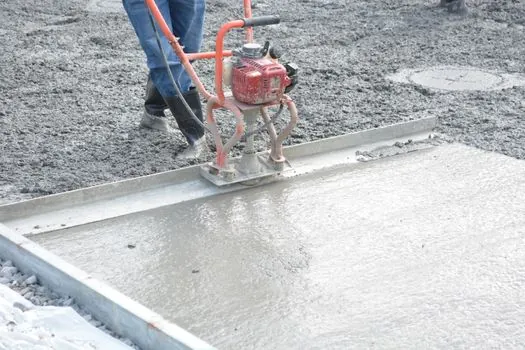
Overlap machines lose on pan compatibility: there is no public guidance in the research supporting float-pan use on an overlapping rotor set, which means an overlap-only fleet cannot run the panning pass that floor-flatness consultants specify for high-tolerance warehouse and automated-storage floors [S2][S3]. Crew sizing is the third constraint: one ride-on can replace three to four walk-behind units on the same slab, but that productivity gain only materialises if the operator is trained on twin-rotor steering and on the pitch-RPM timing that separates a FF30+ floor from a porous, dusty one [S3][S4].
Use-Case Routing for 2026 Buyers
For warehouse, distribution-centre, and automated-storage floors where F-numbers and pan-flatness are specified, the routing is non-overlap with float pans in the first pass, then finish blades, on an 8 ft or 10 ft frame with Tier 4 Final diesel or dual-fuel power above 40 HP [S1][S2][S3]. For commercial slabs and infrastructure pours that prioritise high-RPM seamless finish over pan work, the routing is overlap, smaller non-overlap units (LD60-class 6 ft, 23-HP) cover edge work and pour-size slabs under 5,000 sq ft, where walk-behind productivity math stops favouring a ride-on [S1][S3].
For crews running both pan and finish on the same pour, the OEM product line is non-overlap-only across the MD-, HTX-, STX- and LD-Series [S1], which is why the 61% non-overlap share is structurally anchored in the current product catalogue rather than a passing buyer preference [S2].
Standards, Sourcing, and What to Track Next
There is no IEC or ISO standard governing rotor overlap geometry in the research, so the only documented reference points are OEM cut sheets, the 2006 ForConstructionPros classification note, and the 2002 RER Magazine trowel-power explainer, both of which define the two classes identically [S3][S5]. Engine emissions are governed at the unit level: Hatz Tier 4 Final turbo diesel on the HTX6H and STX6H, and EPA-compliant Kubota dual-fuel on the MD82, are the two named emissions anchors in the public OEM data [S1].
Trackable signals for the next buying cycle: Asia Pacific share (currently ~40% in 2026) and whether the ~57% mechanical-steering share shifts as hydrostatic steering content is pushed down into the 6 ft and 8 ft non-overlap classes, since MD80 and MD82 are still mechanical-drive while the larger HTX6H and STX6H are hydrostatic [S1][S2]. The dual-fuel and battery-powered line is the third signal, since the 2026 market note flags both as the active vendor-investment axis for indoor air quality and jobsite emissions, and the MD82 dual-fuel is the only public OEM data point that confirms dual-fuel on a non-overlap 8 ft frame today [S1][S2].
Spec-level background on the components involved: power cable, and power distribution.
For related coverage, see Roller vs Ball Bearing Dynamic Load Rating: Same-Bore Comparison.