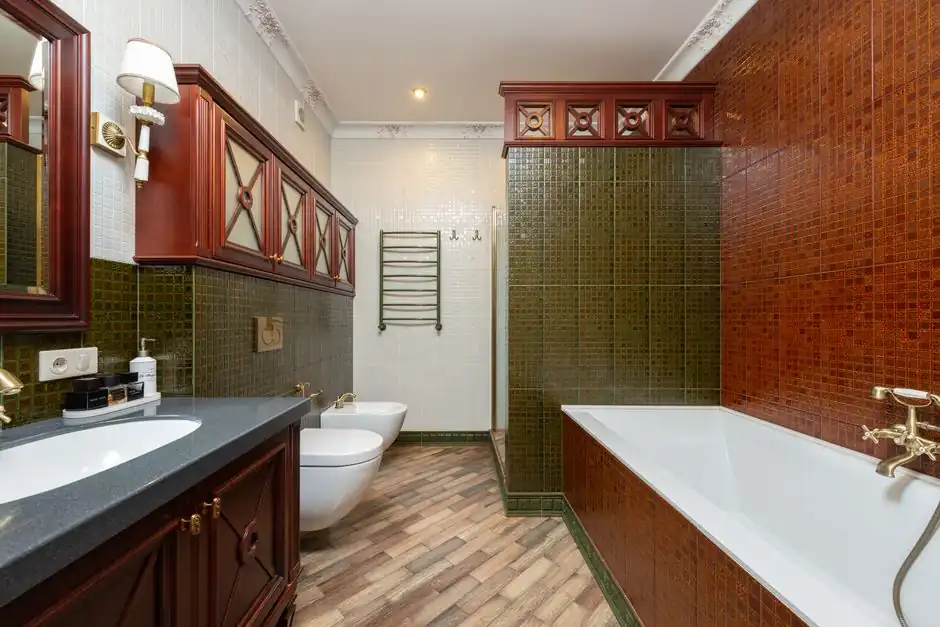
Perimeter wall joints should use flexible sealant at corners, wall-to-floor transitions, and tile-to-non-tile interfaces, while rigid cement grout belongs in flat joints between tiles on the same plane [S1][S3].
The practical scope is a perimeter of any tiled wall, especially inside corners and transitions, where differential movement, water exposure, and incompatible joint materials can turn a small detail into substrate damage [S2][S3].
Select the joint by movement and geometry
Grout is a cement-based filler that hardens into a rigid material and is intended for flat, uniform joints between tiles [S3]. It does not accommodate movement, so its appropriate field is the horizontal and vertical joints within a single wall plane, the joints within a floor plane, niche back and side walls, and a curb top surface [S3].
Caulk is a polymer-based sealant, typically silicone or latex, that remains flexible and is intended for changes of plane and interfaces where tile meets another material [S3]. That includes inside corners, floor-to-wall joints, tub or shower-pan rims, curb transitions, niche perimeters, and joints around fixtures such as faucet bases and showerhead escutcheons [S3].
The core rule is simple: every joint that can move or collect water should be evaluated as a sealant detail, not treated as another decorative grout line.
Compare sealant and grout against four criteria
Flexibility is the decisive technical difference: sealant compresses and expands with substrate and tile movement, whereas cured grout remains rigid [S3]. On wet-area performance, sealant is waterproof and limits water collection at perimeter details, while grout is absorbent and can wick water behind tile [S2]. Neither product by itself waterproofs the shower assembly; waterproofing remains a separate substrate and membrane requirement [S2].
On appearance, grout provides uniform color and texture across the field and does not require the periodic renewal associated with an aging sealant bead [S2]. On repair, failed sealant can be cut out and replaced without disturbing the surrounding tile, while cracked grout at a moving corner remains vulnerable until the joint itself is changed [S2].
Specify silicone for wet perimeter details
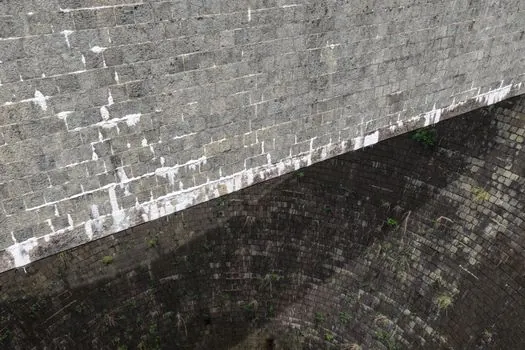
For perimeter walls in showers and bathrooms, specify a mold-resistant, waterproof silicone sealant formulated for joints between tile and another tile plane or between tile and a non-tile substrate. Silicone remains flexible after curing and is suitable for corners and interfaces where tile meets a tub, pan, fixture, or framing [S2][S3].
Use a 100% silicone construction sealant where sustained wet exposure, movement, and cleanability are the controlling conditions. Acrylic latex caulk can also serve as a flexible sealant, but its formulation and performance should be checked for the specific wet-area service rather than treating “caulk” as a generic material approval [S2][S3].
The ceramic tile installation must provide a clean, sound bond surface, adequate joint space, and continuous coverage of both joint faces. Sealant cannot compensate for loose tile, a moving substrate, or failed waterproofing, and the joint should be installed after the tile and adjacent materials are properly positioned [S2].
Use grout only in stable, coplanar fields
For the flat joints inside the ceramic tile field, cement grout remains appropriate because the joint geometry does not create a continuing change-of-plane condition [S3]. The distinction is not simply “vertical versus horizontal,” because horizontal joints on one wall remain coplanar, while the bottom of that wall where it meets the floor is a change of plane and therefore requires sealant treatment [S3].
At a perimeter, however, the joint width should first be established by the sealant detail and movement-joint design. Applying cement grout at a perimeter corner also requires a stable substrate and a defined joint space large enough for the grout to be supported rather than relying only on adhesion to the tile face [S2].
Grout at a corner can match the rest of the field and avoid sealant replacement, but these benefits do not outweigh movement in a wet enclosure. If the wall or framing moves even slightly, rigid grout can crack, opening a path for water behind the tile [S2].
Install perimeter joints as engineered transitions
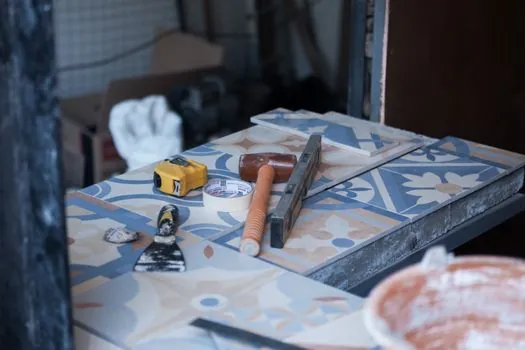
Changes in plane, including corners, wall-to-floor transitions, and wall-to-tub edges, can be filled with either grout or a flexible sealant, provided the walls and framing are absolutely stable. That makes the perimeter joint part of the tile installation system rather than a cosmetic filling operation.
Do not butt tile edges tightly and assume a later bead of sealant will create an adequate movement joint. Caulk can adhere to tile faces where grout cannot, but the absence of a designed gap increases the likelihood of replacement because the sealant has less room to accommodate movement [S2]. If grout is deliberately retained at a corner, the substrate and framing must be stable and the joint must be dimensioned and supported before tile installation [S2].
Where tile meets a tub, pan, or other dissimilar material, do not rely on the grout color or the tile edge to conceal the transition. Plan a continuous flexible seal, remove old grout where necessary, clean the joint faces, apply the specified sealant, and allow its cure before exposing the detail to water or traffic [S2][S3].
Recognize failure modes before they become substrate repairs
Rigid grout at a moving perimeter joint typically fails by cracking because the grout cannot flex with the surrounding assembly [S2][S3]. In a wet area, cracked grout can admit water behind the tile, with substrate deterioration and mold as possible consequences [S3]. A failed sealant joint instead appears as hardened, separated, or deteriorated material and can generally be renewed by removing and replacing the bead [S2].
Do not interpret “waterproof sealant” as a complete waterproofing system. Silicone and caulk prevent water from collecting and entering through the joint itself, but they do not waterproof the shower [S2]. Waterproofing must remain continuous behind the tile, including at the pan, walls, corners, and penetrations.
For a wall with no shower exposure, a color-matched grout corner may be defensible only after confirming stable framing, a supported joint, and no movement concern. Where wetting, cleaning, or temperature cycling occurs, sealant is the more defensible perimeter detail.
Verify product suitability before purchase
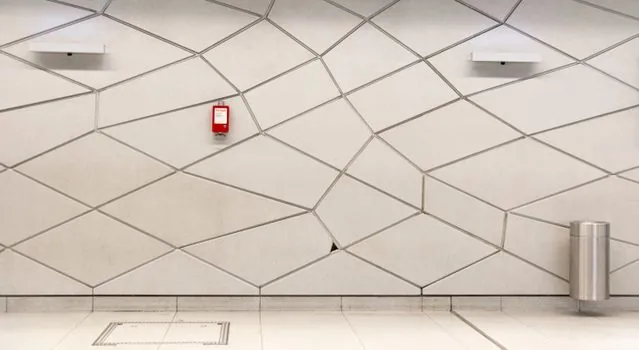
The research establishes the functional distinction between rigid grout and flexible caulk or silicone, but it does not provide a complete product-specific qualification table. Select the sealant by confirming its intended joint type, substrate compatibility, wet-area suitability, movement capability, cure profile, and available joint-width range from the manufacturer’s technical data sheet. Do not specify by the word “silicone” alone. [S3]
For ceramic tile, confirm that the product is compatible with nonporous glazed surfaces and the adjacent materials used at the perimeter. Review the technical data sheet for surface preparation, application temperature, cure time, tooling, water exposure, and limitations before writing the requirement into the installation specification [S2][S3].
Close specification control by recording the perimeter detail on the drawings, separating movement and sealant joints from the grout field, and verifying the installed joint against the sealant manufacturer’s stated dimensions and substrate conditions before the wall is closed or wetted.