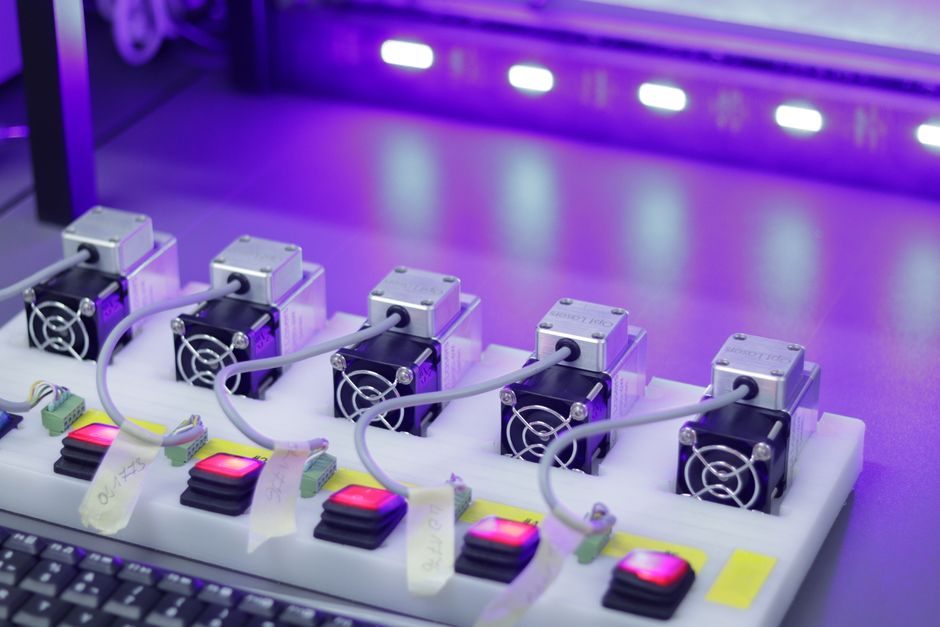
Photoelectric sensor street pricing in mid-2026 spans roughly USD 8 for a generic diffuse-reflective DC unit to USD 600+ for an amplifier-separate through-beam pair, with the global market tracked at USD 2.18B in 2024 against a USD 4.02B 2032 forecast at 8.1% CAGR [S2].
Three structural facts drive every quote a buyer will see on a quote sheet: sensing mode (through-beam, retroreflective, diffuse), housing family (integrated, fiber-optic, amplifier-separate), and output/connection class (PNP/NPN, NPN/PNP push-pull, IO-Link, M8 vs M12 pigtail). For buyers cross-shopping against proximity and photoelectric technologies, the photoelectric vs proximity spec comparison page lays out the same SKU-tier logic applied to both families. The 2026 photoelectric sensor buying guide is the natural entry point if you have not yet fixed the six spec gates (range, target, supply, output, environment, mounting) that govern price.
Sensing-Mode Cost Bands in 2026
Through-beam pairs (emitter + receiver) carry the highest unit cost among discrete photoelectric SKUs because you pay for two matched optics, two cables, and a longer alignment budget — single-axis M18 pairs in the Asian OEM channel land at USD 90–180 per pair, while long-range amplifier-separate through-beam heads can push USD 350–600+ per axis [S2][S3].
Retroreflective SKUs (sensor + reflector) sit in the USD 35–110 band for the common 5 m polarized class; diffuse-reflective SKUs in M18 or rectangular housings with 100–300 mm range typically run USD 8–45 [S3]. Diffuse is the cheapest because the optics, photodiode, and ASIC all sit in one housing with no second aiming axis. Background-suppression (BGS) variants — diffuse with a fixed or teachable cutoff — usually add USD 15–40 over a vanilla diffuse, with the gap widening on laser-emitting classes where the emitter/detector pair costs more.
Cost Levers That Move the Quote
Five levers move the same sensor SKU 2×–5× in price: housing material (ABS plastic vs nickel-plated brass vs stainless 316L), connector (pre-wired 2 m PVC vs M8 4-pin pigtail vs M12 4-pin vs M12 8-pin for IO-Link), sensing range, output type, and environmental rating [S1][S2]. Switching from pre-wired 2 m PVC to a 4-pin M8 pigtail typically adds USD 4–10 per unit; switching to M12 4-pin adds USD 6–15.
Output class is the second large lever: PNP (sourcing) and NPN (sinking) discrete outputs are baseline. NPN+PNP push-pull (often branded "dark-on/light-on selectable" or "complementary") adds USD 8–25 per unit. IO-Link (typically on M12 4-pin or 5-pin) adds USD 25–80 per unit on most catalogs, with the price gap narrowing sharply on high-volume 2026 production runs as IO-Link adoption broadens in the packaging and automotive cells tracked in the photoelectric sensor buying guide 2026. Laser-emitting classes — laser class 1 or class 2 — add USD 40–120 over an equivalent LED diffuse.
Amplifier-Separate and Fiber-Optic Price Reality

Amplifier-separate photoelectric sensors (remote amplifier + small remote head) carry a structural price premium because the fiber or remote optic is a low-volume part and the amplifier carries the display, teach, and IO-Link stack. KEYENCE's PS-T amplifier-separate series — explicitly listed as "This product has been discontinued" on the manufacturer page — illustrates the lifecycle hazard of betting a long-run line on a proprietary amplifier family [S1].
Fiber-optic amplifier pairs in 2026 list at USD 180–450 for the amplifier (depending on display, teach method, IO-Link, and channel count) plus USD 25–120 per fiber-optic cable; through-beam fiber pairs (two fibers + one amplifier) commonly run USD 250–600. The total cost of ownership is competitive with integrated through-beam only when the application is space-constrained, high-temperature, or has a tight bend-radius need — the use cases where the fiber-optic photoelectric sensor is genuinely specified, not the general-purpose discrete case.
Asian OEM Channel vs Distributor Channel
The 2026 Asian OEM channel (trading-house and Alibaba-tier suppliers) for diffuse-reflective M18 PNP NO 100 mm units prices in the USD 6–14 range at 100-piece MOQ, with cable-and-connector options on the same SKU pushing single-unit pricing into the USD 9–22 range [S3]. The same SKU from a tier-one European or Japanese catalog (SICK, Keyence, Omron, Banner, Panasonic, Balluff) typically lists at USD 80–220 single-unit, with 20%–40% volume breaks at 50-piece and 100-piece trays.
The price gap of roughly 6×–10× is not always a quality gap: many Asian OEM M18 diffuse units use the same commodity LED + photodiode + NPN/PNP ASIC combination, and a number of tier-one brands source the same Chinese-made M18 housings as the trading-house channel. The reliable differentiators are IP67/IP69K sealing, EMC conformance documentation, vibration/shock test reports, and country-of-origin traceability — all of which show up on the spec sheet side-by-side with the photoelectric vs proximity comparison gates.
Failure Modes and Hidden Cost Drivers
The four dominant field-failure modes on photoelectric sensors — lens contamination, target reflectivity mismatch, electrical noise on DC supply, and mechanical misalignment — cost more than the sensor itself on a 24/7 line. Standard IP67 housings (typical for M18/M30 diffuse) tolerate light washdown but not aggressive CIP chemicals; IP69K stainless SKUs add roughly 2.5×–4× over an IP67 plastic equivalent but eliminate most lens-contamination downtime on food and beverage lines. [S1]
Retroreflective polarized SKUs fail in two recurring ways: shiny-wrap targets (shrink-wrapped pallets, glossy bottles) rotating polarization state, and reflective backgrounds within the specular cone. BGS diffuse eliminates the second failure mode at the cost of a tighter range window and roughly 1.5×–2× the SKU price. Through-beam pairs are the most tolerant of contamination and target variability, but the alignment, mounting, and cable-routing cost per axis is structurally higher — a real factor when a line spec calls for 40+ through-beam pairs.
Sourcing Standards and 2026 Watch-Points
Buyers should anchor every quote to three standards-grade documents: an IP/IK rating per IEC 60529/IEC 62262, an EMC declaration aligned to the industrial generic standard, and a RoHS/REACH statement. For explosion-risk areas, ATEX 2014/34/EU and IECEx certification on the sensor nameplate — not on a generic family datasheet — is the binding requirement; laser classes additionally need IEC 60825-1 documentation for class 1/2/3R laser-emitting heads. [S2]
Two 2026 watch-points are visible. First, the discontinuance of established amplifier-separate lines such as the PS-T family in 2026 [S1] is a reminder that proprietary amplifier ecosystems carry a lifecycle-premium risk: a tier-one-brand sensor purchased in 2024 can become an obsolete spare part in 2026, with no drop-in equivalent. Second, the photoelectric sensor market report projects an 8.1% CAGR through 2032 [S2], which keeps raw unit pricing under mild downward pressure on commodity diffuse and retroreflective SKUs while feature-rich IO-Link and laser classes trend sideways on price. Track discontinuation notices, M12-8 IO-Link availability, and tier-one brand lead-time sheets as the most actionable 2026 signals.
For component-level specifications, see linear guide.