Photoelectric sensor selection on a conveyor line is governed by four matching variables: detection mode, sensing range (5 mm through-beam to 60 m long-range), target surface reflectivity (10-90% albedo range), and electronic response time (20-100 microseconds typical). Get any of those wrong and the sensor will detect a cardboard demo box but miss production SKUs.
For a working engineer, the practical decision chain runs in this order: enumerate line speed and shortest target dwell, set the minimum sensing range with a 1.5x margin, pick the optical principle that survives the target's albedo, then derate the device for dust, washdown, or ambient light. Reference [S1] frames the four-mode taxonomy used throughout industrial catalogs, and [S4] confirms that conveyor-specific sizing is dominated by speed, product size, and dust exposure rather than housing style.
Detection Modes and Where Each One Wins
Through-beam photoelectric sensors deliver the longest range (up to 30 m per [S1], up to 60 m for high-power models per [S3]) and the strongest ambient-light rejection because the receiver is tuned to the paired emitter's modulation frequency [S2]. They require precise two-side alignment, which is the trade-off engineers accept for color-independent detection of opaque targets.
Retro-reflective units fold emitter and receiver into one housing, use a corner-cube reflector on the opposite side, and cover 0.1-10 m [S1]. They cut wiring by half but fail when dust, shrink-wrap, or a polished surface acts as an unintended reflector. Diffuse reflective sensors use the target itself as the return path, range 0-7 m [S2], and pay for that single-sided simplicity with sensitivity to surface color, gloss, and standoff distance.
Background suppression (BGS) sensors apply triangulation or time-of-flight to ignore anything past a set cutoff, typically 30-300 mm [S2]. They are the default pick when target color varies and the background is a moving conveyor belt, a machine frame, or a stray operator's hand. For very dark targets, BGS at 50-300 mm outperforms standard diffuse at the same range, because detection depends on distance, not albedo [S3].
Sizing the Sensing Range: Apply the 1.5x Margin Rule
Rated sensing range in a datasheet is measured against a standardized white Kodak test card at clean air, 25 deg C, and perpendicular incidence. Real conveyors give you none of those conditions, so apply a 1.5x derating: if the required detection distance is 1 m, specify a sensor with at least 1.5 m rated range [S4]. Dark targets with 10-20% albedo can halve effective range on a standard diffuse sensor, which is the failure mode documented in [S3] for a 20 m mattress-base conveyor at 1 m standoff.
For long conveyor sections, through-beam remains the most range-efficient option. Reference [S2] lists 0.1-30 m as the working envelope, while [S3] documents through-beam models up to 60 m. Laser-photoelectric variants reach 30 m on a focused beam, with the added benefit of a visible spot for alignment and a narrower beam waist, useful for small-component detection down to 0.1 mm features on semiconductor and precision assembly lines [S2].
Response Time, Target Dwell, and Line Speed
Sensor response time sets the upper bound on usable line speed. Reference [S5] cites an Autonics BS5 through-beam at Light ON 20 microseconds and Dark ON 100 microseconds, an order of magnitude faster than typical relay-output diffuse sensors at 1-2 ms. For a target that must be resolved while crossing the beam, the rule is: target length (mm) divided by conveyor speed (mm/s) must exceed the sensor's response time by at least 3x [S4].
If products are spaced 100 mm apart on a 2 m/s line, each target is in the beam for 50 ms; a 1 ms diffuse sensor is fine. If spacing drops to 10 mm at the same speed, dwell is 5 ms and you need a sub-100 microsecond through-beam or laser unit, or you will blend adjacent items into one continuous detection event [S4]. Color-mark sensors operating at 8-25 mm range are a separate sub-category built for registration-mark tracking on packaging lines, where microsecond response is the headline spec [S2].
Dark Targets, Glossy Surfaces, and the Albedo Problem
A standard diffuse sensor fails on dark objects because the receiver does not get enough returned light. Per [S3], light surfaces return 80-90% of incident light, while dark brown or black surfaces return only 10-20%, dropping the received signal below the detection threshold at any meaningful range. Three fixes are field-proven: switch to through-beam (color-independent), upgrade to BGS (uses distance, not reflectivity), or step up to a laser emitter (higher power density and coherent spot).
Costed against a 11-sensor conveyor retrofit, the [S3] case study quantifies the trade-off: through-beam at roughly $150-300 per unit ($1,650-3,300 total), laser at roughly $250 per unit ($2,750 total), versus a diffuse BGS swap that often cannot reach the original 1 m standoff and forces a bracket redesign. For high-speed packaging on a tight budget, fiber-optic photoelectric sensors with separate amplifier and remote optics are a 0-1 m range option worth pricing for confined-space installs [S2].
Environment Derating: Dust, Washdown, Ambient Light, and Housing
Dust is the silent killer of retro-reflective setups because it coats the reflector faster than the lens. Through-beam survives dust better (two short optical paths instead of one long return path) and BGS is unaffected by reflector contamination. For washdown or food-grade lines, IP67 or IP69K housings with stainless steel or PBT cases are the baseline; reference [S5] lists an Autonics BS5 at IP50 and -20 to 65 deg C, acceptable for general factory air but not for daily high-pressure wash.
Ambient light rejection is handled by modulated emitters and narrowband optical filters. Through-beam and laser units reject sunlight and strobe light well; diffuse units are more vulnerable. When sensors are mounted near a welding station, a UV-curing lamp, or a strobe-triggered vision system, request a specific ambient-light immunity spec in lux from the vendor, not a generic "sunlight resistant" claim. For conveyor-side motion, the crossed-roller guide family and other mechanical positioning hardware are usually the upstream constraint on repeatability, not the sensor itself.
Selection Criteria: A Side-by-Side Comparison
Across the four mainstream modes, the engineering decision reduces to four numeric criteria. Sensing range: through-beam 0.1-60 m, retro-reflective 0.1-10 m, diffuse 0-7 m, BGS 30-300 mm [S1][S2][S3]. Color independence: through-beam full, BGS high, retro-reflective medium, diffuse low. Mounting complexity: through-beam highest (two sides, aligned), retro-reflective medium (reflector), BGS and diffuse low (single side). Unit cost: diffuse lowest, retro-reflective and BGS mid, through-beam and laser highest at roughly $150-300 per unit [S3].
Use this matrix to shortlist. Long-range, color-agnostic, dusty: through-beam. Medium-range, single-sided, cost-sensitive: retro-reflective with a polarized filter to ignore shiny targets. Short-range, color-varying, mixed background: BGS. Ultra-short-range, registration marks, color contrast: dedicated color-mark sensor at 8-25 mm. When the line drives a linear guide or similar precision axis, repeatability of the sensor trigger often matters more than raw response time, so favor BGS or through-beam over diffuse for closed-loop positioning.
Integration and Sourcing Notes
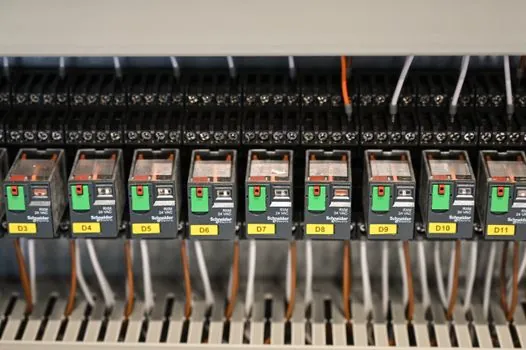
For automation buyers sourcing on cost and lead time, the IndustryBuying catalog referenced in [S5] lists 2,982 photoelectric sensor SKUs with 1,624 from Omron, 514 from Panasonic, 442 from Autonics, 345 from RS PRO, and 312 from Azbil, plus 2,160 units direct-imported from Japan and 652 from China. The headline spec pattern across the catalog is a 5-24 V DC supply, NPN or PNP transistor output, IP50 to IP67 housing, and 20-100 microsecond response, which matches the engineering envelope used in the comparison above.
The reliability question to put to any vendor is whether the spec is measured against a white target at 25 deg C (the datasheet condition) or against a dark target at 0.5 m standoff in 50 deg C ambient with dust loading (your line). If the answer is only the first condition, expect the field failure mode documented in [S3]. For broader lighting equipment and electric lamps integration, pair the sensor's emitter wavelength (commonly 660 nm red or 850-940 nm infrared) with the surrounding lamps and light fittings to avoid modulation-frequency interference, and confirm that the PLC input card samples faster than the sensor's worst-case response time before commissioning the line.
For related coverage, see Planetary Reducer Selection for Pulp and Paper Mill Drives.