Schneider Electric offers 37 power metering and energy monitoring product ranges spanning DIN rail meters, multifunction panel devices, utility-grade meters, and high-density branch circuit systems [S2].
The supplier landscape includes Eaton, Fluke, General Electric, Siemens, Emerson, ABB, Yokogawa, Rockwell Automation, Mitsubishi Electric, Schneider Electric, and Fuji Electric [S5].
What a power monitoring system measures
Electrical power monitoring systems measure voltage and current, then derive per-phase current and voltage, active and reactive power, power factor, frequency, and harmonic content for trending and reporting [S4].
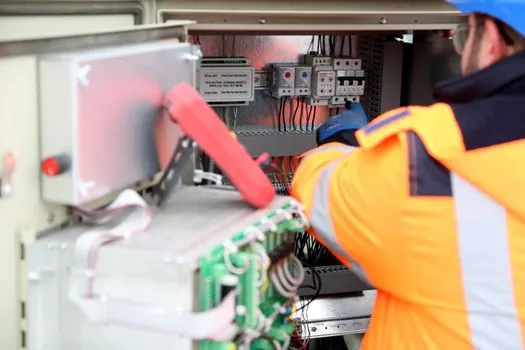
Installation position defines the engineering answer. Switchgear, service-entrance, and panelboard metering establish facility consumption, demand, and distribution health, while current and voltage sensing at motors, pumps, or drives supports asset-level condition analysis [S4].
Both levels can record sags, swells, imbalance, and transients, but a panel meter cannot identify which downstream machine is responsible for a measured change [S4]. This distinction also separates energy accounting from predictive maintenance, and it should drive the metering architecture before individual brands are compared.
Comparing the principal supplier product types
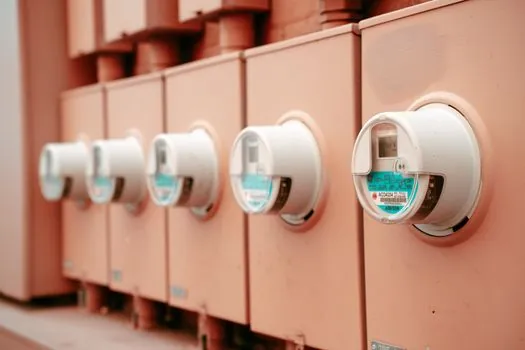
Multifunction meters consolidate voltage, current, power, and energy into one real-time device, reducing panel space and installation effort compared with multiple single-purpose gauges [S2]. Schneider's high-density branch system, HDPM6000, targets busway and panelboard circuits in large and critical power applications, while the EM4800 addresses multi-circuit networks and tenant metering [S2].
For basic branch and equipment accounting, the PM3000 and iEM3000 families use DIN rail mounting, while the EM3500 provides a compact DIN-mounted option for power monitoring [S2]. For utility and critical-load applications, the ION8650 supports revenue metering, power quality, and substation automation, the ION9000 targets advanced disturbance tracking, and the ION7400 serves feeders or critical loads [S2].
For retrofit work, Schneider's EM4200 Enercept is designed to fit existing facilities, compact installations, and configurations requiring flexible energy-code support [S2]. The practical comparison is therefore panel density against measurement breadth: multifunction units optimize panel space, basic meters optimize installed cost, high-density devices optimize circuit count, and ION-class meters optimize revenue or power-quality analysis [S2].
Where panel-level and asset-level systems fit
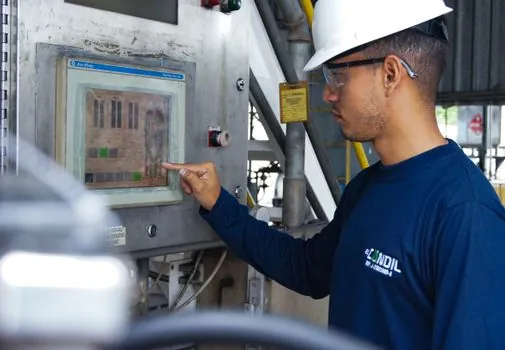
Rockwell Automation's energy monitoring portfolio covers power quality, energy cost management, and industrial operational optimization, with FactoryTalk Energy Manager and FactoryTalk Historian among the listed analytics platforms [S1]. Schneider Electric similarly positions its meters and software around power availability, reliability, and energy efficiency [S2].
Socomec supplies power monitoring and energy metering products aimed at electrical performance and energy efficiency, while AMETEK Power Instruments serves electric power generation and distribution with instruments and monitoring systems [S3][S7]. Eaton's family covers metering devices, protective relays, communications hardware, and software within low-voltage power distribution and control [S6].
Panel-level systems are appropriate for load allocation, billing support, demand analysis, and facility reporting. Asset-level systems are appropriate when a team needs to distinguish a deteriorating motor or drive from ordinary process variation. Tractian's 2026 manufacturing analysis states the same electrical waveform can contain the signature of a broken rotor bar, stator inter-turn short, or failing inverter switch [S4].
Supplier selection criteria and practical limits
Four selection criteria separate usable systems from feature lists: measurement point, monitored variables, alarm output, and response workflow. A complete system should specify whether it measures at the panel, feeder, circuit, or machine, and should retain historical data for comparison rather than display instantaneous values alone [S4].
Alarm design is another differentiator. A threshold alarm returns an interpretation task to the operator, while an analyzed event can identify a failure mode, severity, affected supply, drive, cable, or motor, then create a maintenance action [S4]. Power-quality data becomes operationally valuable when sag, harmonic, and imbalance events are mapped to the assets absorbing them [S4].
Retrofit compatibility remains a hard constraint. A DIN meter is a practical choice for a panel with limited space or an existing enclosure, but it cannot provide the same asset-level attribution as sensors installed beside a motor or drive [S2][S4]. Likewise, a high-density branch network can improve circuit visibility while adding communications, addressing, and configuration work that a simple facility meter does not require [S2].
Software, communications, and hardware scope
A supplier evaluation must include the software path, not only the meter. Rockwell's listed ecosystem includes FactoryTalk Historian, FactoryTalk Analytics, FactoryTalk Energy Manager, FactoryTalk Conductor, and ThingWorx IIoT, while its energy monitoring offering is positioned around power quality, energy cost, and operational optimization [S1].
Schneider's product category explicitly combines power and energy meters with software, and its energy meters support multiple protocols for integration with new or existing systems [S2]. Eaton's package spans four named equipment classes: metering devices, protective relays, communications hardware, and software [S6].
These combinations are important for plant engineering. A meter with accurate electrical measurement but no defensible history, alarm routing, or work-order integration still leaves interpretation with the maintenance team. A vendor offering software, communications hardware, and field devices can reduce integration gaps, but project approval still needs to verify protocol support, data retention, cybersecurity, and compatibility with the installed power monitoring system.
How to compare leading manufacturers
The leading supplier list is broad, with Eaton, Fluke, General Electric, Siemens, and Emerson placed first in the market overview, followed by ABB, Yokogawa, Rockwell Automation, Mitsubishi Electric, Schneider Electric, and Fuji Electric; the list is explicitly not ranked [S5]. Therefore, it should be used as a sourcing map, not a technical scorecard.
For a manufacturing plant, the comparison should be built around 4 questions: Can the system measure at the required electrical level? Does it retain the necessary variables and event data? Can alarms become named, located work? Does the vendor support the plant's communications, software, and retrofit constraints?
The aerospace case demonstrates why one cannot select by supplier list alone. Selecting an aerospace power monitoring system by protection needs requires protection requirements, operating environment, and application-specific constraints to be resolved before comparing metering hardware.
Standards, sourcing, and system boundaries
Power monitoring systems support energy management, power-quality analysis, and asset maintenance, but their scope differs from complete power distribution design. Cable sizing, protection coordination, and transformer application must be resolved separately; a power cable or power transformer should not be selected from a monitoring-system supplier list. [S4]
For critical installations, request written evidence for metering accuracy, event resolution, supported electrical variables, protocol compatibility, data retention, alarm latency, and environmental ratings. The cited manufacturer material establishes 1 measurement architecture, 3 supplier scope categories, 6 principal monitored variables, and 4 event types, including sags, swells, imbalance, and transients [S2][S4][S6].
Trackable procurement signals are the meter location schedule, the list of alarms that must generate work, and the number of circuits or assets requiring separate visibility. Those 3 items convert a broad supplier search into an auditable specification, which can be compared against the 37 Schneider Electric product ranges and the named 5-company priority group within the 11-company market list [S2][S5].