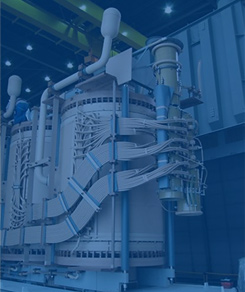
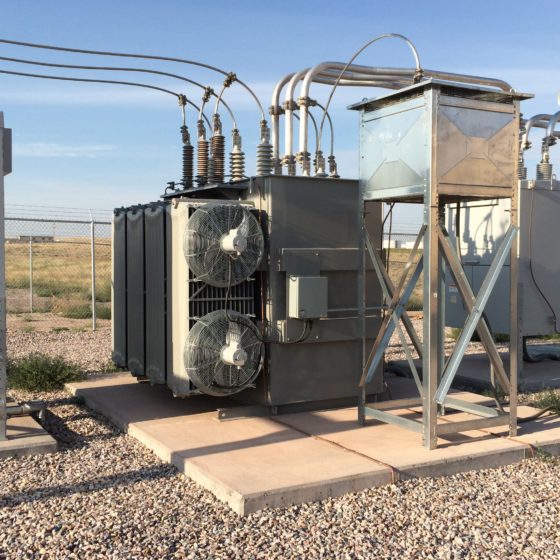
A power transformer is a static electromagnetic machine that transfers electrical energy between two or more circuits at different voltage levels by mutual induction through a laminated iron core, with no moving parts in the energy path. It is the backbone of every transmission and distribution grid: generation at 10 to 27 kV is stepped up to 110, 220, 400, or 765 kV and higher for low-loss long-distance transport, then stepped down again at substations toward the user. The term "power transformer" conventionally covers the larger units, broadly above 10 MVA, that run near rated load and almost always carry an on-load tap changer, as distinct from the smaller catalog distribution transformers that feed the final low-voltage network.
Selection is governed primarily by the IEC 60076 series (with IEEE C57.12.00 and ANSI in North America), and the vector group, percent impedance, cooling class, insulation level, and capitalized loss figures drive most of the engineering and commercial decision. This guide decodes those parameters in the order a procurement or design engineer actually needs them, from physical principle through nameplate to a step-by-step purchase sequence.
This guide is written for industrial procurement engineers and electrical design engineers. It covers 6 chapters, from construction and classification, through cooling classes and insulating fluids, to vector groups, nameplate decoding, and the selection decision sequence, with 7 selection FAQs and manufacturer references. All parameters reference the public standards IEC 60076-1 through -20, IEC 60214 (tap changers), IEC 60296 and IEC 62770 (insulating fluids), IEC 60071 (insulation coordination), IEEE C57.12.00, and the EU Ecodesign Tier 2 regulation (EU 2019/1783).
Chapter 1 / 06
What is a Power Transformer
A power transformer works on Faraday's law of electromagnetic induction. An alternating voltage applied to the primary winding drives an alternating flux through a laminated silicon-steel core; that common flux links the secondary winding and induces a voltage in proportion to the turns ratio. In an ideal transformer the voltage ratio equals the turns ratio and the volt-amperes in equal the volt-amperes out, so stepping the voltage up by ten steps the current down by ten. Real units deviate from the ideal by the no-load magnetizing current, the winding resistances, and the leakage reactance, and those deviations are precisely what the nameplate parameters quantify.
The core is built from thin, grain-oriented silicon-steel laminations (typically 0.23 to 0.30 mm) or, in premium designs, from amorphous metal ribbon to cut hysteresis and eddy-current loss. The windings are copper or aluminum, wound concentrically (core-form construction) or interleaved with the core (shell-form construction). In a liquid-immersed unit the entire active part sits in a steel tank filled with insulating fluid that serves double duty as electrical insulation and as the heat-transport medium, circulating to external radiators. A conservator or a sealed gas cushion accommodates the thermal expansion of the fluid across the load cycle.
The industrial history runs from Michael Faraday's induction ring in 1831 to the first practical alternating-current transformers of 1885: the closed-core "ZBD" design built by Karoly Zipernowsky, Otto Blathy, and Miksa Deri at Ganz Works in Budapest, and William Stanley's parallel work for Westinghouse in the United States the same year. The transformer is the device that let alternating current win the so-called war of the currents, because it allows the grid to transmit at high voltage and low current to slash resistive loss, then deliver at safe low voltage. Modern ratings have grown to single units exceeding 1,000 MVA and ultra-high-voltage classes of 765 kV alternating current and 1,100 kV for the largest networks.
In scale, the installed base is enormous and the unit value is high: a large grid transformer is a multi-year, build-to-order capital asset weighing tens to hundreds of tonnes, often the single most expensive and longest-lead item in a substation. Lead times of 12 to 24 months and limited global manufacturing capacity make spare-unit strategy and condition monitoring strategic rather than incidental concerns. A failed 400 kV transformer can take a substation off line for many months, so reliability, not first cost, dominates procurement thinking at the transmission level.
Four engineering figures dominate the value of any power transformer over its life: the no-load loss, the load loss, the percent impedance, and the insulation (basic impulse) level. No-load and load loss set the running energy cost and the efficiency obligation; impedance sets the downstream fault current and the parallel-operation compatibility; the insulation level sets how much over-voltage stress the unit survives. Together these decide both the capitalized total cost of ownership and whether the unit is even fit for its position in the network.
Chapter 2 / 06
Construction Types and Classification
Power transformers are classified along several independent axes at once: by function in the grid, by core geometry, by number of phases, by winding count, and by insulation medium. A single unit is described by one value on each axis, for example a three-phase, core-form, two-winding, liquid-immersed step-up transformer. Confusing these axes is the most common beginner error in a specification. The table below summarizes the functional classes and their typical place in the network.
Functional Type
Typical Rating
Typical Voltage Class
Grid Position
Generator step-up (GSU)
100 to 1,000+ MVA
Up to 765 kV
Power plant to grid
Transmission interconnect
100 to 1,500 MVA
220 to 765 kV
Grid-to-grid interties
Substation step-down
10 to 100 MVA
33 to 220 kV
Bulk supply to MV bus
Autotransformer
100 to 1,000 MVA
110 to 765 kV
Voltage-level tie
Distribution transformer
10 kVA to 5 MVA
Up to 33 kV
MV bus to LV network
Core-form versus shell-form. In core-form construction the windings are wound as cylinders around the limbs of the core, and the core surrounds little of the winding; this is the dominant geometry for transmission units because it is easier to build, repair, and insulate at high voltage. In shell-form construction the core surrounds the windings on most sides, giving better mechanical bracing against short-circuit forces and a more compact magnetic path, favored historically for the largest generator step-up units and for some high-fault-duty applications. Both are valid under IEC 60076; the choice is a maker's manufacturing and short-circuit-withstand decision rather than a buyer's.
Single-phase versus three-phase. Most installations use one three-phase unit because it is cheaper, smaller, and more efficient than three single-phase units. However, banks of three single-phase transformers are chosen for the very largest UHV ratings where a three-phase unit would exceed transport weight or clearance limits, and where a single spare phase, rather than a whole spare three-phase unit, is the economical contingency strategy. Transport feasibility, by rail or road weight limit, frequently forces the single-phase-bank decision at 500 kV and above.
Two-winding versus autotransformer. A conventional two-winding transformer isolates primary and secondary galvanically. An autotransformer shares a common winding portion between the two voltages, which makes it dramatically smaller, lighter, and more efficient when the turns ratio is modest (typically below about 3:1), so it dominates transmission-level interties such as 400 kV to 220 kV. The trade-off is that the windings are no longer galvanically isolated, so a fault or transient can pass through, and an autotransformer cannot block zero-sequence current the way a delta winding can. Three-winding designs add a tertiary (often delta) winding to stabilize the neutral, supply station auxiliaries, or connect reactive compensation.
Finally, the insulation medium splits the field into liquid-immersed and dry-type, which is the axis most visible to a buyer because it determines fire risk, indoor suitability, and maintenance regime. That axis is detailed in the next chapter together with the cooling class.
Chapter 3 / 06
Cooling Classes and Insulating Fluids
The cooling class is the four-letter code on every liquid-immersed nameplate, defined in IEC 60076-2. The first two letters describe the internal coolant and its circulation, the last two describe the external coolant and its circulation. The first letter is O for mineral oil, K for a high fire-point liquid such as natural or synthetic ester, or L for a non-flammable synthetic liquid; the second letter is N (natural convection), F (forced by pump), or D (directed flow forced through the windings). The third letter is A (air) or W (water) and the fourth is again N or F. The table below decodes the classes you will actually meet.
Cooling Class
Internal Coolant
External Coolant
Typical Use
ONAN
Mineral oil, natural
Air, natural
Distribution and small power, silent base rating
ONAF
Mineral oil, natural
Air, forced (fans)
Peak-load uplift, roughly +25 to 33% over ONAN
OFAF
Mineral oil, forced (pump)
Air, forced (fans)
Large power, higher rating step
ODAF
Mineral oil, directed
Air, forced (fans)
Very large grid and GSU units
OFWF / ODWF
Mineral oil, forced/directed
Water, forced
Hydropower, indoor, space-limited plants
KNAN / KNAF
Ester, natural
Air, natural/forced
Fire-safe indoor and offshore liquid-filled
AN / AF (dry)
None (solid insulation)
Air, natural/forced
Cast-resin and VPI dry-type
The power of the multi-stage code is that one transformer carries several ratings. A nameplate reading ONAN/ONAF/OFAF 60/80/100 MVA delivers 60 MVA on pure convection, 80 MVA with fans, and 100 MVA with fans plus oil pumps. The buyer sizes the frame for the highest stage but pays no fan or pump energy when the load sits at the base stage, and gains contingency headroom for peak or N-1 conditions. Stage ratios are commonly quoted as percentages, for example ONAN/ONAF 70/100 percent. IEC 60076-2 explicitly allows a transformer to carry more than one assigned power rating tied to its cooling mode.
Insulating fluids. The traditional fluid is mineral (naphthenic) insulating oil to IEC 60296, prized for low cost, good dielectric strength, and decades of field data, but limited by a fire point near 165 degrees C. Where fire risk or environmental spill risk is high, natural ester fluids to IEC 62770 (and IEEE C57.147), such as vegetable-oil-based products, raise the fire point above 300 degrees C (typically near 360 degrees C), classify as K-class less-flammable liquids, and biodegrade readily, at the cost of higher viscosity and price and greater oxidation sensitivity. Synthetic esters and silicone fluids serve special indoor and traction applications. The fluid choice interacts directly with fire code: K-class fluids can often be installed indoors where mineral oil would demand a fire-rated vault.
Dry-type construction.Dry-type transformers, governed by IEC 60076-11, use no liquid at all. Cast-resin units encapsulate the windings in epoxy under vacuum, while vacuum-pressure-impregnated (VPI) units impregnate the coils with polyester or silicone varnish. Dry-types carry three additional class ratings on the nameplate: a climatic class (C1 or C2), an environmental class (E0, E1, E2 for humidity and pollution), and a fire-behavior class (F0 or F1, where F1 is self-extinguishing with low smoke and toxicity). They are the default for hospitals, high-rise buildings, ships, mines, and tunnels, but practical ratings are capped near 40 MVA and 36 kV, and they run audibly louder and cost more per kVA than liquid units at large sizes.
The selection rule of thumb is straightforward: fire code and installation location are decided first. Occupied buildings and confined indoor spaces push toward dry-type or K-class ester; outdoor bulk-power sites where rating and lifecycle cost dominate push toward mineral-oil liquid-immersed; water-cooled variants appear only where space or ambient air make air cooling impractical, such as inside hydropower caverns.
Chapter 4 / 06
Vector Groups, Standards, and Tap Changers
The vector group is the most misunderstood single field on a power-transformer order, yet it dictates whether two transformers can run in parallel and how the unit behaves on unbalanced or harmonic-rich load. It encodes both the winding connection (star, delta, or zigzag) and the phase displacement between HV and LV line voltages, expressed as a clock number where each unit is 30 degrees. The first capital letter is the HV connection, the second lowercase letter the LV connection, an n or N denotes a brought-out neutral, and the digit is the LV clock position relative to HV at 12 o-clock.
Vector Group
HV / LV Connection
Phase Shift
Typical Application
Dyn11
Delta / star with neutral
330° (30° lead)
Distribution, suppresses 3rd harmonic
YNd1
Star with neutral / delta
30° lag
Generator step-up, transmission
YNyn0
Star-N / star-N
0°
Autotransformers, interties
Dd0
Delta / delta
0°
Industrial, no neutral needed
Yzn5 / Dzn0
Zigzag LV
150° / 0°
Earthing, unbalanced LV loads
Dyn11 is the global workhorse for medium-voltage distribution because the delta HV provides a circulating path for triplen (third) harmonics, keeping them off the line, while the star LV with brought-out neutral supplies single-phase loads and a defined earth reference. YNd1 dominates generator step-up because the star HV neutral can be solidly or impedance-earthed for the transmission system while the delta LV blocks zero-sequence current from the generator. Two transformers may only be paralleled if their vector groups are identical (or in a compatible clock-shifted family), their voltage ratios match, and their percent impedances are within roughly 10 percent of each other; mismatched groups create a phase difference that drives huge circulating current at the closing instant.
Governing standards. The IEC 60076 series is the global reference: Part 1 (general), Part 2 (temperature rise for liquid-immersed), Part 3 (insulation levels and dielectric tests), Part 5 (short-circuit withstand), Part 7 (loading guide), Part 10 (sound level), Part 11 (dry-type), and Part 20 (energy efficiency). North American practice follows IEEE C57.12.00 and the C57 test-code series, with ANSI ratings. On-load tap changers are covered by the IEC 60214 series. Energy efficiency is additionally regulated, not merely recommended: the EU Ecodesign Tier 2 regulation (EU 2019/1783, in force since 1 July 2021) sets maximum no-load and load losses or a minimum Peak Efficiency Index, and the US DOE 2016 rule (10 CFR Part 431) sets equivalent minimum efficiencies.
Tap changers. Real grids do not hold voltage perfectly constant, so transformers carry taps that adjust the turns ratio to keep the secondary voltage within band. An off-circuit tap changer, typically four or five positions at plus or minus 2 by 2.5 percent, must be moved with the transformer de-energized and is set once. An on-load tap changer (OLTC) to IEC 60214 switches under full load without interruption: a diverter switch transfers current between taps through transition resistors so the load is never broken, with the diverter operating in tens of milliseconds, giving regulation ranges commonly around plus or minus 8 to 16 steps of 1.25 percent each. The OLTC is the most maintenance-intensive component, and its oil compartment is monitored separately by dissolved-gas analysis because contact arcing generates characteristic gases distinct from the main-tank insulation.
Insulation level. Every winding carries a rated insulation level expressed as the highest voltage for equipment (Um) plus the rated lightning impulse withstand voltage (LI, the BIL) and the power-frequency withstand. For example, a 145 kV class winding is typically specified with a 650 kV BIL. These figures must coordinate with the surge arresters and the network insulation coordination per IEC 60071; under-specifying BIL invites failure from switching and lightning transients.
Chapter 5 / 06
Reading the Nameplate: Key Parameters
The nameplate is the legal and technical identity of the transformer, and every value on it traces to a test in the factory acceptance protocol. A buyer who can read a nameplate can verify that the delivered unit matches the order and predict its in-service behavior. Eight parameters carry the engineering weight; each is explained below.
Parameter
Typical Value / Range
What it Governs
Rated power
10 to 1,000+ MVA
Continuous load capacity per cooling stage
Voltage ratio
e.g. 230 / 36.75 kV
Turns ratio, grid position
Percent impedance (Uz)
4% to 18%
Fault current, regulation, parallel sharing
No-load loss (P0)
~0.1% to 0.3% of MVA
Continuous energy cost
Load loss (Pk)
~0.5% to 1.2% of MVA
Loss at rated load, efficiency
Temperature rise
55 or 65 K oil / 60 K winding
Insulation life, loadability
BIL / insulation level
e.g. 145 kV Um, 650 kV LI
Surge withstand, coordination
Vector group
e.g. YNd1, Dyn11
Phase shift, parallel compatibility
Rated power and voltage define the duty point. Rated power is the continuous output in MVA at a stated cooling stage and ambient; for multi-stage cooling the nameplate lists a rating for each. The voltage ratio (for example 230 kV / 36.75 kV) is the no-load ratio at the principal tap; the secondary figure is usually quoted slightly above the nominal LV bus voltage to compensate for in-service voltage drop. IEC and IEEE define preferred kVA and voltage series so that buyers and makers converge on standard frames.
Percent impedance (Uz) is the percentage of rated voltage needed to circulate rated current with the secondary shorted. It sets the prospective short-circuit current (roughly rated current divided by per-unit impedance), so a 6 percent unit can feed about 16.7 times rated current into a bolted fault, which the downstream switchgear must be rated to break. Low impedance gives tighter voltage regulation; high impedance limits fault duty but worsens regulation and raises load loss. Distribution units sit at 4 to 6 percent, mid-size power transformers around 7 to 11 percent, and large grid and arc-furnace units at 10 to 18 percent.
No-load loss and load loss are the two efficiency numbers. No-load loss (core or iron loss) flows continuously whenever the unit is energized and is independent of load; load loss (copper loss plus stray loss) scales with the square of load current. Because no-load loss runs 8,760 hours a year, it usually carries the higher capitalization weight in total-cost-of-ownership evaluation, and it is the figure most tightened by Ecodesign Tier 2 and DOE 2016.
Temperature rise and insulation life. Liquid-immersed transformers are typically specified at 65 K average winding rise (or 55 K for a conservative life) over a 40 degrees C ambient, with the top-oil rise limited accordingly per IEC 60076-2. The insulation thermal class (commonly A for oil-paper systems) sets the hottest-spot limit; the IEC ageing rule is that roughly every additional 6 to 8 K of hottest-spot temperature halves the cellulose insulation life. Loadability above nameplate is possible for short periods under the IEC 60076-7 loading guide, at the cost of accelerated ageing.
BIL and vector group complete the picture. The basic lightning impulse insulation level (BIL) must coordinate with surge arresters and network insulation per IEC 60071; the vector group, as covered in Chapter 4, fixes the phase displacement and parallel compatibility. Reading these eight fields together tells an engineer whether the unit fits its electrical position, its loss budget, and its fault environment, before a single physical inspection.
Chapter 6 / 06
Selection Decision Factors
To turn the preceding chapters into a specific purchase, follow the decision sequence below. Most costly selection mistakes come not from a single wrong number but from settling a downstream choice before an upstream one is fixed. These steps double as an RFQ template that a maker can quote against without ambiguity.
Rating and cooling stages: Fix the base and peak MVA from the load study, including N-1 contingency, then choose the cooling sequence (ONAN, ONAN/ONAF, or ONAN/ONAF/OFAF) so the base load sits comfortably below the silent base rating and the peak fits a forced stage.
Voltage ratio and vector group: Set the HV and LV rated voltages and the principal-tap ratio, then choose the vector group (Dyn11, YNd1, YNyn0) to match the earthing strategy and any transformers it must parallel with.
Percent impedance: Select Uz to balance voltage regulation against downstream switchgear breaking capacity. Confirm it matches existing units within roughly 10 percent if parallel operation is intended.
Insulation level and BIL: Specify Um and the lightning impulse withstand (BIL) coordinated with surge arresters per IEC 60071, plus the power-frequency and switching-impulse withstand for higher classes.
Insulation medium and fire class: Decide liquid-immersed (mineral oil to IEC 60296, or K-class ester to IEC 62770) versus dry-type (IEC 60076-11 with C, E, and F classes), driven first by fire code and indoor or outdoor location.
Tap changer: Choose off-circuit taps for a fixed-voltage feed, or an OLTC to IEC 60214 (for example plus or minus 8 by 1.25 percent) wherever the operating voltage must be regulated under load.
Losses and efficiency capitalization: Set guaranteed maximum no-load and load losses, and evaluate bids on capitalized total cost of ownership (price plus A times P0 plus B times Pk), ensuring compliance with Ecodesign Tier 2 (EU 2019/1783) or DOE 2016 as applicable.
Tests, monitoring, and transport: Specify routine, type, and special tests to IEC 60076 (including partial discharge and, for critical units, short-circuit withstand to Part 5), any online monitoring (DGA, hotspot fiber, bushing tan-delta), and confirm transport weight, dimensions, and route clearances before contract.
One last dimension that is easy to underweight at the quotation stage is serviceability and lifecycle support: lead time and the maker's load on critical materials (grain-oriented steel, copper), bushing and OLTC spare availability, field-service reach for oil processing and on-site repair, and the strategy for a spare unit or spare phase. Tier-one makers such as Hitachi Energy, Siemens Energy, GE Vernova, Hyundai Electric, Mitsubishi Electric, and Toshiba, alongside large Chinese builders such as TBEA, China XD, and Baobian Electric (the last capable of 1,000 to 1,100 kV UHV units), all maintain regional service and test capacity. For a transmission-class asset that must run for 30 to 40 years, that support footprint, not the lowest bid, is usually the decisive factor.
What is the difference between a power transformer and a distribution transformer?
The split is by role and rating, not by a hard line. Power transformers handle transmission and bulk step-up or step-down duty, usually above roughly 10 MVA and at primary voltages of 33 kV and higher up to 765 kV and beyond. They run near their rated load for much of the day, so designers minimize load (copper) losses and accept higher no-load losses. Distribution transformers feed the final low-voltage network, typically below 5 MVA and 33 kV, and spend most hours lightly loaded, so designers minimize no-load (iron) losses instead. Power transformers are almost always built to order with on-load tap changers, while distribution units are catalog products with off-circuit taps. Both are governed by the IEC 60076 series, with IEEE C57.12.00 as the North American equivalent.
What does a vector group such as YNyn0 or Dyn11 mean?
The vector group encodes the winding connection and the phase displacement between high-voltage and low-voltage line voltages. The first capital letter is the HV winding connection (Y for star or wye, D for delta, Z for zigzag), the second lowercase letter is the LV connection, and n or N marks a brought-out neutral. The trailing number is a clock figure: each unit equals 30 degrees of LV lag behind HV. Dyn11 means delta HV, star LV with neutral, and the LV vector at the 11 o-clock position, a 330 degree lag or equivalently 30 degrees lead. Dyn11 is the workhorse for distribution because it suppresses third-harmonic circulating current and provides a stable LV neutral. YNyn0 keeps both sides in phase and is common for autotransformers and transmission interties. Parallel transformers must share the same vector group, or the closing current can be catastrophic.
What does ONAN/ONAF cooling mean and why are two ratings shown?
Cooling class is a four-letter IEC 60076-2 code: the first pair describes the internal liquid (O for mineral oil, K for high fire-point ester or silicone, L for non-flammable synthetic) and its circulation (N natural, F forced by pump, D directed flow), and the second pair describes the external medium (A air, W water) and its circulation. ONAN is oil natural, air natural, pure convection with no moving parts. ONAF adds fans. When a nameplate reads ONAN/ONAF 40/50 MVA, the transformer carries 40 MVA on convection alone and 50 MVA, a 25 percent uplift, once the fans start. Large units stack stages such as ONAN/ONAF/OFAF or ODAF for three ratings. The ratio lets a buyer size for the base load yet retain headroom for peak or contingency loading without buying a larger frame.
What is impedance voltage and why does it matter for selection?
Impedance voltage, also called percent impedance or short-circuit impedance, is the percentage of rated voltage that must be applied to the primary to drive rated current through a short-circuited secondary. It is set by winding geometry and is the single most consequential design parameter for a system. A low impedance, around 4 percent, gives good voltage regulation but lets prospective short-circuit current run high, roughly 1 divided by the per-unit impedance times rated current, which stresses downstream switchgear breaking capacity. A high impedance, 10 to 12.5 percent, limits fault current but worsens regulation and increases load loss. Distribution transformers sit near 4 to 6 percent; large grid transformers run 10 to 18 percent. Transformers operated in parallel must have impedances within roughly 10 percent of each other, or load sharing becomes badly unequal.
What is an on-load tap changer and when do I need one?
A tap changer alters the active number of turns on a winding to adjust the voltage ratio. An off-circuit (de-energized) tap changer, typically plus or minus 2 by 2.5 percent, must be switched with the transformer isolated and is set once at commissioning. An on-load tap changer (OLTC), governed by IEC 60214, switches under full load without interruption using a diverter switch and transition resistors, giving a regulation range commonly around plus or minus 8 to 16 steps of 1.25 percent. You need an OLTC whenever the supply or load voltage swings during operation: grid interties, generator step-up plants with reactive scheduling, arc-furnace feeds, and any bus that must hold a tight voltage band. OLTCs are the most maintenance-intensive part of a transformer, so dissolved-gas analysis and contact-wear monitoring focus heavily on the diverter compartment.
Liquid-immersed or dry-type: how do I choose?
Liquid-immersed transformers use mineral oil or ester fluid for both insulation and cooling, scale efficiently past 1,000 MVA and 765 kV, run cooler and quieter at a given rating, and cost less per kVA at large sizes, but they need oil containment bunds, fire separation, and periodic oil testing. Cast-resin and VPI dry-type transformers, governed by IEC 60076-11, contain no flammable liquid, carry climatic, environmental, and fire-behavior class ratings (for example F1 self-extinguishing), and suit indoor substations, hospitals, marine, and high-rise installations, but they are practically capped near 40 MVA and 36 kV and run louder. The decision is usually driven by fire code and location first, then by rating and total cost of ownership. For indoor or occupied buildings, choose dry-type or a K-class ester-filled unit; for outdoor bulk power, choose mineral-oil liquid-immersed.
Which manufacturers and what type and routine tests should I require?
Global tier-one makers of large power transformers include Hitachi Energy (formerly ABB), Siemens Energy, GE Vernova/GE Grid, Hyundai Electric, Mitsubishi Electric, and Toshiba; major Chinese makers such as TBEA, China XD, and Baobian Electric build up to 1,000 to 1,100 kV UHV units. Routine tests under IEC 60076-1 and -3 cover winding resistance, ratio and polarity, impedance and load loss, no-load loss and current, separate-source and induced AC withstand, and partial discharge measurement. Type tests add temperature-rise (IEC 60076-2) and lightning impulse (IEC 60076-3). Special tests include short-circuit withstand (IEC 60076-5), sound level (IEC 60076-10), and dissolved-gas baseline. For any critical unit, require a witnessed factory acceptance test and a partial-discharge limit at or below 100 pC at the relevant induced-voltage level.
Power Transformer Manufacturers
Source-backed product routes. Open a company dossier for procurement scope and cited evidence.