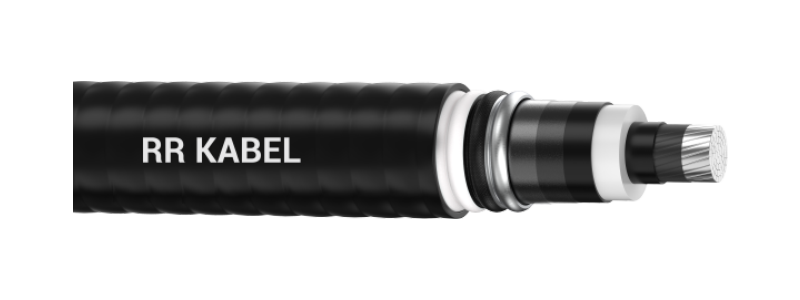
A power cable is an engineered assembly of one or more insulated conductors built up with screens, fillers, armour, and an outer sheath, designed to carry electrical energy from a source to a load while surviving the mechanical, thermal, and chemical stresses of its route. It is the backbone of every distribution network, factory feeder, and machine wiring system, and the single largest cost line in most electrical installations after the switchgear itself.
Power cables are classified first by rated voltage, then by conductor material and class, insulation compound, and the protective layers added for the environment. This guide decodes those layers in the order they appear on a spec sheet, so a procurement or design engineer can map a process requirement to a specific type code, cross-section, and standard before requesting quotes.
Photo: Hannes Grobe, CC BY-SA 3.0, via Wikimedia Commons
This guide is aimed at industrial purchasing engineers and design engineers. It covers 6 chapters from what a power cable is, through conductor classes, insulation grades, voltage ratings and construction, ampacity and spec decoding, to selection decisions, with 7 selection FAQs and manufacturer comparisons. All parameters reference the public standards IEC 60502-1 and IEC 60502-2 (cable construction), IEC 60228 (conductors), IEC 60364-5-52 (current-carrying capacity), and the IEC 60331 / 60332 / 60754 / 61034 fire-performance series.
Chapter 1 / 06
What is a Power Cable
A power cable is an assembly designed to transmit electrical power, distinguished from a control or signal cable by its job of carrying load current rather than information. Where a single insulated wire such as a building wire carries one conductor with one insulation layer, a power cable adds collective layers around its cores: extruded insulation on each conductor, fillers to round out the lay-up, an inner bedding, optional metallic screens or armour, and a continuous outer sheath. The result is a single mechanical unit that can be pulled into a duct, buried in a trench, or laid on a tray and still meet the dielectric, thermal, and mechanical requirements of its rated standard.
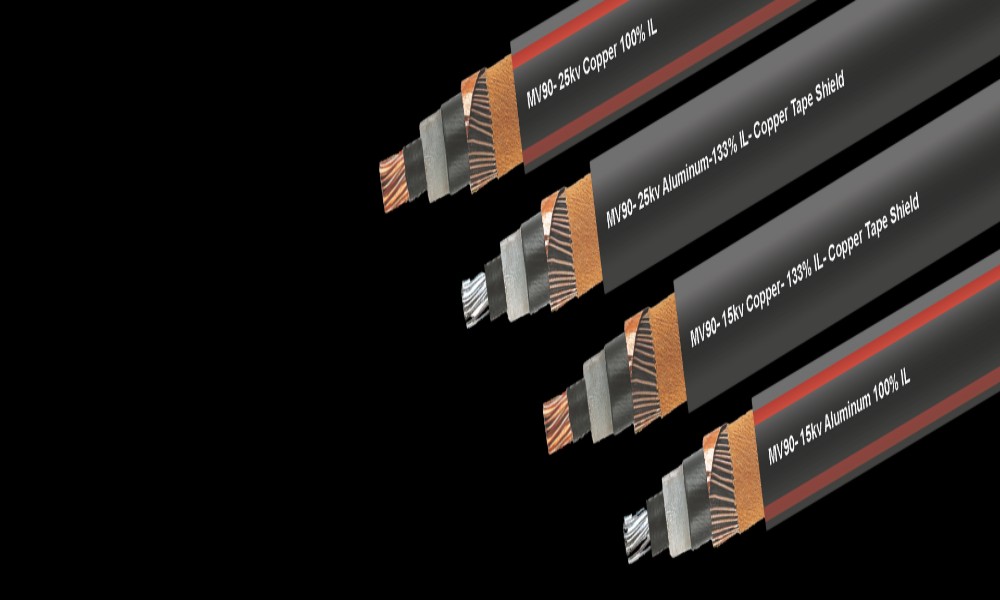
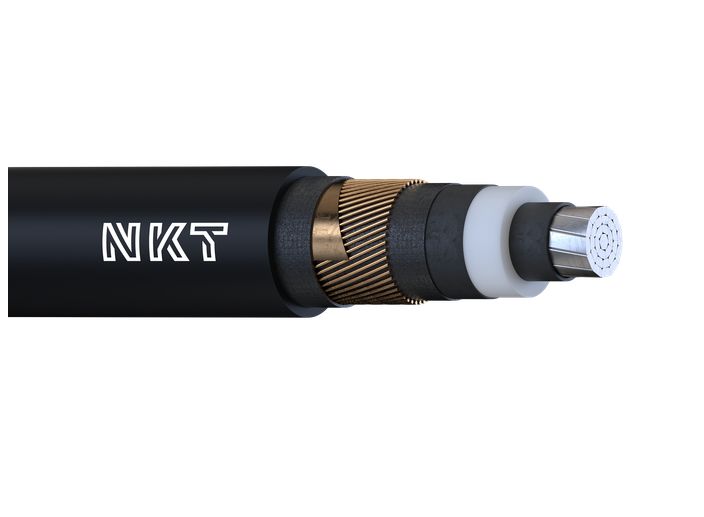
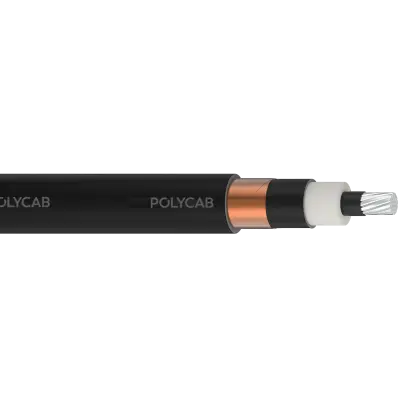
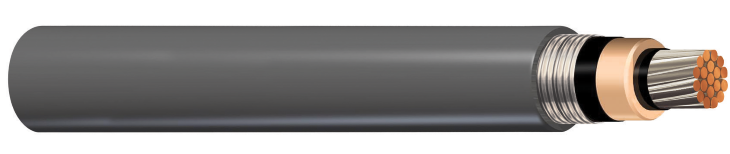
Structurally, almost every power cable shares the same concentric anatomy from the centre outward: (1) the conductor, solid or stranded copper or aluminium sized in square millimetres; (2) for medium voltage, a semiconducting conductor screen bonded to the insulation; (3) the insulation itself, a thermoplastic such as PVC or a thermoset such as XLPE or EPR; (4) for medium voltage, a semiconducting insulation screen and a metallic screen of copper tape or wire; (5) the inner sheath or bedding; (6) optional armour for mechanical protection; and (7) the outer sheath that resists moisture, sunlight, chemicals, and abrasion. The art of cable engineering is choosing each layer for the duty without over-building cost into the cable.
The history of insulated power cable runs alongside the electrification of industry. Vulcanised rubber and gutta-percha insulated the first telegraph and lighting circuits in the 1880s. Paper-insulated lead-covered (PILC) cable dominated utility distribution from the 1900s through the mid-twentieth century, its oil-impregnated paper offering excellent dielectric strength at the price of heavy lead sheaths and messy jointing. PVC arrived in the 1940s as the first practical extruded thermoplastic, and cross-linked polyethylene (XLPE) was commercialised through the 1960s and 1970s, raising the continuous conductor temperature from 70 to 90 degrees Celsius and displacing paper across both low and medium voltage. XLPE remains the dominant insulation for new installations today.
The scale of the application range is enormous. Power cables span from a flexible 0.5 mm2 appliance cord through 0.6/1 kV building feeders, 6/10 kV to 18/30 kV medium-voltage distribution, and on to high-voltage transmission cables of 110 kV, 220 kV, and 400 kV with conductors of 2000 mm2 or more. Each voltage class brings its own insulation thickness, screening requirement, and test regime, so a cable that is correct for one duty can be entirely unsuited to the next class up. There is no universal power cable; selection is the disciplined matching of a duty to a standard, a type code, and a cross-section.
Four engineering properties govern whether a chosen cable is fit for service over its design life: rated voltage, current-carrying capacity (ampacity), short-circuit withstand, and the environmental rating of the sheath and armour. These determine not only whether the cable works on day one, but whether its insulation survives decades of thermal cycling without the partial discharge or water treeing that ends a medium-voltage cable's life prematurely.
Chapter 2 / 06
Cable Types and Voltage Classes
Power cables are sorted first by rated voltage, written in the U0/U form defined by IEC 60183 and IEC 60502, where U0 is the rms voltage from conductor to earth or screen and U is the rms voltage between phases. The voltage class drives the entire construction: low-voltage cables need only insulation and a sheath, while medium-voltage cables add the semiconducting and metallic screens that control the electric field. Choosing a class too low is dangerous, and choosing one too high wastes money on insulation and screens that the system will never stress. The table below sets out the mainstream classes against their governing standards.
Class
Typical Rating (U0/U)
Governing Standard
Typical Applications
Low voltage
0.6/1 kV
IEC 60502-1
Building feeders, machine wiring, industrial distribution
Medium voltage
6/10, 12/20, 18/30 kV
IEC 60502-2
Substation feeders, plant and campus distribution rings
High voltage
64/110 to 87/150 kV
IEC 60840
Grid transmission, large generation interties
Extra-high voltage
220 kV and above
IEC 62067
Bulk transmission, long interconnectors
Building wire
450/750 V
IEC 60227 / UL 83
Single insulated conductors in conduit and trunking
Flexible / trailing
0.6/1 kV
IEC 60245 / 60502-1
Mobile equipment, drag chains, reeling drums
Low-voltage cable (0.6/1 kV) is the workhorse of industrial and building installations. Rated 600 V to earth and 1000 V between phases, it covers standard 230 V, 400 V, and 690 V systems with margin. The most common European types are N2XY (copper, XLPE, PVC sheath) and its aluminium sibling NA2XY, alongside the older all-PVC NYY. These are extruded with a single insulation layer and need no electrical screen because the field at 600 V is too weak to stress the surface of the insulation, which keeps construction simple and cost low.
Medium-voltage cable (3.6/6 kV up to 18/30 kV) to IEC 60502-2 introduces three field-control layers that are absent at low voltage: an extruded semiconducting conductor screen bonded to the insulation to exclude air voids, the XLPE insulation itself, and an extruded semiconducting insulation screen over which a metallic screen of copper tape or copper wires is applied. The metallic screen carries capacitive charging current and earth-fault current, and defines the earthed boundary of the electric field. Insulation thickness scales with voltage; an 18/30 kV XLPE core uses on the order of 8 mm of insulation against roughly 0.7 mm for a 0.6/1 kV core.
Building wire to IEC 60227 (European, 450/750 V) or UL 83 (North American, types THHN and THWN-2) is a single insulated conductor pulled into conduit or trunking, not a complete cable in the IEC 60502 sense. It is included here because procurement frequently spans both categories; the distinction matters because building wire relies on the raceway for mechanical protection, while an IEC 60502 cable carries its own. Flexible and trailing cables to IEC 60245 use very fine Class 5 or 6 stranding and an elastomer sheath to survive the repeated bending of reels and drag chains.
Chapter 3 / 06
Conductors and Insulation Grades
Two choices made early in a specification echo through everything that follows: the conductor and the insulation compound. The conductor is defined by material (copper or aluminium) and by its IEC 60228 flexibility class, while the insulation is defined by its compound family, which fixes the continuous and short-circuit temperatures the cable can survive. The conductor table below summarises the IEC 60228 classes that appear on every spec sheet.
IEC 60228 Class
Description
Construction
Typical Use
Class 1
Solid
Single solid wire
Small fixed installations up to about 16 mm2
Class 2
Stranded, fixed
Several stranded wires, compacted
Fixed power cables, the most common class
Class 5
Flexible
Many fine wires
Flexible cords, machine and panel wiring
Class 6
Very flexible
Very many very fine wires
Welding cable, reeling and trailing duty
Conductor material. Copper has a resistivity near 1.72e-8 ohm-metre at 20 degrees Celsius, the lowest of any practical conductor metal, and is the default for small sizes, flexible cables, and panel wiring where its smaller diameter and easy jointing matter. Aluminium has a higher resistivity near 2.83e-8 ohm-metre, so an aluminium conductor must be roughly one to two standard sizes larger to match the ampacity of a copper one. Aluminium is chosen for large feeders and utility distribution from about 95 mm2 upward, where its one-third weight and far lower metal cost outweigh the larger cross-section. IEC 60228 standardises nominal sections from 0.5 mm2 to 2500 mm2 (extended to 3500 mm2 in the 2023 edition), with maximum resistance values that all makers must meet regardless of strand count.
Conductor class. Class 1 is a single solid wire, simple and economical but stiff above about 16 mm2. Class 2 is stranded and compacted for fixed installation and is the most common class for power cable. Class 5 (flexible) and Class 6 (very flexible) use progressively finer strands so the cable can be bent and re-bent without work-hardening; these are mandatory for trailing, reeling, and machine-tool duty. The standard fixes the maximum strand diameter and the maximum conductor resistance, but lets makers use fewer strands as long as the resistance limit is met.
Insulation grade sets the thermal ceiling, which in turn sets the ampacity. The three mainstream compounds for industrial power cable are PVC, XLPE, and EPR. The comparison below lists the key engineering limits drawn from the cable standards.
Insulation
Type
Continuous Conductor Temp
Short-Circuit Limit
Notes
PVC
Thermoplastic
70 °C
160 °C
Low cost, softens when hot, lower ampacity
XLPE
Thermoset
90 °C
250 °C
Dominant compound, high ampacity, low loss
EPR
Thermoset
90 °C
250 °C
Very flexible, good for MV flexibles and ships
PVC is a thermoplastic rated for 70 degrees Celsius continuous and 160 degrees during a short circuit. It is inexpensive and easy to extrude, but it softens at temperature and its lower ceiling means a PVC cable carries less current than an identically sized XLPE one. XLPE is cross-linked into a thermoset network that resists deformation, raising the continuous rating to 90 degrees Celsius and the short-circuit limit to 250 degrees. That higher ceiling, combined with low dielectric loss and good moisture resistance, is why XLPE is the default for both low and medium voltage today. EPR (ethylene propylene rubber) shares the 90 degree continuous and 250 degree short-circuit limits but is far more flexible, which makes it the compound of choice for medium-voltage flexible cables, mining trailing cables, and marine and offshore service where vibration and bending are constant.
Chapter 4 / 06
Construction, Screens, and Armour
Once conductor and insulation are fixed, the remaining layers tailor the cable to its environment. These are the layers that turn a set of insulated cores into a buriable, pullable, screened, and earthed assembly. Understanding each one lets an engineer read a type code and know exactly what is inside without opening the cable.
Type codes. The German VDE 0276 codes printed on IEC 60502-1 cables are a compact build description. N marks a standard cable to German norms; an A in the second position marks an aluminium conductor and its absence marks copper; Y marks PVC and 2X marks XLPE; the order spells out insulation then sheath. So NYY is copper / PVC insulation / PVC sheath, N2XY is copper / XLPE / PVC, and NA2XY is aluminium / XLPE / PVC. A trailing J means a green-yellow protective earth core is present and O means it is not. For medium voltage, codes such as N2XSY and N2XS2Y add S for the copper screen and a second Y or 2Y for the outer sheath. The table below maps the most common low-voltage codes against their plain construction.
Type Code
Conductor
Insulation
Sheath
Typical Rating
NYY
Copper
PVC
PVC
0.6/1 kV
N2XY
Copper
XLPE
PVC
0.6/1 kV
NA2XY
Aluminium
XLPE
PVC
0.6/1 kV
N2XRY / SWA
Copper
XLPE
Steel wire armour + PVC
0.6/1 kV
N2XS2Y
Copper
XLPE + Cu screen
PE
6/10 to 18/30 kV
Screens (medium voltage). Above about 3.6 kV the electric field at the conductor surface becomes strong enough that any air void would ionise and start partial discharge, which erodes the insulation over years. Two extruded semiconducting layers solve this: the conductor screen smooths the field at the inner surface of the insulation, and the insulation screen does the same at the outer surface. Over the insulation screen sits the metallic screen, a helix of copper tape or copper wires, which earths the outer field boundary and provides the return path for charging current and earth-fault current. Sizing the metallic screen for the prospective earth-fault current is a routine but critical step in medium-voltage specification.
Armour. Armour is mechanical protection, not part of the electrical insulation system. Steel wire armour (SWA) is a layer of galvanised steel wires applied over the bedding of multicore cables, giving resistance to impact, crushing, and rodent damage and allowing higher pulling tension during installation. It also serves as an earth-continuity conductor when bonded at the glands. For single-core cables on AC systems, steel armour is avoided because the alternating magnetic field would induce circulating currents and eddy losses in a ferromagnetic loop around one conductor; instead, non-magnetic aluminium wire armour (AWA) is used. Steel tape armour (STA) is an alternative for ducted routes where wire armour's pulling strength is not needed. If the route is fully inside conduit, trunking, or indoor tray with no mechanical exposure, an unarmoured cable such as N2XY is sufficient and cheaper.
Sheath and fire performance. The outer sheath resists moisture, sunlight, oils, and abrasion; standard PVC suits most indoor and buried duty, PE is common as the medium-voltage outer sheath, and special compounds handle UV, hydrocarbons, or low temperature. Fire performance is a separate property set verified by its own standards: flame retardance by the IEC 60332 series (60332-1 single wire, 60332-3 bundled), low smoke and zero halogen (LSZH) by IEC 60754 for acid-gas emission and IEC 61034 for smoke density, and fire resistance, meaning circuit integrity during a fire, by IEC 60331 and EN 50200 ratings such as PH 30 to PH 120. These are independent; a cable can be flame retardant without being fire resistant, and life-safety circuits in tunnels and high-occupancy buildings typically need both LSZH and a fire-resistant grade.
Chapter 5 / 06
Ampacity and Spec-Sheet Decoding
Current-carrying capacity, or ampacity, is the maximum continuous current a cable can carry without exceeding its conductor temperature limit, and it is the single most consulted figure on a power cable spec sheet. Ampacity is not a fixed property of the cable alone: it depends on conductor size and material, insulation temperature class, and above all the installation method and surrounding conditions. IEC 60364-5-52 tabulates reference ampacities for defined installation methods and then supplies derating factors for the real situation. The table below gives representative IEC 60364-5-52 values for copper conductors with 90 degree XLPE insulation, three loaded conductors, at a 30 degree Celsius ambient.
Section (mm2)
Clipped Direct, 3-phase (A)
Free Air / Tray, 3-phase (A)
2.5
28
—
6
48
—
16
88
—
25
117
141
35
144
176
50
175
216
70
222
279
95
269
342
120
312
400
185
384
533
240
450
634
The values above are reference figures; every real installation derates them. Read a spec sheet by working through the eight parameters that actually drive selection, each explained below.
Rated voltage (U0/U). Confirm the conductor-to-earth value U0 covers the phase-to-earth duty under fault, not just the nominal phase-to-phase voltage. A 0.6/1 kV cable suits 400 V and 690 V systems; a 12/20 kV cable suits a 20 kV network. Conductor section and class. The square-millimetre section sets resistance and ampacity, while the IEC 60228 class sets flexibility; both appear in the description, for example Cu 4 x 95 mm2 RM (Class 2 stranded).
Ampacity and derating. Take the reference ampacity for your installation method, then multiply by correction factors for ambient temperature, grouping of adjacent circuits, and burial depth or soil thermal resistivity. The product is the cable's real allowable current, which must exceed the design current. Voltage drop is specified in millivolts per ampere per metre; over a long run this often governs the size rather than ampacity, with typical limits of 3 percent for lighting and 5 percent for power circuits.
Short-circuit withstand is the current the conductor can carry for the protection clearing time without exceeding the insulation's short-circuit temperature (250 degrees Celsius for XLPE, 160 for PVC), checked with the adiabatic equation. Insulation and conductor temperature fixes both the ampacity and the maximum permissible operating temperature. Bending radius, typically given as a multiple of the overall diameter (for example 12 to 15 times for armoured medium-voltage cable), limits how tightly the cable can be routed without damaging the insulation or screen.
Finally, standards and test class tie the whole sheet together: the cable should cite its construction standard (IEC 60502-1 or -2), its conductor standard (IEC 60228 with class), and any fire-performance ratings (IEC 60332, 60331, 60754, 61034). A spec sheet that omits the standard edition or the conductor class is incomplete; request the missing data before comparing quotes, because two cables with the same headline section can differ in screen size, armour, and test pedigree.
Chapter 6 / 06
Selection Decision Factors
To turn the preceding five chapters into a specific cable order, follow the decision sequence below. Most cable failures and field reworks trace not to a single wrong number but to a step taken out of order, for example sizing for ampacity while ignoring voltage drop on a long run. These eight steps form a repeatable RFQ template.
Voltage class and rating: Fix U0/U from the system voltage and earthing arrangement first, confirming U0 covers the phase-to-earth duty under a single-phase fault. This decides whether you need a screened medium-voltage cable to IEC 60502-2 or a simple low-voltage cable to IEC 60502-1.
Conductor material and class: Copper for small sizes, flexibility, and easy jointing; aluminium for large feeders where weight and cost dominate, accepting one to two sizes larger. Pick the IEC 60228 class (2 for fixed, 5 or 6 for flexible duty).
Cross-section, sized three ways: Take the largest section that satisfies derated ampacity, voltage-drop limit, and short-circuit withstand. The governing check is whichever demands the biggest conductor, not the first one you compute.
Insulation and temperature: XLPE at 90 degrees Celsius for most new work and higher ampacity; PVC at 70 degrees where cost rules and the duty is mild; EPR where flexibility and vibration resistance matter. Confirm the short-circuit limit clears the protection energy.
Construction layers: Decide on screens (mandatory at medium voltage), armour (SWA for buried or exposed multicore, AWA for single-core AC), and earth core (J versus O). Each layer adds cost and diameter, so add only what the environment requires.
Installation method and derating: State whether the run is buried, in duct, on tray, in free air, or clipped direct, then apply ambient, grouping, and soil derating factors. The method changes the ampacity by 30 percent or more, so it cannot be an afterthought.
Fire and environmental performance: Specify flame-retardant (IEC 60332), LSZH (IEC 60754 + 61034), or fire-resistant (IEC 60331 / EN 50200) grades per the occupancy and route. Add UV, oil, or low-temperature sheath ratings for outdoor and harsh routes.
Standards, test class, and cost of ownership: Require the construction standard edition, conductor class, and type-test and partial-discharge reports for medium voltage. Compare total installed cost: metal price, drum length and waste, jointing kits, and the failure cost of an undersized run, not just the price per metre.
One last dimension that buyers routinely overlook is serviceability and accessory ecosystem: the availability of compatible glands, lugs, jointing and termination kits, the maker's drum-length and cut-length policy, lead time, and the depth of type-test documentation for medium voltage. A cable is only as reliable as its terminations, and a cheaper drum that forces an incompatible or scarce jointing system can cost far more over a project than the metre price saved. Established suppliers such as Prysmian, Nexans, Southwire, LS Cable & System, NKT, and Sumitomo maintain full accessory ranges and type-test records, which makes them the safer choice for medium-voltage and critical low-voltage projects, while regional makers can be competitive for routine 0.6/1 kV runs once their standard compliance is verified.
FAQ
What is the difference between a power cable and a wire?
A wire is a single conductor, solid or stranded, usually with one insulation layer, for example a building wire such as THHN. A power cable is an assembly of one or more insulated conductors plus collective layers: fillers, bedding, screens, armour, and an outer sheath, all built up around the cores. The cable construction adds mechanical protection, moisture and chemical resistance, and in many designs an earth or screen path. In short, every conductor in a cable is a wire, but a cable is the engineered multilayer assembly that lets those conductors be pulled, buried, or laid on tray as a single unit rated to IEC 60502 or an equivalent standard.
What do the codes in N2XY, NYY, and NA2XY mean?
These are German VDE 0276 / DIN harmonized type codes widely used on IEC 60502-1 cables. Reading letter by letter: N means a standard cable to German norms, A in the second position means an aluminium conductor (its absence means copper), Y means PVC, and 2X means XLPE (cross-linked polyethylene). So NYY is a copper conductor with PVC insulation and PVC sheath, N2XY is copper with XLPE insulation and PVC sheath, and NA2XY is aluminium with XLPE insulation and PVC sheath. A trailing J indicates a green-yellow protective earth core is present, while O indicates no earth core. The same cable may also carry an IEC generic description such as Cu/XLPE/PVC 0.6/1 kV.
What does a voltage rating like 0.6/1 kV or 12/20 kV mean?
Cable voltage is written as U0/U following IEC 60183 and IEC 60502. U0 is the rated rms voltage between one conductor and earth or the metallic screen, and U is the rated rms voltage between any two phase conductors. For a 0.6/1 kV cable, the insulation is rated 600 V to earth and 1000 V phase to phase, which suits standard 400 V and 690 V low-voltage systems. For 12/20 kV, the insulation withstands 12 kV to earth and 20 kV phase to phase, suiting a 20 kV distribution network. Some catalogs add a third figure Um, the highest system voltage, for example 12/20 (24) kV. Always match U0 to the phase-to-earth duty, because under a single-phase earth fault the unfaulted phases rise toward the full phase-to-phase value.
Should I choose copper or aluminium conductors?
Copper has lower resistivity, about 1.72e-8 ohm-metre at 20 degrees Celsius versus about 2.83e-8 for aluminium, so an aluminium conductor must be roughly one to two standard sizes larger to carry the same current. Against that, aluminium weighs about one third as much per unit volume and costs far less per metre, which is why utilities and large feeder runs favour aluminium, especially from 95 mm2 upward. Copper is preferred for small sizes, flexible cables, panel wiring, and any termination where the smaller diameter and easier jointing matter. Aluminium terminations need bimetallic lugs or correct contact paste and torque to avoid the oxide and creep problems that gave early aluminium wiring a poor reputation.
When do I need an armoured cable such as SWA?
Armour is mechanical protection, not insulation. Specify steel wire armour (SWA) for multicore cables that are directly buried, pulled through ducts, or exposed to crushing, impact, or rodent risk. For single-core cables on AC systems, use aluminium wire armour (AWA) instead, because steel wire around a single conductor forms a magnetic loop that heats up and adds losses from the alternating field. The armour also provides a fault-current return path and earth-continuity conductor when correctly bonded at the glands. If the route is fully inside trunking, conduit, or on indoor tray with no mechanical exposure, an unarmoured cable such as N2XY is usually sufficient and cheaper.
What fire performance standards apply to power cables?
Three distinct properties are tested by separate standards. Flame retardance, the ability to limit fire spread, is verified by the IEC 60332 series: 60332-1 for a single vertical wire and 60332-3 for bundled cables. Low smoke and zero halogen (LSZH) performance combines IEC 60754, which limits acid-gas and halogen emission, with IEC 61034, which limits smoke density so escape routes stay visible. Fire resistance, meaning the cable keeps the circuit energized during a fire, is verified by IEC 60331 and related EN 50200 ratings such as PH 30 to PH 120. These are independent: a cable can be flame retardant without being fire resistant. Tunnels, metros, and high-occupancy buildings typically require LSZH plus a fire-resistant grade for life-safety circuits.
Which manufacturers supply industrial and utility power cable?
For low-voltage building and industrial cable, Prysmian, Nexans, Southwire, LS Cable & System, NKT, and large Chinese makers such as Hengtong, ZTT, and Far East Cable cover N2XY, NYY, and equivalent ranges. For medium-voltage 6/10 kV to 18/30 kV distribution cable to IEC 60502-2, Prysmian, Nexans, NKT, LS Cable, and Sumitomo are the established suppliers, with extensive type-test and partial-discharge records. For North American building wire to UL 83 and UL 44 (THHN, XHHW-2), Southwire, Encore Wire, and General Cable (Prysmian) dominate. Verify each maker's type-test reports, applicable standard edition, and conductor class before you commit a specification.
Power Cable Manufacturers
Source-backed product routes. Open a company dossier for procurement scope and cited evidence.