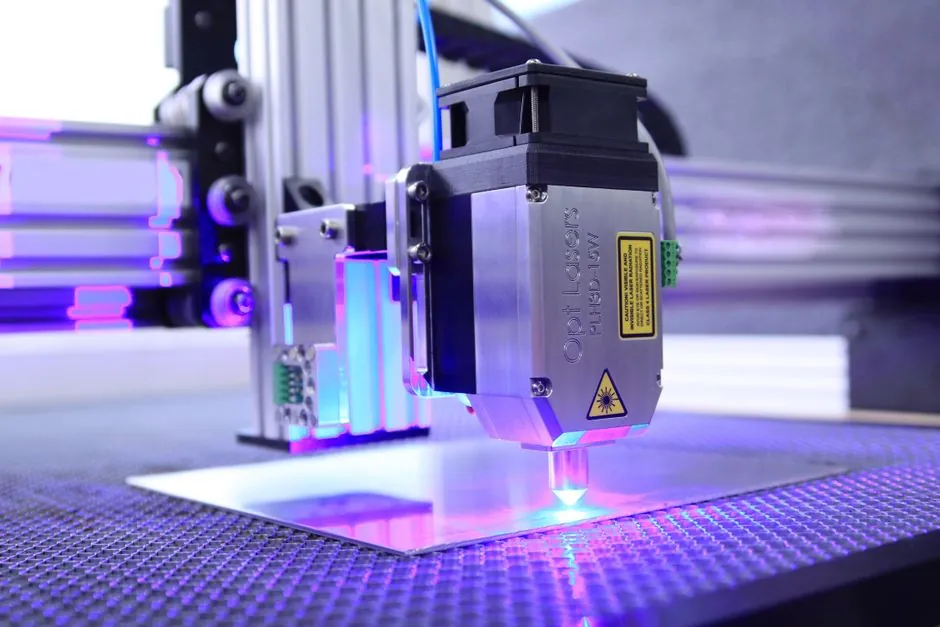
Pulsed time-of-flight rangefinders use sub-50 ns pulses and can exceed 30,000 m on non-cooperative targets with best-case accuracy around 0.15 m [S4].
Continuous-wave (phase-shift) rangefinders emit a modulated CW beam and resolve the round-trip phase difference, which makes them the workhorse for short-range, high-precision handheld distance meters [S4]. For engineers choosing a laser distance meter, the decision is really about which physical principle survives the target geometry, the eye-safety class, and the accuracy target.
Pulsed TOF: how it works and what it costs
A pulsed laser rangefinder emits a narrow burst (pulse width under 50 ns) toward the target, times the round-trip, and divides by the speed of light using h = c·t/2 [S4]. Because peak powers can reach megawatt to petawatt levels in Q-switched or mode-locked designs, the per-pulse energy stays small while the peak irradiance is high enough to overcome diffuse, non-cooperative surfaces [S2][S3]. Reported field performance lands at 5 m typical accuracy, with best-case figures near 0.15 m, on ranges past 30,000 m [S4]. That range envelope is why the same architecture underpins military fire-control rangefinders, satellite laser ranging, atmospheric lidar, and cloud-height ceilometers [S4]. The penalty is the high-voltage driver, fast Si or InGaAs APD front-end, and picosecond timing electronics, which is why consumer surveyors rarely carry a pulsed unit. Multi-pulse averaging on fiber-laser transmitters is a recognised way to push the single-shot detection envelope further and stabilise the walk error on low-reflectivity targets [S5].
Continuous-wave phase-shift: how it works and what it costs
A CW laser rangefinder modulates a continuous beam at one or more RF frequencies, illuminates the target, and recovers the phase difference between the local oscillator and the reflected echo to back out distance [S4]. Because the measurement is phase rather than timing, the theoretical resolution is set by the modulation frequency and the phase-meter noise floor, not by a stopwatch. That is why handheld laser distance sensors for interior surveying typically quote ±1.5 mm at 0.05–40 m, climbing to ±2.0 mm out to 100 m on cooperative reflectors. The trade-off is range: as the path length grows, the phase wraps through more 2π cycles and ambiguity resolution becomes the limiting error source, so CW units are rarely used past a few hundred metres. They also need a cooperative or reasonably diffuse but stable target, because the receiver integrates continuously and is more vulnerable to ambient light than a gated pulsed receiver.
Decision matrix: pulsed vs CW on four criteria
Range: pulsed TOF wins by two orders of magnitude, with documented non-cooperative performance beyond 30,000 m versus typical CW envelopes of 0.05–300 m [S4]. Accuracy at short range: CW phase-shift wins, with sub-millimetre resolution versus the 0.15 m best case published for pulsed systems [S4]. Eye-safety and power budget: CW can be eye-safe (Class 1/2) at low average power, which is why handheld surveyors stay CW; pulsed units concentrate peak power into nanosecond bursts and are usually Class 1M/3R unless the divergence is widened [S2]. Cost and electronics complexity: pulsed TOF needs a high-speed detector and timing ASIC, so the bill of materials is heavier; CW phase-shift rides on a photodiode, an RF modulator, and a phase detector, which is what made the sub-$50 handheld laser distance meter possible.
Where each architecture earns its place
For interior fit-out, BIM capture, facade measurement, and indoor industrial positioning, specify a CW phase-shift unit: the geometry is short, the target is cooperative, and the mm-level accuracy is what the workflow needs [S4]. For long-range, non-cooperative, or moving targets, including tank fire control, artillery spotting, crane anti-collision on shipyards, large-stockpile volumetrics, and atmospheric/cloud measurement, pulsed TOF is the only realistic option [S4]. The Safran Vectronix note on multi-pulse fibre-laser rangefinders adds a middle path: averaging many sub-pulses in the same measurement window reduces speckle noise and improves hit probability on low-reflectivity surfaces without leaving the pulsed envelope [S5].
Limitations, failure modes, and integration traps
Pulsed systems suffer walk error when the return pulse changes shape with target distance or reflectance, so high-end designs calibrate the timing discriminator against pulse amplitude; ignoring this on a low-reflectivity target can move the reading by tens of centimetres. CW phase systems wrap through 2π at distances set by the modulation wavelength, and a wrong ambiguity-resolution algorithm will give a reading that is off by exactly one modulation period; that is why surveyors report on multi-frequency phase instruments rather than single-frequency. Both architectures are sensitive to atmospheric refraction along long horizontal paths, so for any job past a few hundred metres the engineer should fold in refractive-index correction, not just the textbook h = c·t/2 [S4]. For process automation that needs continuous non-contact profiling, the trade-offs shift again, and a separate laser profiler or triangulation sensor becomes more cost-effective than either rangefinder class.
Standards, sourcing, and what to verify on the datasheet
Spec sheets should state the operating principle (time-of-flight pulsed vs phase-shift CW), the wavelength and pulse width, the eye-safety class per IEC 60825-1, the accuracy over the full range, and the beam divergence; if a vendor will not separate peak from average power, walk away. For surveying, ISO 16331 series defines the field test conditions for handheld laser distance meter accuracy, and ASTM E2592 covers lidar reflectance targets. For level and inventory applications the same pulsed-TOF physics shows up in guided-wave radar level transmitters, and the engineers choosing a tank gauge face the same pulsed-vs-CW logic. Two signals worth tracking: continued roll-out of 1550 nm pulsed TOF modules for eye-safe long-range work, and tighter integration of multi-pulse averaging firmware to stabilise non-cooperative readings [S5].
For related coverage, see Decade Resistance Box: 0.01% vs 0.1% Accuracy Class Compared.