
Polyurethane (PUR) and polyisocyanurate (PIR) rigid foams are formulated from the same two raw streams, polyol and isocyanate, but diverge at the isocyanate index: PIR runs a stoichiometric excess of NCO groups that trimerise into isocyanurate rings, while PUR balances NCO with polyol OH almost entirely into urethane linkages [S2][S3].
The resulting molecular architecture, urethane chains in PUR versus a urethane/isocyanurate network in PIR, is the single root cause of the differences engineers see in fire rating, smoke emission, and upper service temperature, and it is what the 2026 wave of building-envelope and cold-storage specifications is written around [S1][S4].
Reaction Chemistry: Urethane Linkage vs Isocyanurate Trimer
A PUR system is built when the OH groups of a polyether (or polyester) polyol react with the NCO groups of an isocyanate such as polymeric MDI, giving the repeating urethane linkage (-NH-CO-O-) and a closed-cell foam blown by a physical blowing agent or by the CO2 generated when water reacts with NCO [S2][S6].
PIR takes the same two components but formulates the isocyanate index well above 1.0, typically in the 2.0–3.0 range, and adds a trimerisation catalyst so the surplus NCO groups cyclise into isocyanurate rings; the residual NCO still forms urethane links, but the isocyanurate rings are what give the cured foam its rigidity and char-forming tendency under flame exposure [S3][S5]. Concretely, the 2026 PET-polyol comparative study reports a char yield step-change from ~3 wt.% in PUR to >22 wt.% in PIR, a roughly sevenfold increase that directly tracks the isocyanurate ring content in the network [S1].
Thermal Stability and Glass Transition
Because the isocyanurate ring is a more thermally stable motif than the urethane linkage, PIR foams show a higher glass transition temperature (Tg) and improved thermo-oxidative stability on TGA than PUR foams of comparable density [S1].
The same study quantifies the practical payoff: the main thermal degradation peak of the PIR formulation sits ~55 °C higher than the PUR reference, meaning the foam holds mechanical integrity deeper into a fire envelope before charring and collapse begin [S1]. Synthesia's panel-focused note adds that PIR remains dimensionally stable across a higher operating temperature window than PUR, which is why PIR cores are the default in insulated metal panels destined for fire-sector partitions and clean rooms [S5].
Fire Behaviour: Peak HRR, Smoke, and Toxic Gas
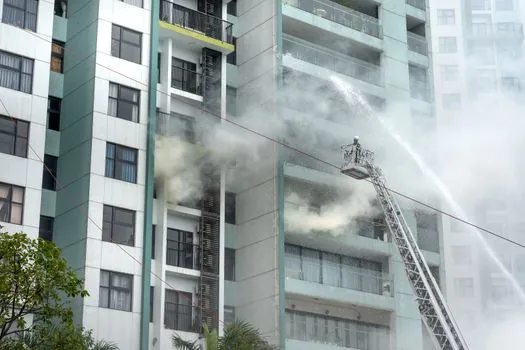
Cone calorimetry on the recycled-PET polyol system gives the headline number for specifiers: PIR cuts peak heat release rate (pHRR) by ~50% versus the PUR reference, indicating substantially lower fire intensity once ignition occurs [S1].
Two further fire-engineering facts separate the two foams in real enclosures. First, PIR generally requires a lower loading of flame retardant in the panel recipe than PUR to reach the same reaction-to-fire classification, because the isocyanurate network itself contributes to char formation; halogen-free PIR formulations are commercially available, and lower retardant loading translates into less smoke during combustion [S1][S5]. Second, the same thermal-shift behaviour that raises the degradation peak also gives PIR slower flame spread, which is the property insurance underwriters and EN 13501-1 classification reports actually grade against [S1][S4]. The 2025 cold-storage panel guide from KPS Global rates both PUR and PIR as "High" fire resistance in its four-way comparison, but PIR is the one most often paired with FM- or LPCB-approved facing systems for cold rooms and food-processing partitions [S4].
Comparison: PUR vs PIR Across the Decision Criteria
For an engineer comparing the two on the four criteria that actually drive panel selection, the picture is consistent across all four 2025–2026 sources: PUR is the lower-cost, easier-processing option with a slightly lower lambda, while PIR costs more, needs hotter processing, but returns a higher fire rating per millimetre of thickness [S3][S4][S5].
On a criteria basis: (1) Thermal conductivity, both PUR and PIR sit in the ~0.020–0.024 W/(m·K) range, with PIR often quoted slightly lower; (2) R-value per inch, both rated "High" in the KPS four-way table and ahead of EPS and XPS [S4]; (3) Fire rating / smoke, PIR wins on pHRR (~50% lower) and lower retardant loading, hence lower smoke [S1][S5]; (4) Cost and processability, PUR is cheaper, pours at lower mould temperature, and tolerates spray, pour, and injection routes, while PIR needs ~25–35 °C higher mould temperatures and a trimer catalyst package, so processing lines are typically dedicated rather than shared [S3][S5][S6].
Where Each Foam Is (and Is Not) the Right Spec

Specifying PUR is the right call when the application is cavity-fill, retro-fit injection, or any site where a wet system has to flow into irregular geometry; PUR's lower viscosity at the mix head and lower exotherm let it pack tight against substrates without the higher mould heat that PIR needs to fully trimerise [S2][S3].
Specifying PIR is the right call where building code or insurer demand an EN 13501-1 B-s2,d0 or better reaction-to-fire class, where panel thickness is constrained (cold-room headroom, façade reveals), or where long-term dimensional stability above ~110 °C service is needed; the higher crosslink density from isocyanurate rings is what carries those service conditions [S4][S5]. The case where neither is right is high-temperature process pipework above ~150 °C continuous, where both foams soften and mineral wool or calcium silicate substitutes should be considered instead. For process engineers sizing refrigeration duty, the practical decision ladder is lambda target → fire class → cost, and that ladder almost always lands on PIR for new cold-storage and clean-room builds and on PUR for budget-driven cavity-fill [S3][S4]. Where fire-rated wall panels meet a structured insulation panel requirement, the insulated metal panel reference is a useful cross-check on facing compatibility with closed-cell urethane cores.
Limitations, Sourcing, and Standards
The PET-polyol study that anchors the fire numbers is laboratory-scale cone calorimetry on a single formulation, so the ~50% pHRR reduction and >22 wt.% char yield should be read as a structural-architecture effect, not a blanket claim for every commercial PIR board; panel-level FM, LPCB, or EN 13501-1 documentation from the actual manufacturer always governs [S1].
Both foam families share the same sustainability bottleneck: petrochemical-feedstock polyols, although the 2026 PET-recycled polyol route in the comparative study demonstrates a credible path to drop-in polyester polyol from waste streams, with no penalty in fire performance and a measurable improvement in char yield [S1]. End-of-life recovery for both foams is typically mechanical recycling, chemical glycolysis, or energy-from-waste incineration, with the metal facings stripped and recycled separately in sandwich-panel systems [S5]. For process engineers looking at adjacent energy-cost drivers, the 2026 electricity price volatility piece is a useful cross-reference on why insulation lambda targets are tightening across the European industrial stock.
Two trackable signals to watch over the next 6–12 months: (1) more halogen-free PIR product launches using recycled PET or other waste-stream polyester polyols, building on the 2026 comparative dataset; (2) continued migration of cold-storage and clean-room specifications from PUR to PIR cores as insurers tighten reaction-to-fire documentation, with PUR retained for retrofit spray-foam and budget-driven cavity applications.
The underlying component specifications are covered under lost foam casting line, and checking and testing apparatus.