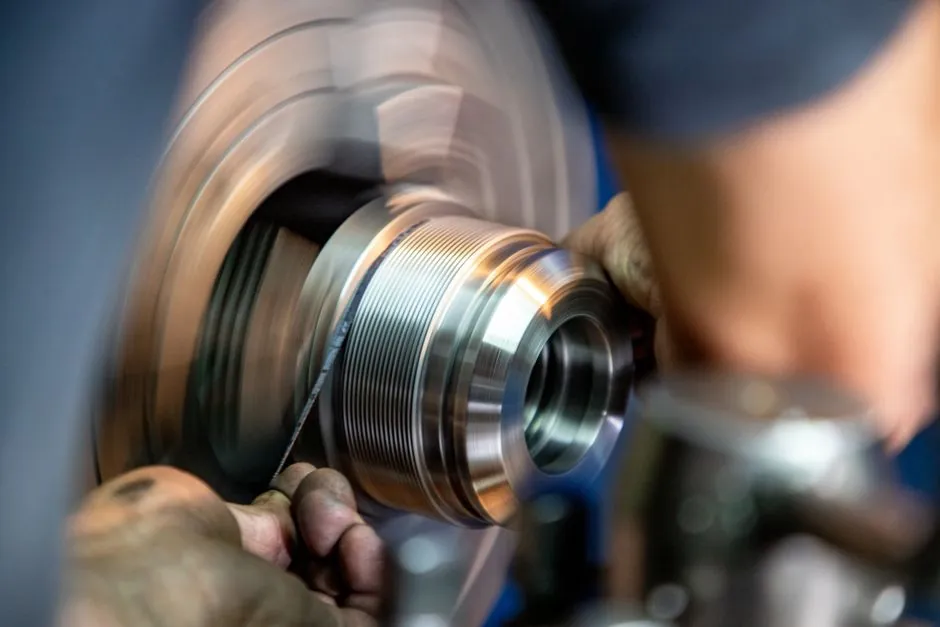
For punching and turning tooling in 2026, the head-to-head narrows to two thin-film coatings: PVD titanium nitride (TiN), a gold ceramic nitride with hardness around 2,000-3,500 HV, and diamond-like carbon (DLC), an amorphous carbon film spanning roughly 8-80 GPa with a coefficient of friction as low as 0.05 against steel [S2][S3].
Tool-life gains split cleanly by workpiece: DLC-coated punches deliver a 3-5x life extension in aluminum stamping, while PVD TiN gives a 2-4x improvement in steel punching applications [S4]. Turning-insert data tells the same story, with TiN favoured in high-heat abrasive cuts and DLC favoured in sticky, low-temperature alloys [S5].
Coating Composition and Process Route
TiN is a single-phase ceramic (TiN) deposited by PVD, typically arc evaporation or magnetron sputtering, at substrate temperatures commonly in the 400-500°C window, and it bonds readily to carbide, HSS, and many cold-work tool steels [S1][S6]. DLC is amorphous carbon with mixed sp2/sp3 bonding, deposited via plasma-assisted CVD, arc evaporation, or hybrid PVD-CVD routes; the ta-C (tetrahedral amorphous carbon) sub-family reaches 25-90 GPa, while hydrogenated a-C:H films sit in the 9-35 GPa band [S3].
Both routes sit firmly inside the broader PVD/CVD tooling-coating families discussed in industrial coating reference material, and the resulting films are typically 2-10 microns thick on turning inserts [S5]. Because DLC deposition temperatures can be held below 200°C on some variants, it is also a candidate for temperature-sensitive substrates that would distort or temper back under TiN process heat [S1][S3].
Hardness, Friction, and Temperature Windows
On hardness alone, DLC wins. ta-C at 25-90 GPa outranks PVD TiN at roughly 20.6-31.7 GPa (which converts to the 2,000-3,500 HV range cited above), and the DLC friction envelope of 0.05-0.20 against steel is well below TiN's typical 0.3-0.6 [S2][S3]. That combination is why DLC is the default for sliding, rotating, and dry-lubricated contacts, and why ta-C DLC is now specified for valve-train and high-load fuel-system components where boundary lubrication is unreliable [S3].
On temperature, TiN retains stability and oxidation resistance up to roughly 500-600°C in continuous service, which is why it remains the standard for high-heat turning of Inconel and other nickel-base superalloys, where the cutting edge routinely sees ~1,000°C chip-interface temperatures and the coating must protect the carbide beneath from diffusion wear [S5][S6]. DLC, by contrast, is capped lower (commonly below 300-400°C depending on hydrogen content) and is the wrong choice for sustained high-heat heavy cuts, where it graphitises and loses hardness [S2][S3].
Tool-Life Multipliers by Workpiece Material

Quantitative life gains are where the two coatings actually diverge, and the numbers are tight enough to drive a real spec call: [S2]
Punching and stamping: DLC extends tool life 3-5x in aluminum operations, while PVD TiN gives a 2-4x improvement in steel punching applications, with PVD TiN described as the "mature" benchmark and DLC offering "tribological advantages" but with adhesion sensitivity on impact-loaded tooling [S4]. For reference, broader tin bronze and tool-steel wear data converges on the same conclusion: harder, lower-friction films pay off only when the contact is sliding-dominated, not impact-dominated.
Turning inserts: TiN is called out as excelling in "high-heat abrasive cuts" of steels and superalloys, while DLC's ultra-low friction and chemical inertness deliver better surface consistency on aluminum, titanium alloys, and other adhesion-prone workpieces, with overall tool-life gains of 3-5x for a well-chosen coating system in the 200-500 m/min cutting band [S5]. A shop turning 4140 steel, for example, sees TiN hold up on roughing passes where heat dominates, and DLC win on finishing passes where built-up edge controls the surface.
Cost, Aesthetics, and Substrate Fit
DLC is consistently priced at roughly 2-3x the per-part cost of PVD coatings, driven by longer deposition cycles, more complex interlayer design, and tighter process control [S3]. PVD TiN, by contrast, is the original and most widely used PVD coating in the industry, scalable to high-volume production, and the lowest-risk default for general-purpose tooling, punches, dies, wear surfaces, and medical instruments [S6].
On aesthetics, TiN gives the iconic gold finish that doubles as a visual wear indicator on cutting edges; DLC is limited to dark gray or deep black, which rules it out where a brand colour or cosmetic finish is required, but is preferred where light reflection or galling is a concern [S2][S3]. On substrate compatibility, TiN bonds well to carbide and HSS, while DLC often needs a Si or Cr interlayer to manage the high internal compressive stress that otherwise drives delamination under impact [S3][S4].
Selection Criteria: Which Coating Fits Which Job
The decision matrix that actually holds up on a 2026 shop floor looks like this: [S5]
Choose PVD TiN when the cut is hot (steels, hard steels, Inconel, high cutting speeds), the budget is tight, the part is cosmetic, the substrate is standard carbide or HSS, or you want a visible gold wear indicator on the cutting edge [S5][S6]. Choose DLC when the contact is sliding or rolling, the workpiece is non-ferrous or adhesion-prone (aluminum, copper, titanium, polymers, coated steels), the operating environment is dry or boundary-lubricated, or sub-200°C process temperatures are needed to protect a tempered substrate [S2][S3][S4].
For a clean spec call, use this 4-criterion comparison extracted from the research [S2][S3][S4][S5][S6]:
Hardness (GPa): TiN ~20-32, DLC 8-90 (ta-C up to 90, a-C:H 9-35). Friction coefficient against steel: TiN ~0.3-0.6, DLC ~0.05-0.20. Maximum service temperature: TiN up to ~500-600°C, DLC typically <300-400°C. Relative cost per part: TiN baseline 1x, DLC ~2-3x.
Pick TiN for steel and high-heat turning; pick DLC for aluminum, titanium, and dry-lubricated sliding components. Avoid DLC on heavy interrupted cuts and on coatings more than ~5 microns thick without an engineered interlayer, since residual compressive stress plus impact load is the documented delamination path [S3][S4]. For impact-loaded punching in steel, TiN remains the safer bet; in aluminum, the 3-5x DLC multiplier usually beats the cost premium within a single shift's production.
Quality Control: Verifying the Film You Bought
Both coatings require thickness verification to confirm adhesion and performance consistency, since deposition temperature, bias, and partial pressure all drift on production loads [S2]. Calibrated coating thickness gauge measurements, typically eddy-current or X-ray fluorescence on TiN and a complementary technique on DLC because of its carbon content, are the standard QA gate before parts ship [S2].
Best practice on a 2026 production line is to spot-check a coupon from every batch for thickness, adhesion (commonly Rockwell or scratch-test per the relevant supplier standard), and visual colour or surface roughness; DLC's high residual stress makes adhesion testing especially important, since delamination under impact is its dominant in-service failure mode [S3][S4]. A growing number of shops also pair coating selection with casting tooling surface-finish recipes, since DLC-coated ejector pins and slides behave very differently from TiN-coated ones when the die is hot.
Limits, Failure Modes, and Common Misapplications
TiN's documented weaknesses are oxidation at sustained high temperature, friction that's still too high for some sliding contacts, and residual-stress-driven spallation under heavy impact [S4]. DLC's documented weaknesses are adhesion sensitivity to substrate and interlayer, delamination under impact loading, higher per-part cost, and a lack of standardised cross-application testing protocols that makes supplier-to-supplier data hard to compare [S3][S4].
Where 2026 buyers get burned: specifying DLC for steel punching under heavy impact (3-5x life claim doesn't hold, TiN at 2-4x does), specifying TiN for dry-lubricated aluminum forming (friction is too high, galling returns within a shift), and skipping the waterproof coating or rust-prevention step on stored coated tools, since both films are thin enough that a single scratch compromises the substrate beneath [S4][S7].
Track these signals over the next 6-12 months: tighter PVD TiN data on additive-manufactured tool-steel substrates, more ta-C DLC variants aimed at aluminum forming, and consolidation among mid-tier DLC coaters as the 2-3x cost premium pushes buyers toward fewer, larger suppliers [S3][S4].
For related coverage, see AC Torque Motor Output Torque vs. Supply Voltage: How Adjustment Actually Works.