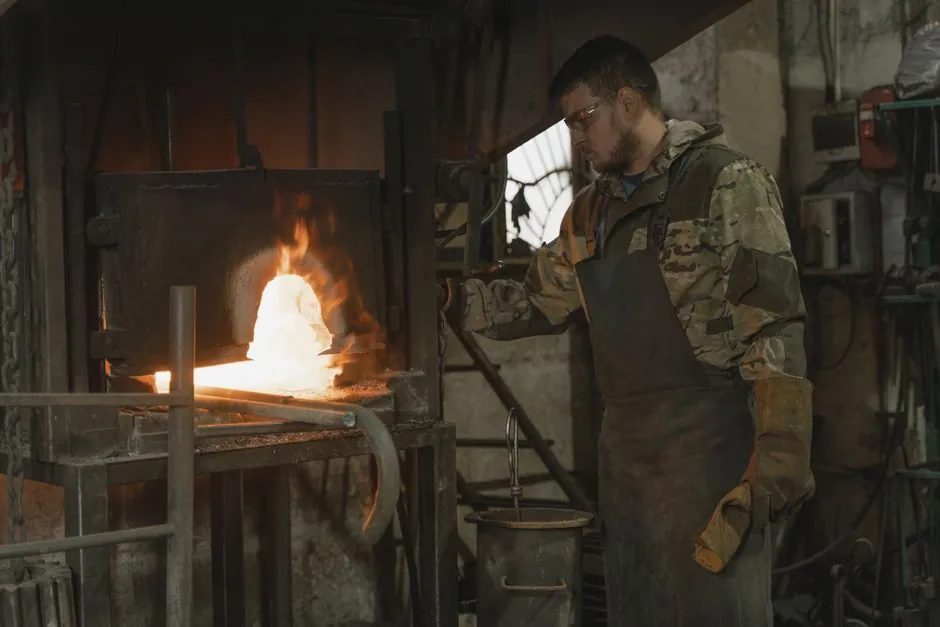
Mechanized furnace-to-quench transfer is the stronger choice for repeatable high-volume production because a robot and integrated cell can standardize movement, while a manual transfer can lose heat and introduce variable timing before quenching [S2].
The decision depends on load weight, production volume, part geometry, quench sequence, safety exposure, and the allowable metallurgical response, rather than on transfer speed alone. Box furnaces commonly use manual removal, whereas continuous and conveyor systems are designed around controlled material flow [S3][S5].
Define transfer time as a process variable
Transfer time is the elapsed interval between removal from the furnace and effective immersion or entry into the quench. For a batch furnace, that interval includes extraction, movement across the floor, fixture positioning, and quench entry; in a continuous furnace, it includes discharge, transfer equipment movement, and quench positioning [S2][S5].
For quench hardening, the transfer interval affects how much heat remains at the part surface before cooling begins. Manual handling can cause heat loss during movement, while the integrated automated cell provides the consistent transfer time needed between furnace and quench units [S2]. This matters because uniform heat transfer during quench produces lower and more predictable distortion in gears [S8].
Do not specify a generic maximum or minimum transfer time without defining the measurement points. Record the time from furnace-door opening to quench entry, the time to first contact, and any delay between part removal and quench immersion. Those three intervals separate handling delay from quench-entry variation and make process comparisons meaningful.
The governing furnace selection information is not limited to furnace temperature or production volume. A valid specification should also identify part size, load weight, target temperature, cycle time, material-handling method, and finished-part quality requirements, including the required atmosphere, airflow, loading pattern, and cooling sequence [S3].
Compare mechanized and manual options against four criteria
Mechanized transfer has the clearest advantage in timing consistency, operator safety, and serial-part traceability, while manual transfer has the advantage of lower initial mechanical complexity for low-volume batch work. Capital cost and maintenance burden are not quantified in the available material, so they must be evaluated against installed automation scope rather than inferred from a generic claim [S2].
On timing consistency, mechanized handling can repeat the same programmed movement through an infeed conveyor, robot, end-of-arm tooling, furnace, quench press, and exit equipment. Manual tong-based handling remains exposed to operator movement, fixture placement, and heat loss between furnace and press [S2].
In the cited aerospace application, two production staff members manually moved parts weighing up to 50 lb into a 2,200°F furnace before pulling them from the furnace after the required temperature was reached. In the cited aerospace application, two staff members manually moved parts weighing up to 50 lb into a 2,200°F furnace, then used tongs to transfer parts to the quench [S2].
Mechanized cells require every part to be evaluated for interface with the equipment components, and the cited single-piece-flow installation required serialized-part data collection and reporting to meet customer specifications [S2].
Heat-treatment furnace systems can integrate equipment and processes while supporting repeatable recipes. A support vector machine model for carburizing and quenching achieved a 3.16% root mean square error and a 0.993 coefficient of determination, showing that process-data quality and calibrated control can materially improve gear-property prediction [S1].
Use manual handling for low-volume, variable batch work
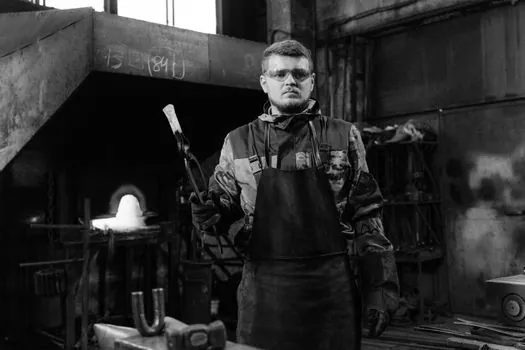
Manual furnace unloading is established practice for box furnaces used in quench hardening and tempering, making it appropriate where loads are small, recipes change frequently, or automation would spend most of its life waiting for a qualified program [S5].
These controls matter because manual adjustments without proper recordkeeping can cause process drift, while uncontrolled furnace hot spots can produce uneven hardness and distortion [S4].
The documented 50 lb case demonstrates that an automated cell can address both safety and transfer consistency, not merely cycle-time reduction [S2].
Integrate transfer control with furnace and quench capability
A fast transfer mechanism does not correct poor furnace uniformity or an unsuitable quench, so the transfer system must be engineered as one loop with the furnace, atmosphere, fixture, and quench. Heat-treatment furnace selection should account for target temperature, cycle time, production volume, material handling, and part-quality requirements rather than treating handling as an accessory [S3].
Continuous and conveyor furnaces suit repeatable flow, while batch furnaces suit varied part sizes, changing cycle times, and low-to-medium throughput. Their transfer requirements differ: a continuous line must coordinate line speed with discharge and quench entry, whereas a batch cell must coordinate the furnace door, carriage or basket, extraction device, and quench [S3][S5].
The operating window must be established by product trials. For high-strength steel gears, conventional trial-and-error across multi-parameter combinations can consume excess production time and material. A machine-learning study instead linked heat-treatment parameters to hardness, carburized-layer distribution, and microstructure, with the final model reporting 3.16% RMSE and 0.993 R² [S1].
Use those trials to determine whether a controlled transfer delay changes hardness, case depth, distortion, or residual stress. For gears, the more uniform the quench heat transfer, the more predictable the distortion, so transfer timing should be evaluated as a contributor to quench consistency rather than as an isolated handling metric [S8].
Protect the quench and verify the integrated cell
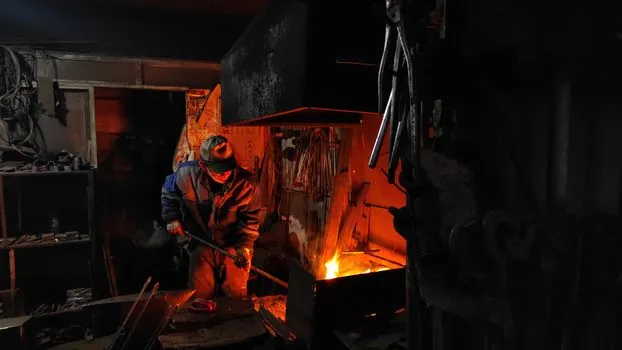
The quench arrangement determines how sensitive the process is to transfer timing. Direct immersion, press quenching, and fixture entry create different heat-transfer conditions, and the part-to-fixture interface must remain repeatable. In the automated aerospace cell, the major equipment included an infeed conveyor, robot, EOAT, furnace with atmosphere system, quench press, and exit equipment [S2].
Oil quenching requires loss-prevention controls under FM Data Sheet 7-41, which covers heat treating of metals by immersion or quenching in oil or other liquids. The relevant quench media, fire controls, handling arrangement, and facility protections must be reviewed together because a transfer mechanism changes where hot metal, oil, and operator access interact [S7].
Automate only after the process logic is defined. The cited aerospace system was required to meet AMS 2750, with capability for NADCAP certification, and single-piece flow was selected to support serialized-part data collection and report generation [S2]. The same sequence applies to other controlled specifications: qualify the furnace and quench, establish transfer timing, validate part performance, and then automate the movement.
For a comparison of furnace architectures and material flow, see the Batch vs Continuous Conveyor Furnace Selection Guide. The heat treatment furnace reference provides the broader equipment context, but the transfer-time requirement remains a separate control value that must be validated for each part and load.
Select and validate the operating method
Select manual handling for mixed, low-volume batch work when transfer timing can be measured and controlled; select mechanized handling for high-volume, repetitive, serialized, or safety-sensitive work where consistent transfer time and reduced operator exposure justify the integration effort [S2][S3][S5].
During commissioning, record at least 30 consecutive transfers for the production load and verify furnace exit temperature, transfer interval, quench-entry delay, part position, and post-quench results. Reject trials with changing geometry, overloaded fixtures, or inconsistent atmosphere conditions. A stable mean alone is not enough; the process capability must reflect the observed spread.
Two trackable acceptance signals are the transfer-time distribution from furnace discharge to quench entry and the change in hardness, case depth, distortion, or residual stress relative to the qualified manual process. Validate mechanized transfer against an established metallurgical baseline, and retain manual handling only when the measured process capability and business case justify the added operator exposure and variability [S1][S2][S8].