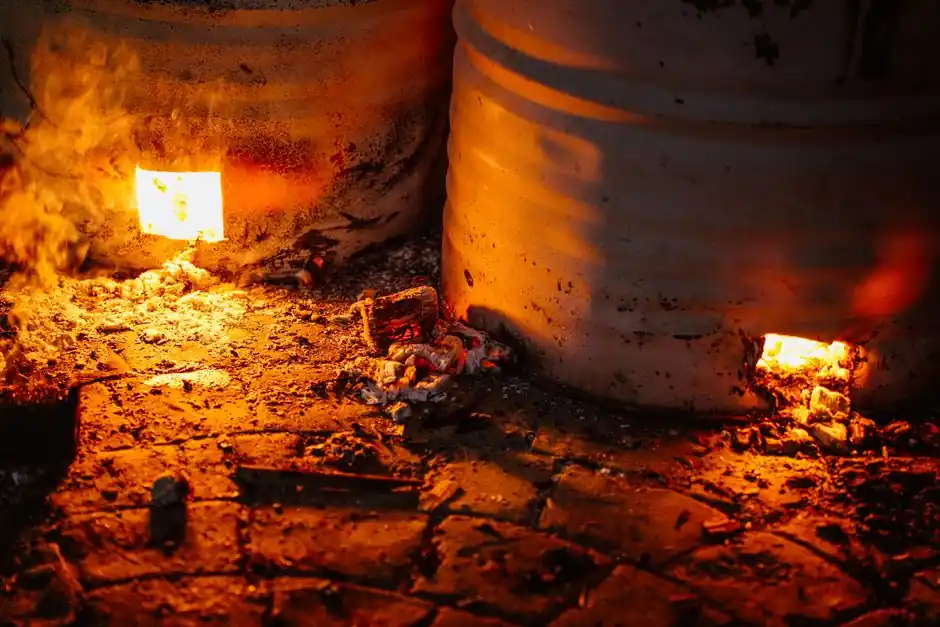
For the 8356 cast alloy process, the stated solution-treatment condition is 538°C for 6–12 hours [S1].
The equipment supports loads up to 1,000 lb, uses alloy-specific solution temperatures, and transfers material to a hot-water quench within 10 seconds [S1].
What Defines a Solution-Treatment Cycle
Solution treatment heats an alloy to a specified temperature, holds it long enough for the desired constituent to enter solid solution, and then applies rapid cooling to retain that condition [S3]. The resulting condition is supersaturated and unstable, so the material may subsequently age and harden [S3].
A complete cycle therefore includes heating from the starting temperature, soaking at the solution temperature, transferring the load, quenching, and unloading. Batch furnaces can also incorporate specialized heating rates, dwell times, or cooling profiles, which makes their cycle longer than a continuous line where material advances through a sequence of controlled zones [S2].
For planning purposes, separate the published 6–12-hour time at temperature from the full batch cycle. The 6–12-hour figure is not a universal total-cycle range, because ramp-up, load recovery, transfer, quench dwell, and cooling occupy additional time [S1][S2].
Reference Cycle Times by Processing Requirement
The documented aluminum system treats up to 1,000 lb per batch on a 54 × 54 in WIRCO tray with up to 54 in of load height [S1]. For the 8356 cast-alloy process, the stated condition is 538°C for 6–12 hours, while common wrought alloys use solution-treatment ranges from 870°F to 990°F [S1].
An IN 718 treatment described in March 2026 uses 955°C, followed by an eight-hour hold and then vacuum or rapid cooling toward 650°C [S6]. That example demonstrates why “solution treatment” alone is insufficient to define a cycle time: alloy, temperature, hold, cooling method, and downstream aging all affect the schedule [S6].
A sensible engineering estimate starts with the alloy specification and then adds the furnace’s verified heating and cooling profile.
Batch Furnace Capacity and Throughput
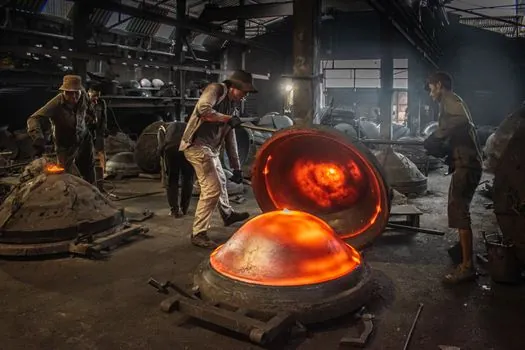
The reference furnace is an NFPA 86 Class B electric design with 144 kW of installed heat [S1].
At the documented 1,000 lb maximum batch weight, a 6-hour time-at-temperature basis corresponds to 6,000 lb-hours of nominal process exposure, while a 12-hour basis corresponds to 12,000 lb-hours. These are arithmetic capacity indicators, not guaranteed production rates, because ramp, quench, cooling, load arrangement, and maintenance remain outside the soak calculation.
Small batch furnaces are generally associated with nonproduction and low-volume work in the pound-per-hour range, whereas batch systems are also built in much larger capacities [S4]. Load size therefore changes the energy demand, recovery time, and practical cycle economics without changing the alloy-specific requirement for adequate solution time [S1][S4].
Heating and Quench Constraints
The system transfers the load to the hot-water quench within 10 seconds [S1].
The system uses a hot-water quench maintained within a 150–200°F range [S1].
The furnace and integrated quench are classified as an NFPA 86 Class B electric design [S1]. The rapid transfer is not an optional handling detail: solution treatment requires rapid cooling after the hold, and the 10-second maximum transfer window directly supports that metallurgical sequence [S1][S3].
Batch or Continuous Production
Batch treatment is appropriate for specialized or complex thermal cycles, mixed part sizes and geometries, multiple alloy grades, and production that requires controlled heating rates, dwell times, or cooling profiles [S2]. It suits low-volume, high-variation work where one load at a time is acceptable [S2][S4].
Continuous treatment is the stronger fit when stable volume, short repeated cycles, and continuous work handling outweigh the capital and process flexibility of a batch furnace. Batch systems require manual or semi-automated loading and unloading, heat the entire load from ambient temperature, and complete the full heating, soaking, and cooling sequence before reloading [S2].
In decision terms, batch furnaces win on cycle flexibility and mixed-product capability, while continuous furnaces win on repetitive flow and reduced heating of an empty furnace chamber between loads [S2]. For solution treatment, the final choice still depends on the alloy specification and the required quench response, not on batch or continuous format alone [S3].
Failure Modes and Cycle-Time Controls
Cycle-time overruns commonly begin with heat-up, not with the prescribed soak: a 144 kW electric furnace must recover the thermal mass of the furnace, tray, fixtures, and product before the load reaches its solution temperature [S1]. Poor loading can also affect part-to-part consistency through uneven spacing, geometry, or load arrangement [S2].
Transfer delay can invalidate the quench response, which is why the reference architecture uses a 10-second maximum transfer window and mechanized tray handling [S1]. The broader handling question is covered in Quench Transfer Time: Mechanized vs Manual Handling.
Load-size effects must also be checked against furnace capacity, rather than inferred from the soak specification alone. Heat Treatment Furnace Load Size and Cycle Time expands that relationship, including the impact of heavier loads on furnace selection and scheduling.
Specification Checklist for Cycle Planning
Require the alloy, product condition, solution temperature, minimum and maximum soak time, acceptable transfer window, quench-medium range, and required load geometry before assigning a cycle. The reference case identifies wrought alloys including 6061, 6063, 7075, and 2024, with solution temperatures from 870°F to 990°F, plus 8356 cast alloy at 538°C [S1].
Confirm whether aging is included. In the documented aluminum system, parts generally proceed to a separate aging process outside the solution-treatment and quench system [S1]. A quoted 6–12-hour solution hold should therefore not be presented as the full production lead time from incoming load to finished aged part.
Track two signals for each production batch: actual time at solution temperature against the approved minimum and maximum, and elapsed transfer time against the specified limit. In the reference equipment, those limits are a 6–12-hour soak range for 8356 cast alloy and no more than 10 seconds for transfer to the 150–200°F hot-water quench [S1].