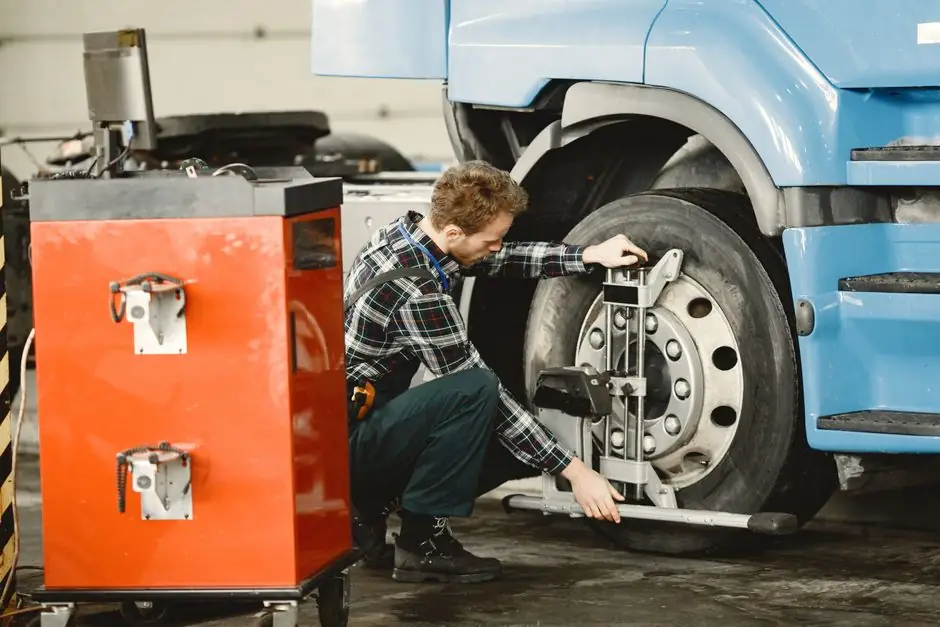
A reach truck may need a different tire from a counterbalance forklift because its chassis, wheel style, floor exposure, and load-support geometry differ.
The correct decision starts with the truck data plate, wheel construction, and duty cycle: smooth indoor floors, mixed outdoor routes, and debris-prone surfaces lead to different tire choices.
Tire selection starts with wheel construction
Press-on wheels and pneumatic-style rims are not interchangeable, so tire category must match the wheel before tread or compound is considered. Flat-base press-on wheels accept cushion rubber or polyurethane, while split-rim and lock-ring wheels accept pneumatic tube-type or resilient solid tires [S4].
That distinction matters more than the vehicle label. A tire selected by appearance can fail to mount correctly or create unsafe wheel-to-hub and clearance conditions. For replacement planning, use the data plate for the model and serial number, then verify the wheel arrangement and tire dimensions against the approved parts listing [S1].
Do not assume that a tire fitted to a counterbalance forklift will suit a reach truck. Counterbalance models have a broad selection of solid and pneumatic options on relevant configurations, while a reach truck remains tied to its own wheel, hub, chassis, and load-support design [S3].
Polyurethane press-on tires are listed as non-marking and electric-friendly.
Cushion rubber and polyurethane press-on tires are intended for smooth indoor floors, with polyurethane also identified as a low-rolling-resistance option for battery-powered fleets [S4]. Cushion tires are also described as an indoor tire option, while pneumatic and solid pneumatic tires are assigned to outdoor use in general forklift guidance [S1][S2].
Polyurethane press-on tires are listed as non-marking and electric-friendly. [S4].
For application context, a reach truck normally works in narrow aisles with forward support legs or outriggers, so tire diameter, width, wheel offset, and fork or leg clearance must be matched to that geometry [S3]. Tire category alone does not establish compatibility.
Outdoor and rough-floor choices change the operating trade-off

Mixed indoor and outdoor work points toward pneumatic tube-type or resilient solid tires, while debris-prone and rough conditions favor resilient solid construction because it is flat-proof [S4].
Most standard reach trucks are designed mainly for indoor warehousing and require reasonably smooth, level floors; specialized variants may serve other conditions [S3][S5]. A yard, dock, or outdoor transition should therefore be treated as a site-specific engineering question, not proof that the truck can use any pneumatic tire.
Reach trucks and counterbalances serve different duty cycles
A reach truck uses forward support legs or outriggers and extends its forks into racking, while a counterbalance forklift balances the load against a heavy rear counterweight [S3][S6]. These structures create different load paths, turning requirements, clearances, and stability conditions, which is why wheel and tire fitment must be truck-specific [S6].
The operating comparison is clear. Reach trucks suit narrow-aisle rack retrieval and higher stacking, with four described configurations including single-reach, double-reach, moving-mast, and multidirectional designs [S2]. Counterbalance trucks suit general handling, direct pallet pickup, loading and unloading, open areas, and mixed indoor or outdoor work [S3][S5].
Reach trucks are a type of forklift that can extend and retract their forks horizontally, and counterbalance forklifts use a counterweight to offset the load. A reach truck may not be the correct machine for a heavier outdoor duty cycle even if a pneumatic tire is available. Tire choice cannot correct a mismatch in load rating, mast geometry, or operating environment.
Compare the four tire options by operating criterion
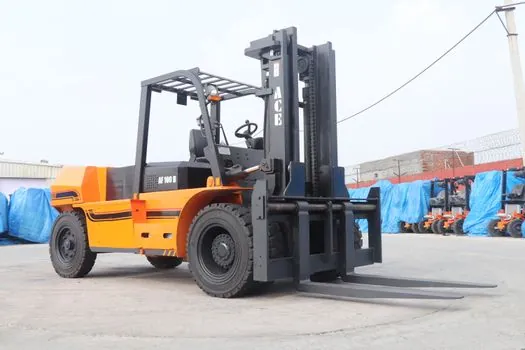
For smooth indoor floors, cushion rubber and polyurethane press-on tires are the leading options; for mixed routes, pneumatic tube-type and resilient solid tires fit the wheel family; for debris-prone work, resilient solid is the stated preference [S4].
Polyurethane press-on tires are the listed option for low rolling resistance and battery life, while pneumatic tube-type tires take the ride-comfort position [S4].
The decisive comparison is therefore not tire-to-tire in the abstract. Check wheel style first, then floor condition, then priority: ride comfort, flat-proof service, or rolling efficiency. The forklift tire buying guide lists the sequence as wheel style, operating surface, operating priority, and installation access, with all four tire families requiring a hydraulic press for installation [S4].
Match size, quantity, and truck configuration
Wheel style is only the first fitment check. Tire size must match the model-approved drive or steer wheel, and the replacement set must preserve the distinction between drive and steer positions. A purchase listing separates matched drive and steer sets from individual sizes and identifies two drive plus two steer tires as a four-tire set [S4].
For a three-wheel reach truck, wheel-count logic differs from a four-wheel counterbalance forklift because the load wheels, drive wheel, or steering arrangement depends on the reach-truck configuration. Multidirectional reach trucks can also have pivoting load wheels [S2]. This makes model and serial number verification more important, not less.
Do not copy a tire marking from the counterbalance truck. Press-on tire markings include the hub and overall dimensions, while pneumatic-style tires must also match the rim or split-ring arrangement [S4]. Confirm ride height, clearance, wheel retention method, load rating, and manufacturer-approved tire options before ordering.
When a different tire type is actually required
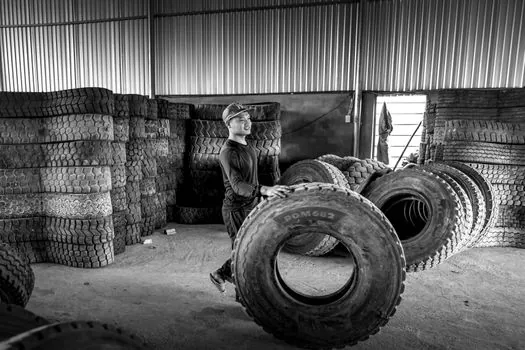
A different tire type is required when the reach truck operates outdoors, crosses rough or debris-covered surfaces, or needs pneumatic ride comfort, provided its approved wheel design supports that tire [S3][S4]. A different tire is also required if the existing wheel is flat-base press-on rather than pneumatic-style, because the two wheel families cannot be interchanged [S4].
A different tire type is not required simply because the vehicle is a reach truck. If the truck remains on smooth indoor floors and its approved wheel uses press-on construction, cushion rubber or polyurethane may be the correct fit. If the wheel accepts pneumatic-style rims, pneumatic tube-type or resilient solid options can be evaluated against the duty cycle [S4].
The field-of-use limit is equally important. Counterbalance trucks can work indoors and outdoors, while reach trucks are mainly associated with indoor warehouses [S5]. A mixed fleet can therefore use a counterbalance forklift for yard and dock work while reserving smooth-floor tires for reach trucks, rather than forcing one tire specification across both classes.
The next trackable check is the truck data plate: record model, serial number, wheel construction, tire size, drive and steer positions, operating floor, and required load height, then obtain the manufacturer-approved tire option before purchase.