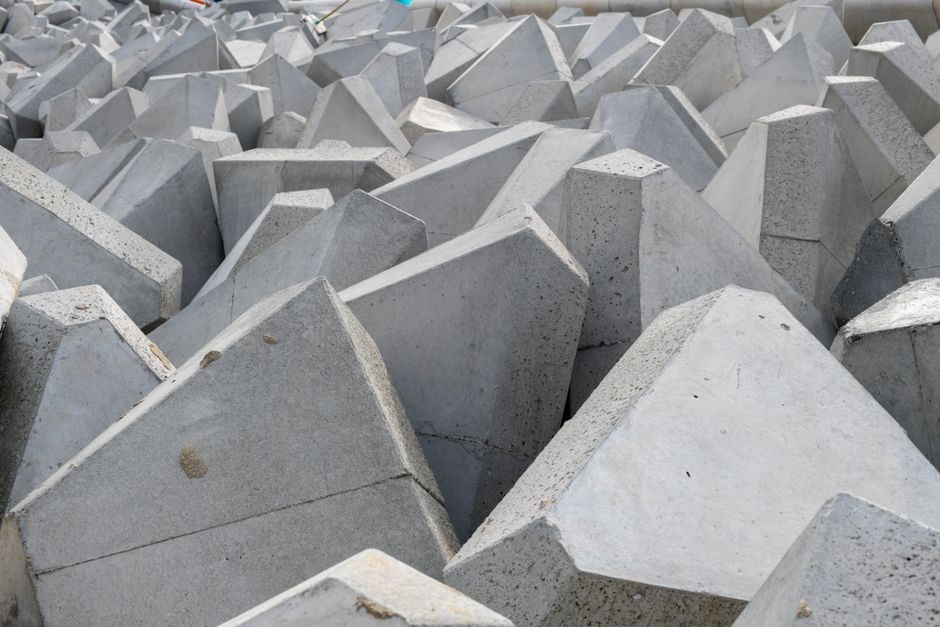
Ready-mix concrete is a factory-batched fresh concrete delivered to site in a truck-mixer, produced to a published mix design and discharged within roughly 90 minutes of water addition, distinguishing it from site-mixed or pre-cast concrete [S1]. The category covers everything from C20/25 residential slabs to C50/60+ structural columns, with Irish and EU certification now anchored on I.S. EN 206-1:2013 for specification, performance, production and conformity [S6].
Three delivery formats dominate the market: transit-mixed (dry-batched, mixed in the drum), central-mixed (fully mixed at plant then agitated in transit) and shrink-mixed (partially mixed at plant before truck-mixer finishing). For specifiers the difference is control of mix consistency and haul-time tolerance, and it is the first branching point on most mix-selection forms.
Plant Classes: How Suppliers Actually Bucket the Product
Plants fall into three practical tiers, each with different output, lab and QC capacity. A Type A central-mix plant typically runs a pan or planetary mixer with rated outputs above 100 m³/h and holds [S6] EN 206-1 third-party certification; this is the only class that NSAI certifies for accredited product conformity in Ireland [S6].
Type B dry-batch plants weigh cement, water and admixtures at the truck and mix in the drum on-route; outputs of 60–80 m³/h are common and mix tolerance widens with haul distance over 45 minutes. Type C volumetric or mobile batchers carry separate bins of sand, stone, cement and water and dose them by volume on site — useful for short loads, rural drives or when the pour is intermittent, though published mix designs are harder to verify [S1].
The selection logic is simple: for commercial and municipal pours over roughly 8 m³ on a single ticket in a metro area, Type A with EN 206-1 certification is the default in Ireland and the UK [S6]. Outside that envelope, the same suppliers run Type B for routine residential work and Type C for remote or odd-hour pours, as confirmed by supplier offerings in Maine, Ontario, Kansas, Texas and Missouri [S3][S4][S5].
Strength and Exposure Grades Under EN 206
Compressive strength is the headline property and is the first field on any batch ticket. Standard cylinder grades run C16/20, C20/25, C25/30, C30/37, C35/45, C40/50, C45/55, C50/60, where the second number is the 150 mm cube strength in MPa and the first is the 150×300 mm cylinder value. Residential slabs and driveways usually sit at C20/25 or C25/30, commercial decks and columns at C30/37–C35/45, and high-rise columns or bridge piers at C40/50 and above [S6].
Exposure classes (XC, XD, XS, XF, XA) drive the water/cement ratio and cover requirements; a typical XD2 car-park deck specifies C30/37 with max w/c 0.50, while a XS3 marine pile-cap pushes to C35/45 with max w/c 0.45 and often 50+ mm cover. These limits are encoded in the EN 206-1 conformity tables that the plant must keep on file for every mix design shipped [S6].
Consistence is the second gate, classed S1 (10–40 mm slump) through S5 (≥ 220 mm), with F-class for self-compacting mixes. A pumped slab on a 40 m boom is usually S3–S4 (100–210 mm), while a strip footing placed directly from chute is often S2. Admixture selection — plasticisers for S3, superplasticisers for S4/S5 — is the lever that gets you there without raising w/c and losing strength, and is documented in the batch ticket [S6].
Three Mix Categories by Constituents
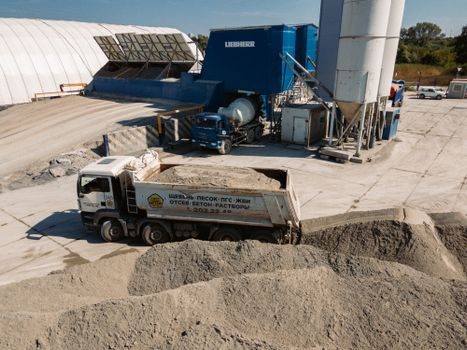
Beyond strength, ready-mix is split by mix design intent. Standard mixes (sometimes called "N" mixes in the UK) carry ordinary Portland cement (CEM I 42.5 N or 52.5 N) and 20 mm coarse aggregate, with a 28-day target strength; these make up the bulk of commercial delivery tonnage and are stocked at most plants in C20/25, C25/30, C30/37 grades [S6].
Specialist mixes cover the second tier: high-strength (C40/50 and above with silica fume or GGBS replacement), self-compacting (SCC, F-class consistence with viscosity modifier and high paste volume), fibre-reinforced (steel or macro-synthetic fibre at 20–40 kg/m³ replacing rebar in slabs), and lightweight (structural LWAC at 1,400–1,800 kg/m³ using expanded clay or slate aggregate). Each of these ties into specific applications: SCC for congested rebar in columns, fibre-reinforced for ground-supported slabs, lightweight for floor toppings and bridge decks [S6].
Architectural and coloured mixes are the third tier, used for polished floors, paving and facades. Pigment dosage is typically 2–6% of cement weight for integral colour, and these batches command a premium of roughly 10–20% over standard C30/37 because of tighter QC and slower turnaround at the plant. Sand gradation, alkali content and cement colour consistency become critical lot-level tests [S3].
Admixture and Cement Choice: The Levers Inside the Ticket
Almost every modern ready-mix ticket includes an concrete admixture package, because plain CEM I mixes can no longer hit EN 206-1 strength and consistence targets at modern w/c ratios.
Cement type is the second lever. CEM I gives the highest early strength; CEM II/A-S or CEM II/A-L (with limestone or slag) at 6–20% replacement is now the default for general use; CEM III/A and III/B with 36–80% GGBS gives low heat-of-hydration and is specified for mass pours; SR cement (sulphate-resisting, typically CEM I-SR 3) is required where XD3, XS3 or XA exposure classes apply [S6].
For slabs-on-grade the right concrete fibre choice (polypropylene micro-fibre at 0.9 kg/m³ for plastic-shrinkage control, or macro-synthetic at 4–7 kg/m³ for structural slab replacement) lets the specifier drop the rebar mesh in thinner ground-supported slabs. A standard residential fibre-reinforced slab is often C28/35 S3 with 5 kg/m³ macro-synthetic, going down at 125–150 mm thickness [S6].
Delivery Logistics: The 90-Minute Rule and Slump Loss
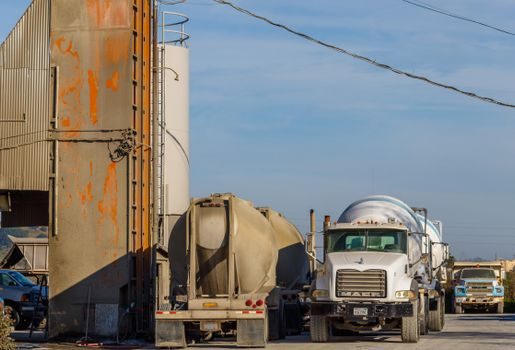
Ready-mix concrete starts losing workability the moment water touches cement. Standard practice — and the limit embedded in most EN 206-1 conformity schemes — is to discharge within 90 minutes of batching, or 45 minutes in hot weather above roughly 25 °C, with retempering at site generally not permitted because it changes the w/c ratio and breaks the certified mix design [S6].
This is why suppliers break their catchment into 30–45 minute haul rings from each plant, and why a concrete batching plant is rated in m³/h of mixer output rather than truck count — a 90 m³/h plant with 8 m³ truck-mixers needs 12+ trucks running in rotation to keep a continuous pour supplied. Plant certification audits (NSAI in Ireland, QSRMC in the UK, NRMCA in North America) all check the haul-time plan against the mix-design workability window [S6].
Placing equipment is matched to delivery rate. A boom pump at 80–140 m³/h needs a steady feed; a line pump at 25–40 m³/h is more forgiving and a better match for a C20/25 strip-footing pour. The pour rate is also why a concrete vibrator selection of 50 mm poker for 200 mm slabs and 75–100 mm pokers for 400+ mm columns is standard, with insertion spacing of roughly 8–10× the poker diameter and 5–15 seconds per insertion [S6].
Curing and Surface Treatment: The Hidden Half of Strength
Specifying C30/37 on the ticket only delivers that 28-day strength if curing is correct. EN 13670 execution standard requires a defined curing regime matched to the exposure class, and the supplier's data sheet must travel with the pour [S6].
Three regimes are common. Water curing (ponding, wet hessian or sprinkler) for 3–7 days is the cheapest and gives the best strength gain; membrane curing using a concrete curing compound sprayed at 0.2–0.3 L/m² gives a sealed surface for slabs where water-curing is impractical; steam curing is reserved for pre-cast elements and accelerates 28-day strength gain to roughly 24 hours. Temperature matters: below 5 °C the hydration rate halves for every 10 °C drop, and pours are typically suspended below freezing unless accelerator and heated enclosures are specified [S6].
The ready-mix concrete batching plant ticket records mix ID, batch time, water added, slump target, ambient temperature and the delivery truck — all of which are inputs to the EN 13670 conformity record. A QA reviewer can back-trace any cylinder break failure to a specific batch and haul, which is why the ticket is the legal artefact, not the invoice [S6].
Selecting the Right Mix: A Short Comparison

For a specifier, the practical choice is between three envelopes. Standard C25/30 S3 XC2 is the default for foundations, ground beams and internal slabs where no aggressive exposure applies, at the lowest cost per m³ and the shortest lead time (typically 24–48 hours from order to pour) [S6].
C30/37 S3 XC4–XD2 with a 0.50 max w/c covers most external and parking structures; it requires a 14–21 day lead time for the mix-design trial and adds roughly 5–10% in cost. C40/50 S4 XD3/SR is the structural-pile or high-traffic envelope, requiring silica-fume or GGBS additions, target trial mix records and 28+ day lead time, with a 15–25% cost premium over C25/30 [S6].
Site constraints stack on top: a remote pour more than 60 minutes from the plant rules out Type A unless retarder is dosed; a winter pour below 5 °C needs accelerator and heated water; a polished floor needs tight colour and slump control with on-site QC access. For more on how EN 206-1 is implemented in practice — and how regional suppliers in Maine, Ontario, Kansas, Texas and Missouri each tier their offerings — see our coverage of chain conveyor selection duty envelopes and the gasket sourcing cost map for adjacent industrial procurement logic.
The next node to watch is the I.S. EN 206 revision cycle that will fold the lower-carbon CEM II/LL and CEM III cement designations into the same conformity framework, and the growing default use of macro-synthetic fibre over rebar in ground-supported slabs — both are pushing plant-side mix libraries wider and shortening the lead-time advantage of standard C25/30 over higher-grade mixes. Track the NSAI certified-mix register and the EN 13670 curing annex as the next verifiable signals.