
Respirator installation is governed by hazard class, oxygen floor, and component certification, not by brand preference. 42 CFR Part 84 Subpart J lists six supplied-air types (A, AE, B, BE, C, CE), each with a defined air source and facepiece combination [S1].
Before any respirator is mounted, hung, or donned, two preconditions are non-negotiable: ambient O2 above 19.5% for air-purifying configurations, and a Grade D breathing-air certificate for supplied-air lines [S2]. The full installation envelope, from tank-vent sterile filters to Type C airline couplings, follows directly from those two floors.
Know Your Type: A, B, C and Their E Variants
42 CFR Part 84 §84.130 defines Type A as a hose-mask respirator with a motor-driven or hand-operated blower plus a large-diameter low-resistance hose and tight-fitting facepiece; Type B removes the blower so the user pulls air through the hose by lung effort alone; Type C is the airline respirator with a detachable coupling, control valve, demand or pressure-demand valve, and facepiece/hood/helmet [S1]. Each baseline type has an "E" variant that adds head/neck impact shielding and window guards for abrasive rebound environments, with shield material limited to plastic, glass, woven wire, sheet metal, or similar that does not unduly obstruct vision [S1]. Selection logic: blower-assisted A/AE for long hose runs where lung-only draw would exceed 25–50 m practical limits; B/BE for short, intermittent, low-resistance entries; C/CE for plant airline distribution with demand or pressure-demand valves.
§84.131 then locks in the required component list, which applies whenever the design requires it: facepiece/hood/helmet, air supply valve or demand/pressure-demand regulator, hand or motor-driven blower, air supply hose, detachable couplings, flexible breathing tube, and respirator harness [S1]. Every component must additionally meet the minimum construction requirements of subpart G, so a compliant respirator is a chain of certified parts, not a single approved assembly [S1].
Breathing Tube, Harness, and the Subpart G Floor
§84.132 imposes functional requirements on the flexible breathing tube, including the design intent to prevent restriction of airflow, kinking, and collapse under suction; the excerpt available confirms the section's existence and topic but the full clause text was truncated in the public source [S1]. In practice this means crush-resistant hose, smooth-bore interiors, and a minimum bend radius published by the manufacturer; any tube that visibly kinks at the rated vacuum fails inspection. The harness must support the hose, the facepiece, and any attached lifeline without routing load through the wearer's neck, which is why Subpart J explicitly couples harness attachment to the hose and lifeline as a unit [S1].
For tank-side sterile-grade installations the equivalent "hose" is the cartridge-vent line, where the GS-HX series specifies a hydrophobic PTFE membrane at 0.2 µm filtration accuracy with 100% integrity testing of every cartridge before shipment [S3]. The shell material is 304 stainless for general water service and 316L for sanitary or corrosive service, and the housing is internal/external polished, acid-washed, and passivated to meet GMP sanitary requirements [S3]. A polypropylene element is explicitly called out by the manufacturer as a poor safety choice for tank respirators because it is only weakly hydrophobic; natural hydrophobic PTFE is the recommended media [S3].
Selection Table: Cartridge Count, Connection, and Dimensions

The published GS-HX selection table lets buyers size the cartridge stack to the tank vent duty rather than guess [S3].
Model, cartridge length, cartridge quantity, connection, and envelope dimensions (D × H × h, mm): GS-HX-WP-0501 / HP-0501, 5", 1 cartridge, Quick Release or Flange, 85 × 220 × 50, DN25; GS-HX-WP-1001 / HP-1001, 10", 1 cartridge, 85 × 350 × 50, DN40; GS-HX-WP-1003 / HP-1003, 10", 3 cartridges, 184 × 465 × 80, DN50 [S3]. The "WP" and "HP" suffixes distinguish the sanitary quick-release configuration from the flanged process connection, and the 3-cartridge stack roughly triples the flow area of the single 10" unit, which is the right lever when tank fill/draw rates would otherwise pull a single cartridge into a vacuum-collapse ("sucked flat") condition [S3].
Pre-Installation Acceptance: Oxygen, Air Quality, and Mounting
Three checks gate the actual mount. First, measure ambient O2 at the work position; air-purifying respirator packages from rental suppliers are explicitly rated for environments where O2 concentration is greater than 19.5%, with no exception for "temporary" or "well-ventilated" sites [S2]. Second, confirm the breathing-air carrier holds a current certificate, because supplied-air systems depend on Grade D or equivalent breathable air and the certificate is what links the hose to that air quality [S2]. Third, inspect the mounting surface: for tank respirators the manufacturer warns that a thin or under-supported cartridge can deform under tank vacuum, so the recommendation is to increase the frequency of in-process spot checks on cartridge integrity rather than rely on a fixed service interval [S3].
For supplied-air respirators the additional gates are facepiece fit-testing (qualitative or quantitative, against the actual facepiece to be worn), hose continuity from coupling to blower or airline, and a demand/pressure-demand valve function test at the start of every shift. A respirator that passes the §84.130 type definition but fails any §84.131 component is not a compliant respirator, regardless of brand [S1].
Failure Modes and When to Replace, Not Repair
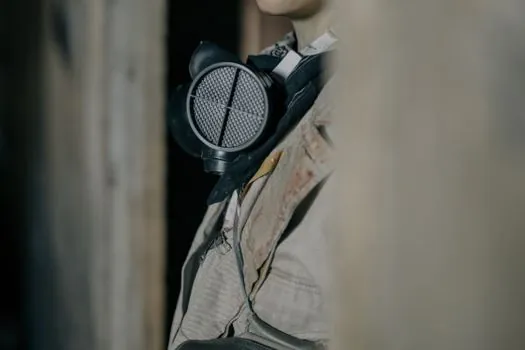
The two recurring failure modes for tank respirators are vacuum collapse of the cartridge and media wet-out. Vacuum collapse occurs when inflow/outflow imbalance during pump-out or thermal cooling pulls the cartridge flat; the corrective action is to upsize the cartridge count (1 × 10" to 3 × 10" in the GS-HX family) or to add a vacuum-relief path, not to drill the housing [S3]. Media wet-out occurs when condensate or carryover liquid wets a hydrophilic element and blocks gas exchange; the corrective action is to specify natural hydrophobic PTFE and to verify the upstream line is dry, with polypropylene rejected for this duty [S3].
For supplied-air systems the equivalent failure modes are demand-valve sticking (replace the valve, do not lubricate with unapproved oils), hose coupling wear (replace the detachable coupling, do not tape it), and facepiece seal degradation on aging silicone (replace the facepiece; Subpart G construction requirements are not field-repairable in the field). A respirator that has been impact-loaded, dropped from height, or exposed to a contaminant that the cartridge was not rated for must be removed from service and either decontaminated to a documented procedure or scrapped.
Standards, Sourcing, and Cross-References
The governing regulation for U.S. supplied-air respirator design and component requirements is 42 CFR Part 84 Subpart J, with construction minima traced to Subpart G of the same part [S1]. For sterile-grade tank vents the relevant manufacturer datasheet is the GS-HX series with its 0.2 µm hydrophobic PTFE membrane, 304/316L shell options, and 100% factory integrity test [S3]. The 19.5% oxygen floor and Grade D breathing-air certificate are baseline acceptance criteria repeated across rental and installation documentation for air-purifying and supplied-air packages [S2]. For broader plant PPE context the safety glasses selection guide 2026 covers eye-side markings and lens spec, and the explosion-proof electrical selection guide addresses zone-rated hardware that often sits next to a respirator mounting on a solvent or pharma skid. A general respirator specification reference consolidates type, filter class, and fit-test terminology for cross-team review.
Two trackable signals to watch on the next review cycle: confirmation that the 42 CFR Part 84 Subpart J breathing-tube clause (§84.132) has been re-read in full, since the public excerpt was truncated, and an updated spot-check frequency on tank-respirator cartridges following any change in fill/draw rate or product viscosity, since the manufacturer ties that frequency directly to vacuum-collapse risk [S1][S3].
Spec-level background on the components involved: linear guide, and crossed roller guide.