A ring saw reaches a maximum cutting depth of 270–325 mm, while a typical cut-off saw cuts about 100–150 mm depending on blade size [S1][S2].
The difference comes from the drive arrangement: a ring saw drives a diamond-tipped cutting band from its outer edge, whereas a cut-off saw mounts a diamond blade on the center arbor [S2][S4].
Maximum depth: 270–325 mm versus 100–150 mm
For a one-sided cut through a standard concrete wall, specify a ring saw when the member is thicker than the cut-off saw’s 100–150 mm practical depth range [S1][S2].
Husqvarna lists the K 970 as a petrol ring saw with 6.5 hp output power [S1].
These model-level ratings establish the practical comparison more reliably than treating “10 inches” as an exact limit for every ring saw [S1][S2].
Why the ring saw reaches farther in one pass
Its peripheral drive gives the blade a usable cutting section beyond the central arbor arrangement of a conventional saw [S1][S2].
A conventional cut-off saw commonly uses 12-inch or 14-inch blades and reaches about 4–6 inches, or 100–150 mm, depending on blade size [S2]. At those diameters, the manufacturer-rated cutting depth leaves limited reach compared with a 14-inch or 17-inch ring-saw system [S1][S2].
Depth alone does not determine the best tool. A ring saw is suited to deep, straight cuts, but a concrete chainsaw can plunge into a wall and produce sharp corners that a round ring-saw blade cannot form cleanly [S5].
Selection criteria: depth, access, material and cut geometry

A ring saw is the stronger choice when the required cut exceeds 150 mm, access is limited, or overcutting through the far face would create repair work [S2][S5].
A cut-off saw is the better choice for slabs, pavers, block, asphalt and general masonry work, especially where the cut is shallow and the machine can travel beyond the slab edge [S2]. Its portability and simpler operating arrangement also make it the usual first saw purchased for routine site work [S2].
Blade selection remains material-specific. Hard concrete, abrasive block, reinforced concrete and masonry affect blade wear differently, while an incorrect blade can increase heat, slow cutting and accelerate wear [S5]. Husqvarna offers three diamond-blade performance levels: Elite-Cut for demanding work, Vari-Cut for professional general use and Tacti-Cut for occasional cutting [S1].
Ring saw or cut-off saw for each site task
Choose a ring saw for a 225–300 mm concrete wall, a concrete pipe in a narrow trench, or a door and window opening that must be cut from one side [S1][S2].
Choose a cut-off saw for a 100–150 mm slab or paver, asphalt paving, brick, block and routine hardscape installation [S2]. If the cut-off saw cannot reach the full thickness in one pass, the job may require extra passes, cutting from both sides, or a move to a deeper-cutting machine [S5].
Contractors commonly operate both tools because they cover different classes of work. A cut-off saw handles frequent shallow cuts, while a ring saw is reserved for deeper or specialized operations such as structural openings and pipe trenches [S2]. For detailed openings requiring square corners, a concrete chainsaw is more suitable than either a ring saw or a cut-off saw [S5].
Reinforcement, pipes and wall openings

Reinforced concrete demands a blade appropriate to the aggregate and reinforcement condition, and water flow is needed to cool the cutting band and suppress dust [S1][S5]. Husqvarna’s ring saws use an integrated low-pressure wet-cutting system designed to bind dust without creating excess slurry [S1].
Concrete pipe is a documented ring-saw application, including pipe positioned in narrow trenches where a pipe-cutting clamp can improve precision [S1]. Door openings, window openings and ventilation openings are also listed as ring-saw uses [S1][S2].
This example is useful because the wall thickness falls above a typical 4–6-inch cut-off-saw range [S2][S3].
Operating limits and failure modes
Excessive feed pressure is a concrete failure mode for both machine types: forcing a ring saw can shorten blade life and add stress to the machine, while unsuitable abrasive wheels can shatter if their speed rating or intended material does not match the saw [S4][S5].
For pavement cutting, the saw must be equipped with approved abrasive blades, and subcontractors must follow all manufacturer recommendations, warnings, and safeguards [S4].
Site rules may restrict these machines further. American Water’s written requirements prohibit cut-off and ring saws for cutting pipe at its worksites and prohibit diamond-tipped blades in cut-off-saw applications, requiring approved abrasive blades instead [S4].
For pavement cutting, the saw must be properly mounted in a cart approved by the manufacturer and designed specifically for the saw model in use, and hands-free use of cut-off saws or ring saws is prohibited [S4]. Operators must also receive training and follow manufacturer warnings, safeguards and applicable federal, state and local health and safety rules [S4].
Blade and accessory constraints
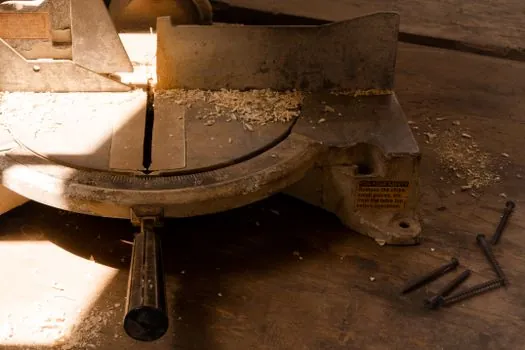
The cutting element determines both saw compatibility and material performance: cut-off saws use rotating wheels or blades, while ring saws use a diamond-tipped circular band driven around the machine [S2][S4]. The distinction is central to the depth difference and to blade selection.
For cut-off saws, approved abrasive blades must carry a rating at least equal to the machine’s operating speed [S4]. Selecting a wheel for the wrong material can cause fracture, while selecting the wrong blade for concrete or masonry can increase heat and wear [S4][S5].
Blade diameter is not the sole predictor of usable depth. The listed Husqvarna configurations pair 14-inch blades with 10.6-inch depth and 17-inch blades with 12.8-inch depth, illustrating how drive geometry and machine design govern reach beyond the nominal blade diameter [S1]. Further guidance on diamond versus abrasive blades for masonry cutting is directly relevant when selecting compatible cutting elements.
Specification checklist for deep concrete cuts
Measure the member thickness first, then compare it with the machine’s rated cutting depth, not the blade diameter alone; the cited ring-saw models span 269–325 mm, while common cut-off saws reach about 100–150 mm [S1][S2].
For a cut between 150 mm and 269 mm, a ring saw is the relevant candidate if access permits one-sided operation. Above 325 mm, the cited Husqvarna model range does not cover the task, so a rail power cutter or another purpose-designed system would need separate evaluation [S1].
For procurement, record the required depth, material, reinforcement condition, cut geometry, access clearance, power source, blade diameter, water supply and site-specific restrictions before accepting the machine. The cut-off saw reference covers the disc-driven format, while the ring saw entry provides the broader powered-cutting context.
The next trackable signal is the measured member thickness against the selected saw’s published maximum depth and the required blade specification. A depth claim is only useful when it is tied to a specific machine configuration and a cut that can physically reach the far face.