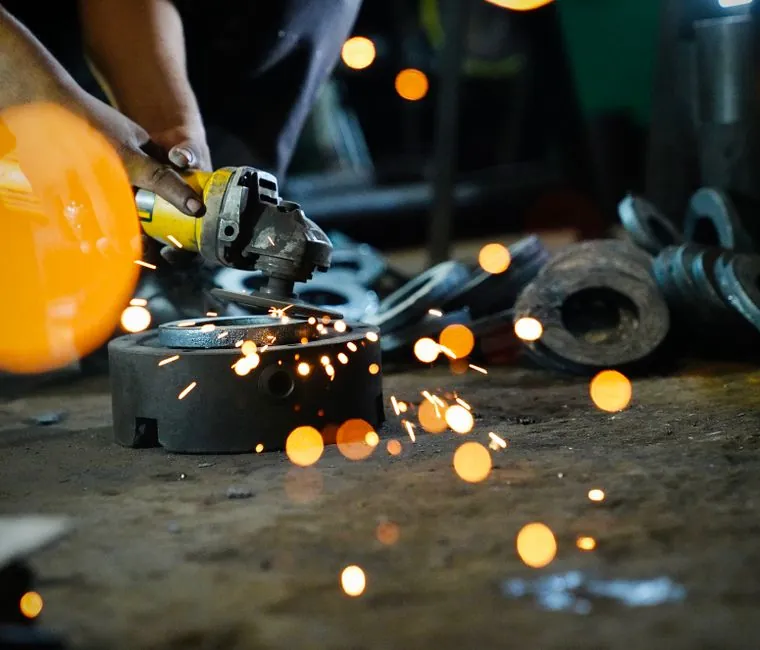
A diamond blade's lifespan is reported as 50–100 times higher than an abrasive disc's, while its stable diameter means cutting depth does not decrease [S7].
A 4.5-inch or 7-inch abrasive cutoff wheel suits steel and thin material, but a purpose-matched diamond blade is faster, cleaner, and more economical for concrete, brick, block, stone, tile, and asphalt [S1][S2].
Decision matrix: cost, service life, cut quality, and dust
Compare the two wheel types across four decision criteria. Initial cost favors the abrasive wheel, while service life, dimensional consistency, dust control, and total cutting cost favor the diamond blade. [S1]
How each wheel removes masonry
A diamond blade cuts masonry by grinding with synthetic diamond crystals bonded into a metal matrix, whereas an abrasive wheel removes material through friction and wears away while exposing new grains [S1].
This mechanism explains the operating difference. Diamond blades come in segmented, turbo, and continuous-rim designs and can be used wet or dry where the blade design permits [S1]. Abrasive cutoff wheels are generally thinner, use bonded abrasive fibers or grains, and discard worn material as fresh abrasive becomes exposed [S1][S2].
For a clean 90-degree cut through metal pipe, rod, or sheet, an abrasive cutoff wheel remains a practical choice because it cuts quickly and costs less per wheel [S2]. The same property is a liability in brick, block, or concrete because abrasive grains wear down while the workpiece remains hard and abrasive.
Where each wheel belongs
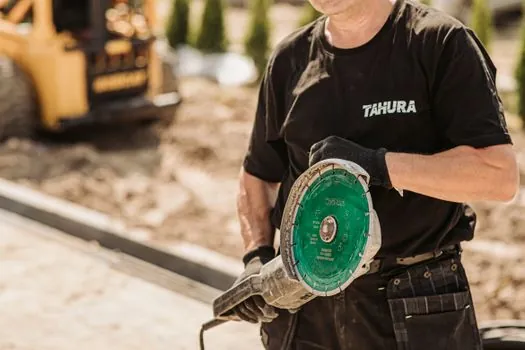
Choose an abrasive cutoff wheel for steel, iron, and other metals, especially thin pipe, rod, sheet, and short fabrication cuts [S1][S2]. Zirconia wheels are identified as a fast, cost-effective option for steel and iron [S2].
Choose a diamond blade for concrete, asphalt, stone, tile, brick, and masonry [S1]. Specialized diamond blades can also be selected for steel or rebar, but blade grade and reinforcement-contact suitability must be checked before use [S1].
The operating distinction is not simply “diamond for hard material.” A diamond blade that is inappropriate for the masonry, such as an asphalt blade used in concrete, can wear poorly. Match the blade designation to the material class, then choose wet or dry operation from the blade and saw instructions.
Life, wear, and operating cost
Abrasive wheels have a low entry price but a poor cost per cut in sustained masonry work because their diameter declines with use [S2][S3]. One concrete-saw discussion estimates a diamond blade may last more than 20 times an abrasive blade [S3], while a separate comparison places abrasive blades at about US$8 and diamond blades at about US$150 [S4].
Those prices illustrate why purchase price alone is misleading. If four abrasive wheels failed, the replacement cost would remain below US$32 at that historical price point, but the user would also incur additional downtime, dust, and handling of partially worn wheels [S4]. A US$150 diamond blade becomes the cheaper option if it replaces enough abrasive wheels to justify the difference, although actual economics depend on cut length, abrasive hardness, machine power, and duty cycle.
Published life claims vary from more than 20 times to 50–100 times and up to 100 times the service life of an abrasive wheel [S1][S3][S7]. Treat these as comparative guidance rather than a guaranteed replacement count. Abrasive hardness, concrete aggregate, reinforcement, water use, and cutting pressure can move blade life materially.
Dust, cooling, and cut consistency
Wet cutting controls dust and cools the diamond blade, supporting cleaner work and longer blade life [S1][S3].
Diamond blades also maintain a more stable cutting diameter, preventing the effective depth of cut from declining as an abrasive wheel wears [S7]. That consistency matters when making a pass, scoring a paver, or establishing a fixed line. Abrasive wheels can make a quick initial cut, but their changing diameter and dulling edge reduce consistency as the wheel wears [S1][S2].
Water is not a universal instruction for every abrasive wheel. One field account indicates that abrasive cutting did not require coolant and that coolant might not be recommended for that application [S3]. Follow the wheel and machine instructions, and never assume that a wet-cutting instruction for one wheel applies to another product.
Selection method for a masonry job
Second, check machine compatibility. The relevant equipment may be an angle grinder, circular saw, or cut-off machine, and the wheel diameter, bore, thickness, and maximum RPM must match the machine. Diamond blades require correct RPM matching [S1].
Third, calculate wear cost rather than comparing the ticket price. Enter abrasive wheel cost times the expected number of wheels consumed, then add replacement time. Compare that result with the diamond blade price divided by its expected number of cuts. For isolated cuts, an abrasive wheel may be rational; for repeated masonry work, the blade that retains its diameter usually wins.
Safety limits and failure modes
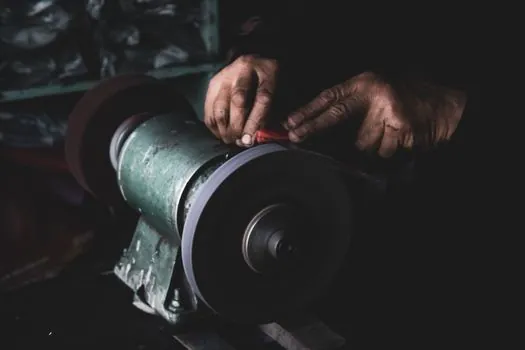
The main abrasive-wheel failure mode is gradual wear, while the main diamond-blade failure mode is segment loss, glazing, cracking, or improper rotation [S1][S3]. A 7¼-inch or 14-inch diamond blade is direction-sensitive in the cited field experience, and reversing a diamond blade once was reported to lose about half its diamonds [S3].
Do not infer that a diamond blade is suitable for every masonry task. Abrasive wheels are specifically presented for metal and thin materials [S1], while specialized diamond blades are needed for steel and rebar [S1]. Match reinforcement capacity to the blade grade, keep the wheel below its marked RPM, and use the guard and operating method specified for the machine.
Before starting, inspect the wheel for cracks, missing segments, glazing, edge damage, and correct bore. Confirm that the blade designation matches concrete, asphalt, stone, tile, brick, or metal as applicable. For continuous or deep cuts, stabilize the machine and use controlled feed pressure rather than forcing the wheel.
Track cost per linear metre, blade changes, cut duration, dust level, and edge quality during the first production setup. Replace the selection if abrasive wheels are being consumed faster than planned, the cut becomes slower as diameter declines, or a diamond blade repeatedly loses segments.