
Ringlock (also marketed as Ringscaff / ring-lock) is a modular rosette-node scaffold built from 48.3 mm OD × 3.25 mm wall verticals in Q235 or Q345 steel, hot-dip galvanized, with aluminium-channel planks at 2070/2570/3070 × 610 mm — the geometry the buyer has to lock down before quoting [S1][S2].
Across Chinese OEM catalogues active in the past 60 days, the system is consistently described as a multi-purpose modular scaffold for shipbuilding, ship repair, offshore, stage and general building-and-construction access, supplied in the M48 and M60 vertical series with surface treatment options of painted, hot-dip galvanized, electro-galvanized and powder coat [S1][S4][S5].
Tube, Steel Grade and Rosette Geometry
The de-facto tube geometry in the standard (vertical) is 48.3 mm OD × 3.25 mm wall, offered in 500/1000/1500/2000/2500/3000 mm cut lengths, hot-dip galvanized (HDG) or painted, with IS09001 quality control on the supplier side [S1].
Raw material is Q235 for general verticals and Q345 where higher leg loads are expected, and the rosette (ring) is what gives the system its name — installed at set intervals along the standard so the same node accepts up to four ledgers and four diagonals from multiple angles, which is the mechanical reason Ringlock replaces Cuplock or tube-and-clamp on most refinery and shipyard access jobs [S1][S4].
One Chinese-OEM portfolio even offers the system in two flange sizes — M48 (48.3 mm) and M60 — so a buyer can upsize the verticals for heavy industrial platforms while keeping the same rosette logic and clamp family [S4].
Ledge, Diagonal Brace and Plank Specifications
Ledgers (horizontals) use the same 48.3 × 3.25 mm tube in 1000/1770/2000 mm effective lengths, and the diagonal-brace range published by one CNBM-affiliated OEM covers 650 to 3072 mm bay sizes with 2 m lifts, with brace weight climbing from 6.90 kg at 610 × 2000 mm to 10.95 kg at 3072 × 2000 mm — useful as a quick tonnage estimator for site logistics [S1][S2].
Plank options split cleanly into two families: hot-dip galvanized steel planks in 2050 × 480 × 45 mm or 3000 × 240 × 45 mm profiles (used where fire resistance and impact duty matter), and aluminium-channel planks at 2070/2570/3070 × 610 mm with a 300 kg per-plank working load, finished by aluminium oxidation with a tube/u-profile hook for the ringlock transom [S1][S2].
Base hardware is a hollow-head jack or jack base, 600 mm long × 38 mm tube on a 150 × 120 × 50 × 4 mm or 150 × 150 × 4 mm base plate, HDG finish — the part that actually carries the load into the ground and the one inspectors flag first on an erected scaffold [S1].
Decision Criteria: Steel vs Aluminium Planks, Painted vs HDG
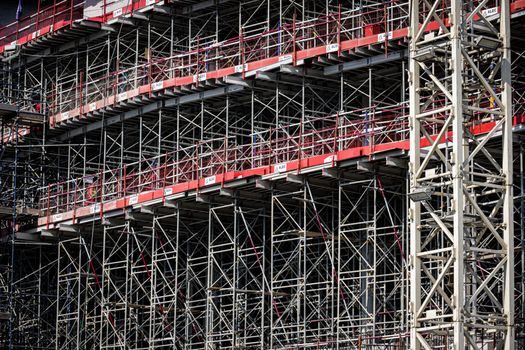
The first real selection gate is deck material: a steel plank at 2050 × 480 × 45 mm, ~9 kg, tolerates hot work, dropped tools and rough shipyard handling, while an aluminium plank at 2570 × 610 mm with a 300 kg rating cuts plank weight by roughly half and speeds manual handling on stage and event builds, but it deforms under point impact and is not the right call near welding or grinding [S1][S2].
Second gate is corrosion protection: hot-dip galvanized (HDG) is the default for offshore, coastal and chemical-plant service life, electro-galvanized (EG) and powder coat are typical for indoor or single-project use, and painted is the lowest-cost option for short-cycle formwork support where the scaffold will be re-sold or scrapped within 12–24 months [S1][S4].
Third gate is steel grade: Q235 is fine for access scaffold under ~3 kN/m² uniform load, but the same system sold in Q345 is the spec to write when the platform doubles as heavy shoring or when lift heights above ~60 m demand higher leg capacity — at the cost of slightly higher unit price per ton [S1][S4].
Where Ringlock Fits — and Where It Doesn't
Ringlock is the right answer for shipbuilding and ship-repair access, offshore-module assembly, stage and event structures, industrial maintenance platforms around pressure transmitters and valve manifolds, and birdcage shoring for slab pours — any job that benefits from the rosette's ability to connect eight members at one node without couplers [S1][S5].
It is the wrong answer for very light-duty interior finishing where a mobile aluminium tower is faster, for facade-only access under 6 m where a traditional tube-and-clamp or quick-stage system is cheaper, and for any application where a non-standard rosette spacing or tube OD is required (e.g. legacy Layher Allround spares can be confused with M48 ringlock but the rosette geometry and wedge differ, so the two should not be mixed on the same bay) [S1][S4].
Sourcing Map, MOQ and Lead Time in 2026

Active 2026 listings on the major B2B portals show ringlock verticals and ledgers on a 1 m.t. MOQ at ~10,000 m.t./month supply capability out of Shanghai with 15–25 day delivery, and aluminium planks on a 20 m.t. MOQ at 3,000 m.t./month out of Qingdao under T/T or L/C terms [S1][S2].
One Shandong-based audited supplier — Rizhao Weiye Tools Co., Ltd. — lists ringlock-compatible hanging/suspended platforms at US$12.59–35.80 per piece on a 1,000-piece MOQ and steel climbing scaffolds at US$500–900 per ton on a 1-ton MOQ, with the same exporter also advertising 5,000,000+ pieces of forged output a year across 50+ countries [S3][S6].
For a buyer's RFQ in mid-2026, the practical path is to fix tube OD/wall, steel grade, surface treatment, plank family and bay size up front, then ask for a per-bay price that itemizes standards, ledgers, diagonal braces (using the 610–3072 mm table above to verify tonnage), planks and jack bases separately — this is also how a fabricator such as an investment casting foundry sized on similar modular platforms typically breaks a quote [S1][S2].
Standards, Erection Rules and What to Verify on Site
Ringlock itself is governed by general scaffolding design codes (EN 12810/12811 in Europe, AS/NZS 1576 in Australia, OSHA 1926 Subpart L in the US) — none of the supplier pages cited here name a specific ringlock product standard, so the buyer should confirm with the manufacturer which code the published load tables refer to before signing [S1][S5].
Erection-side rules that come up on every CNBM and OEM installation note: provide fire-protection cover and a dedicated safety attendant during any electric or gas welding on the scaffold, install falling-object guarding on the working face, and set fencing plus warning signs on the ground during dismantle so non-workers stay clear [S1][S2].
On supply, Rizhao Weiye — and several of its peers — maintain mechanical-arm welding cells and 6+ laser-cutting lines producing 15,000+ tons of welded product a year, and they exhibit at bauma Munich, bauma Shanghai, bauma Conexpo India, Intermat France, Canton Fair and Worldbex Philippines, which is the simplest in-person way to verify a new ringlock vendor's capacity before placing a 1 m.t. trial order [S6].
Next signal to watch: the autumn 2026 bauma Munich and Canton Fair rosters will reveal which Chinese ringlock exporters are pushing the M60 vertical (heavier industrial platforms) versus staying on M48 (general access) — the split will tell buyers whether 48.3 mm remains the safe default or whether 60 mm verticals become the new shipyard standard by 2027 [S6].
For component-level specifications, see scaffolding, and linear guide.