For 2026 procurement, a road roller decision turns on three numbers first: operating weight class, drum configuration (smooth vs padfoot), and excitation type (static vs vibratory), then on engine power and price tier — Chinese factory listings for the 1-tonne class open at US$3,000-3,500 per piece MOQ-1 [S4], while a mid-size BOMAG BW 124 PDH-5 single-drum padfoot unit ships at 3,390 kg operating weight with a 34 kW diesel [S1].
The product family is mechanically simple but selection-heavy: a road roller is a self-propelled compactor that densifies soil, sub-base and asphalt through a combination of static drum load, drum vibration, and sometimes oscillation — three independent levers that change the answer for a 50 mm trench re-fill versus a 200 mm highway lift. Used-equipment channels in China list flexible expandable conveyor-style attachments alongside used rollers, with factory-direct pricing generally well under new units [S2], and OEM-grade new builds (BOMAG, Hamm, Caterpillar, Dynapac, Sany, XCMG) sit at the top of the price ladder.
Class Map: Walk-Behind, Mini Ride-On, Tandem, Single-Drum
Operating weight is the first gate. Walk-behind rollers cover roughly 300 kg to 1 tonne and are used for narrow footpaths, pipeline trenches and small parking lots; Shandong Jingshang Machinery's 2026 catalog leads with this class, advertising a 400-828-6069 service hotline and same-day delivery for the segment [S3].
Mini ride-on rollers (1-2 t) are the fastest-growing spec in 2026. Made-in-China's "Small Road Roller Price" index lists a CE-certified 1-1.2-2 ton double-steel-wheel diesel single-drum vibratory ride-on unit at US$3,000-3,500 per piece MOQ-1, from Shandong Storike Engineering Machinery [S4]. A second tier (1-tonne factory-priced compact units) overlaps that band, confirming the 1-2 t class as the dense competitive middle.
Single-drum padfoot rollers (3-6 t) are workhorses for clay and cohesive subgrade. The BOMAG BW 124 PDH-5 spec sheet lists 3,390 kg (7,473.7 lb) operating weight, 34 kW engine, single-cylinder vibrating drum, padfoot shell for cohesive soils [S1]. Larger 7-12 t single-drum smooth-drum rollers target highway embankments, while 2-4 t tandem asphalt rollers handle surface lifts with dual vibratory drums.
Pneumatic-tyred rollers (8-30 t) sit in a different category — used for sealing asphalt and proof-rolling — and are rarely cross-shopped against drum rollers; flagging it here only because a few mixed listings on B2B catalogs place them next to road rollers without a clear boundary.
Drum Type: Smooth Steel vs Padfoot vs Combination
Drum geometry is the second gate, and the wrong choice wrecks productivity on cohesive soils. Smooth steel drums work for granular soils, crushed rock sub-base, and asphalt finishing; padfoot (sheepsfoot) drums punch into clay and silt to knead and de-air the lift; combination rollers (smooth front / padfoot rear) bridge the two jobs but cost more. [S1]
The BOMAG BW 124 PDH-5 ships specifically as a padfoot single-drum machine for cohesive-soil work [S1]. For a 50-100 mm asphalt wearing course on a city street, a 2-4 t tandem smooth-drum vibratory unit is the spec; for a 200 mm clay embankment lift on a rural road, a 3-6 t single-drum padfoot unit is the spec. Confusing the two means either over-compaction (crushing aggregate) or under-compaction (future settlement).
On walk-behind units, single-drum art-wheels are common — one vibrating drum and a pneumatic traction tyre at the rear, which is mechanically similar in principle to a scaled-down road roller configuration. Buyers should check whether the drive tyre is hydraulic or mechanical, because hydraulic drive doubles the price on this class but halves operator fatigue.
Vibration, Frequency, Amplitude — and When Static Beats Both

Vibration is the third gate and the most misunderstood. A vibratory drum adds a centrifugal force component on top of static drum load — typically 30-80 kN on a 1-2 t mini roller, 80-160 kN on a 3-6 t single-drum machine. Two parameters matter: frequency (Hz) and nominal amplitude (mm). [S2]
Low frequency + high amplitude (around 30 Hz / 1.5-2.0 mm) drives deeper lift compaction in thick granular lifts. High frequency + low amplitude (around 50-60 Hz / 0.3-0.6 mm) is correct for thin asphalt lifts where aggregate fracture is the failure mode. Most 2026 mid-size rollers offer dual-amplitude / dual-frequency as a switchable spec — verify it on the data plate, not the brochure.
Static rollers (no vibration) still earn their slot in two cases: proof-rolling with a 12-15 t pneumatic-tyred unit, and final asphalt rolling with a 2-4 t tandem static drum to avoid aggregate fracture. A BOMAG-class 3.4 t vibrating padfoot roller at 34 kW is not interchangeable with a 3 t static tandem for a 40 mm wearing course — different machine, different job.
Engine, Drive, and Hydraulic Choices
For the 1-2 t mini class, 3-cylinder diesel around 10-25 kW is the norm; for the 3-6 t single-drum class, expect 30-55 kW. The BW 124 PDH-5 spec of 34 kW is mid-pack for a 3.4 t padfoot unit [S1]. Tier 4 Final / EU Stage V emission compliance is standard on European OEMs (BOMAG, Hamm, Ammann) and increasingly required on Chinese OEM exports to Europe and North America — confirm the emission package on the nameplate, not the catalog copy.
Hydrostatic drive is now default on 1 t+ ride-on machines and on every 3 t+ single-drum; mechanical (gearbox) drive still shows up on cheap walk-behind units. The question is not "hydrostatic or not" but "single-speed hydrostatic vs two-speed with creep" — two-speed matters when the same machine services both trench re-fill (slow) and open lot (fast).
A 1-tonne CE-certified double-drum unit at US$3,000-3,500 [S4] will almost certainly be hydrostatic single-speed; expect 2-speed hydrostatic only on units above roughly US$8,000 in 2026. Cooling packages (oil cooler with reversing fan) are worth the upcharge for hot-asphalt continuous-shift work.
Price, Sourcing, and Tier Comparison
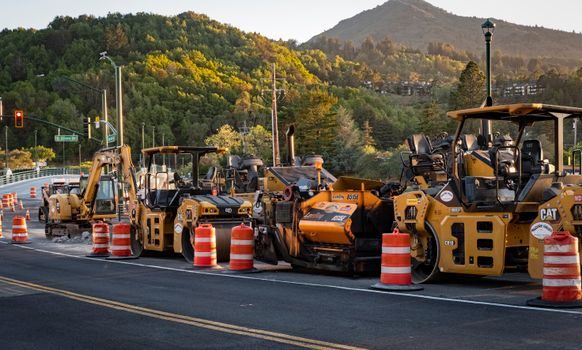
Three price tiers define 2026 sourcing. Entry / used-and-factory-direct: used rollers and Chinese factory new units, US$3,000-6,500 for 1-2 t, with the Shandong Storike 1-tonne at US$3,000-3,500 MOQ-1 [S4] and flexible used-equipment channels on Made-in-China [S2].
Mid tier: established Chinese OEM-branded new units (Sany, XCMG, Liugong) in the 3-12 t class, typically US$15,000-45,000 depending on size and spec. Top tier: European OEM (BOMAG, Hamm, Ammann, Caterpillar) and Japanese OEM new units — these are the build sheets most specifications are written against, including the BW 124 PDH-5 reference [S1].
Decision gate: if the project is a 6-month rental fleet for medium-density residential roads, the Chinese OEM 3-6 t single-drum at roughly US$20,000-30,000 delivers the right cost-per-tonne. If the project is a 3-year motorway contract with method-statement spec calls for BOMAG/Hamm/CAT, the OEM premium is non-negotiable — and you should request the actual spec sheet, not the marketing data, before signing.
Standards, Operator Safety, and Inspection Gates
CE marking is the floor for European export; the Made-in-China 2026 listing flags "CE certified (contact issuer for current status)" for the entry 1-tonne class [S4] — that parenthetical matters, because a CE-marked machine that was never re-validated is a customs risk. For North American delivery, look for EPA Tier 4 Final engine certification; for Australian delivery, look for ADR compliance on lighting and ROPS.
ROPS (Roll-Over Protective Structure) and a seatbelt are mandatory on ride-on rollers in most regulated jurisdictions — verify the ROPS serial plate, not just the canopy. Vibration exposure for the operator is governed by whole-body WBV limits; expect 0.5-1.2 m/s² on a 1-2 t unit and 0.3-0.8 m/s² on a 3-6 t unit, lower frequencies dominating the spectrum on heavier machines.
For a quick on-yard inspection, run this gate: drum bearing play (no radial movement under a pry bar), hydraulic oil sample for the drive loop (target ISO 4406 cleanliness 18/16/13 or better), engine compression test on diesels above 2,000 hours, and ROPS / seatbelt serial plate match against the data plate. If any of those four fail, walk.
Selection Rules and Common Mistakes

Rule 1: size the roller to the thinnest critical lift, not the thickest. A 3-6 t padfoot drum that can compact a 300 mm clay lift will crush a 40 mm asphalt wearing course. Rule 2: specify dual-amplitude / dual-frequency for any machine that will see both sub-base and asphalt — paying 5-8% more at order saves a second machine on the yard. [S3]
Rule 3: weight-to-drum-line-load ratio is a better predictor of compaction than gross weight alone — a 3.4 t single-drum padfoot with a 1.4 m drum delivers roughly 24 kN/m static linear load [S1], in the right range for cohesive subgrade lifts. Rule 4: don't cross-shop a 1 t mini ride-on with a 3 t single-drum — different jobs, different prices, different operators. If procurement has to do it, write a method statement first.
Rule 5: in the 1-2 t mini class, the BOMAG, Hamm, and Wacker Neuson nameplate commands a 30-60% premium over equivalent Chinese OEM listings [S1][S4] — that premium buys tighter QC, longer drum-bearing life, and dealer-backed parts. Budget for it only if downtime on this machine stalls a critical-path activity.
Finally, for fleet and site context, a road roller rarely arrives alone — coordinating with a wheel loader for feed and a concrete or rebar supplier for sub-base preparation is normal. For larger infrastructure scopes involving tunnels, sewer headings, or deep-bore work, machine selection extends into the shield machine class, with diameter and geology rather than weight and drum being the dominant gates.
Two trackable signals to watch for the rest of 2026: emission-stage transitions (EU Stage V successor rules in 2027 will reshape the 1-3 t export market) and Chinese OEM financing terms tightening on 3-6 t units as domestic fleet utilisation softens — both will move the 1-tonne US$3,000-3,500 entry price [S4] in the second half of the year.
For component-level specifications, see crossed roller guide, and linear guide.