
The right road roller for a demolition rebuild is a 3-axis decision: static mass, drum type, and vibratory output must all match the broken-concrete fill, not the original asphalt design. Specifying a 14 t tandem on a crushed slab subgrade simply over-compacts, fractures aggregate, and burns fuel for no density gain.
Demolition sites differ from highway work in three measurable ways: lift thickness is irregular (0.1–0.6 m of mixed rubble), particle top size can exceed 200 mm, and the supporting layer is often the original subgrade that the demolition process has just disturbed. Those three facts drive almost every other spec line below.
Match Mass and Drum Type to the Lift, Not the Compactor Yard
Single-drum vibratory rollers in the 11–16 t class with 1.5–2.1 m drum width are the default for primary compaction of broken concrete fill above 0.3 m lift thickness, because their drum diameter of 1.2–1.5 m can rotate over 100–200 mm rubble without bridging [S1].
Tandem rollers (steel drum front and rear) under 4 t are the right tool for thin asphalt patches, footpaths, and small parking lots; above 12 t they become highway-class machines with 1.98–2.13 m drums and 50–80 kN centrifugal force per drum, which is over-spec for any demolition subgrade. Pneumatic-tyred rollers (7–25 t, 7–11 wheels) belong on sealing chips and base courses, not on freshly broken slab. For utility trenches inside a demolition footprint, a 3–7 t trench roller with sheepsfoot or padfoot drum delivers 30–60 kN at 30–40 Hz into lifts limited to 0.15–0.25 m.
Vibratory Output: Frequency, Amplitude, and Centrifugal Force
For mixed demolition rubble, dual-amplitude/dual-frequency drums in the 30–40 Hz range at 0.8–2.0 mm amplitude deliver usable compaction energy without destroying the aggregate; above 50 Hz the energy couples into individual particles rather than the matrix and density drops [S1].
Centrifugal force is the spec line most procurement teams misread. Two machines of identical mass can differ by a factor of two in centrifugal force (typical envelope 30–280 kN across the 3–16 t class), and that figure — not operating weight — sets the compactive effort per pass. Rule of thumb: aim for a minimum of 1.5–2.0 kN per cm of drum width for granular demolition fill. A 1.5 m / 80 kN drum hits 5.3 kN/cm and finishes in 4–6 passes; a 2.1 m / 100 kN drum lands near 4.8 kN/cm, similar pass count, wider coverage per metre.
Subgrade, Drainage, and the Demolition Footprint
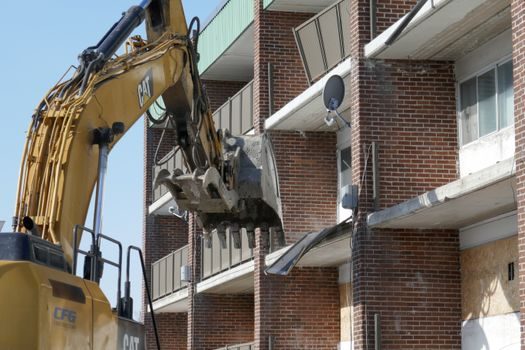
On a freshly stripped demolition footprint, the bearing capacity of the exposed subgrade governs machine choice before the compactor ever hits the fill — a 14 t single-drum on a soaked clay subgrade will pump fines and rut, regardless of drum specs. Standard practice is to proof-roll the exposed subgrade with a loaded dump truck or the roller itself in static mode before any fill goes down; visible rutting above ~25 mm under a single pass signals subgrade improvement is needed before compaction begins.
Drainage layers on demolition rebuilds typically use 150–300 mm of clean crushed concrete (recycled concrete aggregate, RCA) graded to 0/40 or 0/63, compacted in two lifts. Drum vibration must be capable of penetrating that lift — at 30 Hz and 1.0 mm amplitude, effective compaction depth sits in the 0.25–0.40 m range, which is the practical reason tandem rollers under 4 t cannot replace a 12 t single-drum on a demolition subbase.
Drive, Drivetrain, and Oscillation
Articulated tandem rollers with ±35° articulation and ±10–15° drum oscillation follow uneven demolition surfaces without drum hop — a measurable safety win on broken-slab ground. Hydrostatic drum drive and vibration systems are now standard on rollers from 3 t upward; mechanical drum drive survives only on the smallest 1–2 t walk-behind units used in confined demolition corners.
Engine power for the 11–16 t single-drum class sits in the 75–130 kW (100–175 hp) band, with Tier 4 Final / Stage V emissions compliance required on most 2026 European and North American job sites. For demolition sites indoors or in tunnels, an engine-driven roller is non-starter — a battery-electric or Stage V diesel-electric hybrid with 90 dB(A) cap becomes the only spec that survives site noise rules. Diesel-electric drives also decouple engine RPM from drum frequency, so vibration stays at 30–40 Hz even as the engine throttles back between passes.
Safety, Visibility, and Operator Controls Specific to Demolition
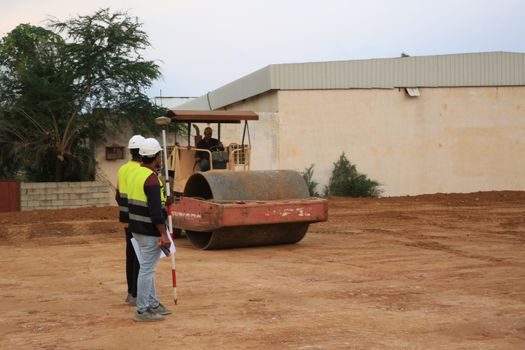
Rollover protective structure (ROPS) and falling-object protective structure (FOPS) are non-negotiable on any demolition site with overhead hazard, and most procurement specs now require both as line items. Cab-mounted cameras covering the front drum edge, the rear, and both corners — typically four-camera systems with 270° coverage — reduce struck-by incidents on sites where ground crews work within 3 m of the rolling pattern.
Compaction measurement systems (CMV, Evib, or OEM equivalents) deliver real-time stiffness readouts, useful on demolition subgrades where the old slab fragments produce erratic readings. They cost roughly 8–15% above a base machine but cut re-roll count by 15–30% on heterogeneous fill, which more than pays back over a 12-month demolition-rebuild program. A radio-remote-control walk-behind configuration is worth specifying for any trench roller working inside a 2 m-deep excavation, where the operator must stay outside the swing radius of the excavator feeding the trench.
Comparison of Common Roller Types on Demolition Subgrade
Side-by-side against four decision criteria, the typical 2026 OEM line-up lines up roughly as follows. (1) 1–2 t walk-behend: low cost, narrow 0.8–1.0 m drum, 15–25 kN centrifugal force, fits utility trenches and confined corners but cannot break 150 mm lift thickness. (2) 3–7 t trench roller with padfoot drum: 30–60 kN at 30–40 Hz, 1.0–1.4 m drum, ideal for 0.15–0.25 m lifts in cohesionless fill and trenches. (3) 11–16 t single-drum vibratory: 80–280 kN, 1.5–2.1 m drum, the default primary compactor for demolition subbase in 0.25–0.40 m lifts over 5,000 m². (4) 12 t+ tandem: designed for asphalt finish rolling and highway base, not demolition subbase; the wrong tool for a crushed-slab fill despite being a common rental-yard default.
Standards, Documentation, and What to Ask the OEM
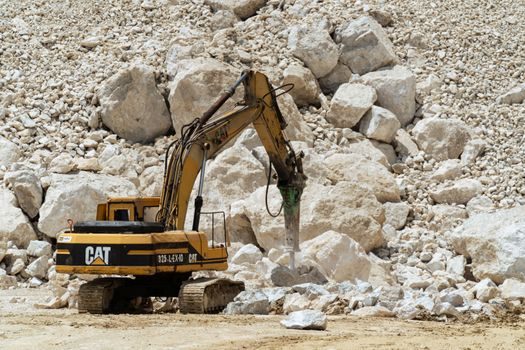
Relevant spec envelopes for 2026 procurement include ISO 6165 for earth-moving machinery definitions, EN 500-1/EN 500-4 for ride-on vibratory rollers, and OSHA 1926.602 for operator qualification on US job sites; European sites will additionally pull in Stage V emissions (EU 2016/1628) and the machinery directive's ROPS/FOPS clauses.
Ask the OEM for: (a) actual centrifugal force at both amplitudes with amplitude values stated, not a single marketing figure; (b) drum-shell thickness (typically 16–25 mm on 12 t+ single-drums; below 14 mm is a short-life spec on demolition rubble); (c) vibration isolator type — rubber buffers versus coil springs, the former cheaper but service-life limited to 2,000–3,000 hours on demolition duty; (d) ROPS/FOPS certification test certificates dated within 12 months of delivery. Cross-check any marble cutter spec alongside when planning slab breakdown — the roller only arrives after the cutter has sized the rubble to a manageable top size.
Trackable signals for the next 12 months: 2026 Stage V diesel-electric hybrid launches across the 8–12 t tandem class, with operating-cost data expected from rental fleets by Q4 2026; battery-electric 3–5 t trench rollers entering European rental fleets for indoor demolition work, with first field density data to compare against diesel equivalents. Procurement teams benchmarking demolition subgrade compaction should ask rental suppliers for a 5-day demo at full production before signing a fleet contract.
Spec-level background on the components involved: demolition hammer, and roller bearing.