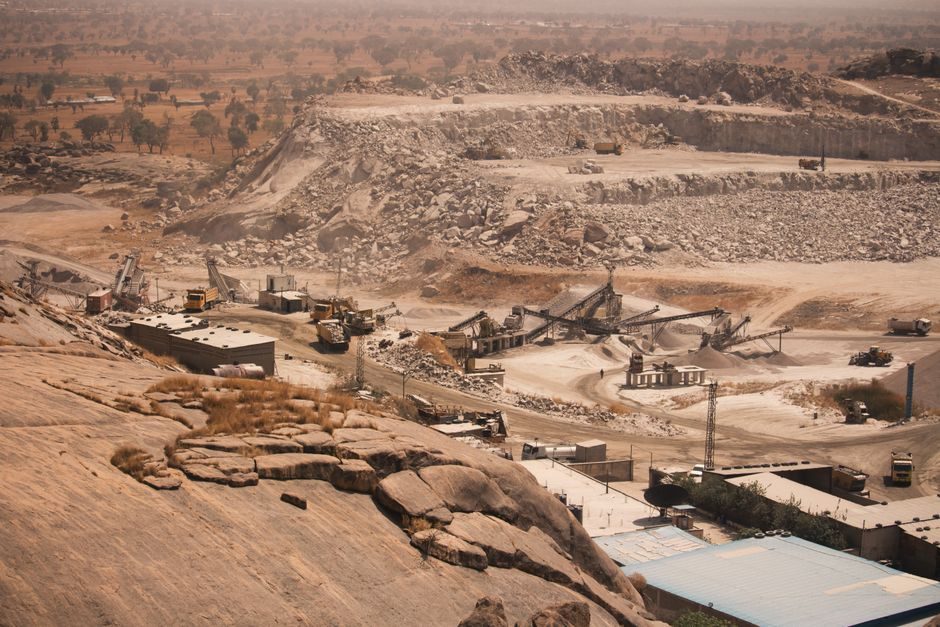
Single-drum vibratory rollers sized between 4 t and 30+ t dominate mining-grade compaction, with 17.5% of global roller compactor demand attributed to mining applications in 2025 and a projected 6.8% CAGR through 2034 [S7]. The selection decision for haul-road maintenance and tailings facility work is driven by static linear load, excitation force, vibration frequency, and ground-clearance geometry, not by the drum-width logic used in highway asphalt work.
For context on the wider machine class, road roller fundamentals and type taxonomy cover the eight functional categories; mining specifications draw primarily from categories 1, 5, and 8 in that taxonomy [S4]. Allied equipment such as mining dump trucks operating on the same haul network impose axle-load limits that, in turn, cap the permissible roller weight on finished running surfaces.
Mining-specific operating envelope versus highway rollers
Mining-grade roller compactors used in heavy haul road applications are typically designed with reinforced frames, upgraded cooling systems, and high-flotation tires to withstand the abrasive, continuous-duty loading profile of pit operations [S7]. Tandem rollers sized for road paving, by contrast, are explicitly configured for asphalt and are not interchangeable with mining soil or rockfill compaction [S2]. The split between pneumatic and tandem configurations is well documented: ride-on tandem drum widths span 32" to 84" while pneumatic rollers are heavier and designed for wider projects, with cushioning that reduces surface cracking on finished asphalt [S2]. Neither is the correct primary choice for mining haul-road base course or for tailings dam shell construction.
Hand-guided walk-behind units in the 300 kg to 4 t class — for example the XCMG XMR040 at 4 t operating weight with 4 kW motor, or the Husqvarna LP 6505 duplex at 745/765 kg with 22 kN centrifugal force — serve confined trench and utility compaction, not mine haul road work [S1]. The capacity ceiling for those pedestrian-controlled machines sits at roughly 22 kN centrifugal force and 1,790 kg for the largest JCB CT160 tandem [S1].
Selection criteria: static linear load, amplitude, and excitation force
The three specifications that govern mining roller selection are static linear load (N/cm), nominal amplitude (mm), and excitation force (kN); the published Yunyong YH-JSY700AIC entry lists 77/56 N/cm front/rear static linear load, 0.5 mm nominal amplitude, 75 Hz vibration frequency, and 30 kN excitation force as a representative mid-range combination [S3]. Climbing ability of 30%, 0-8 km/h working speed, and 2,000 mm turning radius round out the mobility envelope for a machine in this class [S3].
Selection logic in mining follows material layer: thin lifts of cohesive tailings require higher amplitude (≈0.5-0.8 mm) and lower frequency to drive air out without fracturing the matrix, while granular haul-road base responds better to higher frequency (60-75 Hz) at lower amplitude to maximize particle reorientation. The 75 Hz / 30 kN / 0.5 mm triple from the YH-JSY700AIC datasheet aligns with the granular-base profile [S3]. Wacker Neuson's RD-series tandem line, with drum widths from 31.5" to 47.2" and max operating weights from 2,964 lbs to 7,518 lbs, illustrates the narrower, lighter end of the ride-on spectrum typically deployed on mine access roads rather than primary haul lanes [S2].
Type-by-type comparison for mining duty
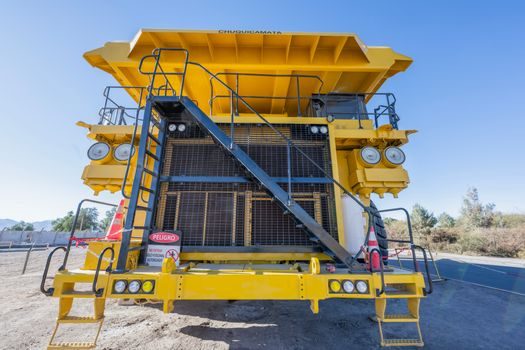
Comparing the candidate machine classes against four mining decision criteria — compaction depth, surface finish, mobility in confined pit geometry, and continuous-duty survivability — produces a structured selection matrix. Single-drum vibratory rollers with high flotation tires score highest on compaction depth and continuous-duty survivability, while tandem rollers score highest on surface finish but lowest on compaction depth. Pneumatic-tire rollers sit between, with the additional advantage of kneading action for chip-seal and wear-course layers. Walk-behind duplex units score highest on mobility in confined geometry but are disqualified from primary haul-road work by capacity and safety constraints [S1][S2][S7].
The Sany 8-type taxonomy [S4] places single-drum vibratory rollers in category 1 (vibratory soil compaction), tandem rollers in categories 2-3 (asphalt), and pneumatic-tyre rollers in category 4 — a useful cross-check against application fit. Special-purpose rollers (category 8) cover landfill and landfill-compactor variants that share the mining-grade chassis philosophy of reinforced frames and high-flotation tires [S4][S7].
Use cases across the mining value chain
Three use cases drive the bulk of mining roller demand: haul-road base and wearing-course compaction, tailings dam shell and upstream slope construction, and ROM pad / stockpile platform maintenance. Each has a different optimum roller profile. Haul-road base lifts of 300-500 mm thickness on well-graded crushed rock respond to 12-18 t single-drum vibratory units at 60-75 Hz and 0.3-0.5 mm amplitude. Tailings dam shell construction, often using cycloned sand, calls for heavier 20-25 t single-drum units operating at 0.5-0.8 mm amplitude and 30-40 Hz to penetrate the looser material without sealing the surface prematurely. [S3]
For ROM pad and stockpile platforms, where the rolling stock is dominated by mining dump trucks with elevated tire pressures, the roller spec tilts toward pad-foot or sheepsfoot drum variants rather than smooth-drum units, and toward higher static linear load to achieve penetration into the uncompacted underlying fill. Walk-behind rollers in the 300-800 kg class are restricted to utility trenching, sump compaction, and confined infrastructure work where the 22 kN centrifugal force ceiling of units like the Husqvarna LP 6505 [S1] is sufficient.
Limitations, failure modes, and what not to deploy
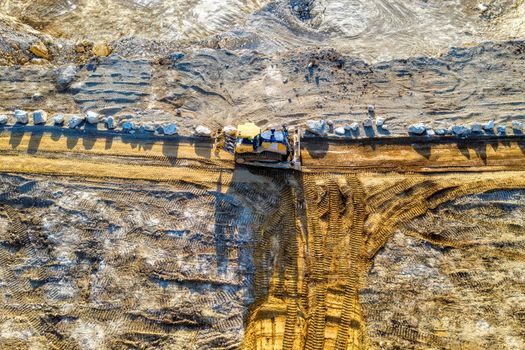
Tandem rollers designed for asphalt finishing — including the Wacker Neuson RD12L through RD28-120 series in the 2,964-7,518 lbs range [S2] — fail in mining service for two principal reasons: insufficient static linear load to compact thick rockfill lifts, and lack of high-flotation tires to traverse soft shoulder material without bogging. Pneumatic-tire rollers suffer the inverse limitation: their kneading action is well suited to chip-seal surfacing but cannot deliver the depth of compaction required for new haul-road base lifts.
Walk-behind units up to 1,790 kg [S1] should not be specified for any primary haul-road lift, regardless of price advantage; the centrifugal force ceiling of 22 kN restricts them to lift thicknesses of 100-150 mm maximum, well below the 300-500 mm typical of mine haul-road construction. Continuous-duty failure modes in mining service centre on drum bearing overheating, hydraulic cooling fan fouling from dust, and frame flex cracking — the same failure modes that drive the reinforced-frame and upgraded-cooling design philosophy documented for mining-grade units [S7]. Drum-bearing specification in this context is a roller bearing selection problem governed by combined radial and axial load, with contamination resistance typically requiring sealed or shielded variants given the dust exposure.
Sourcing and standards context
Specifying engineers should validate any roller selected for mining service against three documentary anchors: the OEM datasheet (drum width, operating weight, vibration frequency, amplitude, excitation force, static linear load, gradeability, turning radius), the market-segment data confirming mining-grade reinforcement (frame, cooling, tires) [S7], and the type-taxonomy cross-check against application [S4]. A representative 2026 export-spec datasheet — Yunyong YH-JSY700AIC, 30 kN excitation, 0.5 mm amplitude, 75 Hz, 77/56 N/cm static linear load, 30% gradeability, 0-8 km/h [S3] — illustrates the level of disclosure a credible spec sheet should carry.
Cross-referencing ride-on tandem offerings from Ammann, BOMAG, Caterpillar, Dynapac, HAMM, Sakai, Volvo, Wacker Neuson, and XCMG [S2] gives a manufacturer breadth that materially affects parts availability and service support at remote mine sites — a non-engineering but operationally decisive factor when total cost of ownership over a 5-7 year machine life is calculated. North American rental channels and the wider Chinese OEM export channel both surface in 2026 sourcing flows, with the Yunyong listing actively marketed on international B2B platforms as of 2026-08-03 [S3].
Cross-equipment context for the mining spec engineer
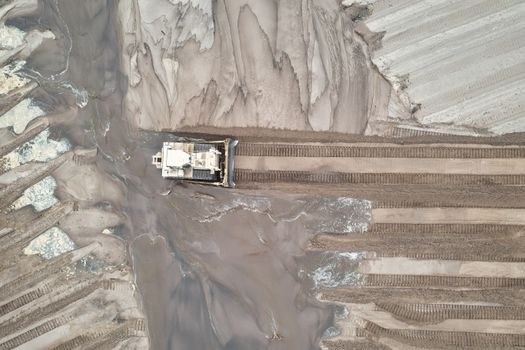
Haul-road construction in mining contexts almost never runs in isolation — the roller works alongside motor graders preparing the grade and water trucks managing moisture for optimum compaction. Selection of the roller must therefore be compatible with the upstream grading and watering equipment on site, and with the loading equipment (typically mining dump trucks in the 40-100 t class) that will subsequently operate on the finished surface. The roller conveyor bearing logic for contamination sealing also translates to the drum-bearing environment on mining rollers operating in dust-laden conditions. [S3]
For engineers cross-specifying across the mining support fleet, the adjacent selection problem of toxic gas detector selection for mining: 4-gas, pump, ATEX spec map follows the same ATEX/IECEx hazard-classification discipline that should govern roller selection in underground coal applications, where permissible equipment must meet the relevant mining-permissible standard before deployment. Surface mining applications generally have fewer ignition-hazard constraints but the same dust-ingress logic applies to air intakes and bearing seals.
Trackable signals over the next quarter include any 2026-Q3 OEM announcements of mining-reinforced single-drum platforms in the 20-25 t range, additional export-spec datasheet disclosures from Chinese OEMs aligned with the 77 N/cm / 30 kN / 75 Hz baseline, and updates to mining-segment market share within the broader roller compactor forecast [S3][S7].