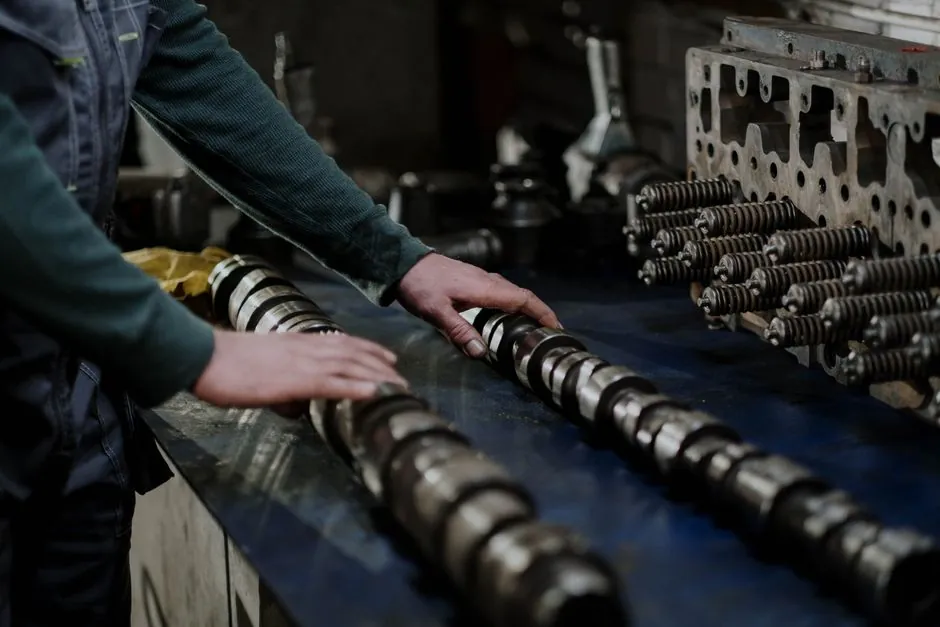
A rotary ball spline with a support bearing on the nut combines the torque-transmitting ball spline and a radial support bearing (angular contact balls, crossed rollers, or gears) inside a single nut housing, so the shaft and the rotating portion of the nut deliver linear and rotary motion together [S2][S7].
A linear-only ball spline nut rides on a grooved shaft, transmits torque through the grooves, and needs a separately mounted radial bearing to support any rotation of the nut, which adds length, sourcing effort, and a second tolerance stack-up [S3][S5].
Core Construction and Where the Support Bearing Sits
A ball spline assembly uses three components: a shaft with linear (not helical) grooves, a spline nut, and load-carrying balls that recirculate inside the nut [S5]. The grooves on the shaft prevent the nut from rotating on the shaft, so torque passes between shaft and nut while axial travel is provided by ball recirculation [S2].
In a linear-only configuration, when the shaft is fixed, the shaft ends are turned down and a separate radial bearing is mounted on those journals; when the nut is fixed, the same radial bearing has to be mounted on the outer diameter of the nut, and the user has to find, source, and integrate that bearing themselves [S3][S5]. In a rotary ball spline, that radial support bearing is built into the nut itself, eliminating the user-side bearing sourcing step and shortening the overall envelope of the assembly [S7].
Angular Contact, Crossed Roller, or Geared: Three Support-Bearing Styles
Three rotary-support styles are in production across the major lines: angular contact ball bearings, crossed-roller bearings, and gear-driven nuts [S2]. THK's catalog lists both a "Rotary Ball Spline with Support Bearing" and a separate "Rotary Ball Spline with Gear" product group, confirming these are distinct configurations rather than one device with options [S1].
Angular-contact support bearings (for example NB's SPB standard series) are the general-purpose choice for moderate load and reasonable speed [S3]. Crossed-roller support bearings (NB's rotary ball spline uses cross rollers for the rotating portion) deliver higher radial and moment load capacity; NB publishes that this construction supports up to 10 times the load of a conventional ball bushing [S4]. Gear-driven rotary ball splines (THK's Rotary Ball Spline with Gear) add an external gear on the nut so the rotary motion is driven by a mating pinion rather than a built-in bearing race [S1][S2].
Load, Torque, and Preload Behavior
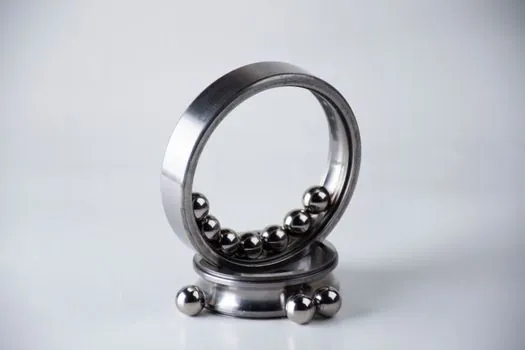
Ball-spline load and life are calculated with the standard rolling-bearing life equation using both radial and torque loads, and the device is preloaded much like a profiled rail or ball screw to raise rigidity and control angular backlash [S2].
Torque capacity scales with the number of grooves and the number of contact points per ball: two Gothic-arch grooves give 8 contact points, four Gothic-arch grooves give 16 contact points, and four-point contact eliminates clearance that would otherwise allow deflection [S2][S5]. A higher preload tightens the balls in the grooves and removes that clearance, but it also raises friction; selection is a trade-off between rigidity, smooth running, and product life, and is offered as standard or custom grades by manufacturers [S3][S5].
Decision Matrix: Rotary-Support vs Linear-Only Nut
For four typical decision criteria, the rotary ball spline with integrated support bearing and the linear-only nut compare as follows. (1) Number of components: the integrated version is one nut with the bearing inside, while the linear-only version needs the nut plus a user-sourced radial bearing on the shaft journals or the nut OD [S3][S5]. (2) Axial envelope: the integrated version is shorter because the rotary nut and spline nut are one unit with crossed rollers directly attached to the rotating portion, while the linear-only version extends further because the radial bearing sits beside the spline nut [S3][S8]. (3) Sourcing and integration effort: the integrated version removes the step of finding, sourcing, and integrating a separate bearing, while the linear-only version makes the user responsible for matching bearing size to the shaft or nut OD [S3][S5]. (4) Load and stiffness ceiling: the integrated version with crossed rollers supports up to 10x the load of a conventional ball bushing of comparable size [S4]; the linear-only version is limited by whichever separate bearing the user bolts on.
Two further points to weigh. (5) Bearing-size flexibility: on a linear-only assembly with a fixed shaft the shaft ends can be turned down to accept different bearing sizes, but with a fixed nut the nut OD is harder to modify for a different bearing size, which is exactly the case the integrated rotary ball spline is designed to remove [S3][S5]. (6) Accuracy: the integrated version delivers sub-millimeter positioning because backlash and stiffness are set by one supplier's matched assembly, while a user-stacked linear-only version carries the run-out and preload tolerances of two separate parts.
Where Each Type Fits, and Where It Does Not

Use a rotary ball spline with support bearing when the application needs simultaneous linear and rotary motion on one shaft, examples being SCARA robot arms, pick-and-place heads, tool changers, and semiconductor or inspection stages where compact envelope and a single supplier's matched tolerance matter [S3][S5][S6]. NB positions the product line for robotic motion with sub-millimeter accuracy, and Thomson highlights the compactness benefit in robot joint and end-effector designs [S4][S6].
Stick with a linear-only ball spline nut when the shaft rotates inside a fixed structure and standard radial bearings on turned-down shaft journals are acceptable, when only torque transfer is required with no continuous nut rotation, or when the envelope is not constrained and a separately sourced bearing is cheaper than an integrated rotary unit [S3][S5]. The linear-only nut is also the right call when the application already carries a heavy existing bearing arrangement and re-engineering to an integrated rotary nut would buy nothing.
Limits, Failure Modes, and Sourcing Watch-Outs
Preload is the main tuning knob and the main failure trigger: under-preload leaves angular backlash that hurts positioning accuracy, while over-preload raises friction, heat, and wear, shortening life [S3][S5]. A reference for sizing the linear stage behind these nuts is covered in rack and pinion actuator stroke design, and bearing-stack preload logic is a useful parallel for engineers used to sizing a standard ball bearing inside a rotary nut.
Ball spline accuracy grades are not based on DIN or JIS, so one maker's "precision" can match another's "high" grade; a spec sheet must be compared against the maker's own run-out and perpendicularity definitions rather than a shared class number [S2]. The shaft root diameter and unsupported length also set critical speed, just as on a ball screw with end-fixity, so fixed-fixed, fixed-floating, and similar end conditions must be declared at the quote stage [S2].
Trackable Signals Worth Watching
Two signals to monitor over the next sourcing cycle: whether suppliers continue to split the rotary ball spline catalog into a support-bearing line and a separate gear-driven line (THK currently lists both as standalone groups, which signals sustained demand for the gear-driven variant in indexing tables) [S1]; and whether crossed-roller support bearings continue to be published at the 10x load-of-ball-bushing figure as the NB reference number is updated [S4]. Engineers who need a more general review of bearing types in the same family can use the linear bearing reference and the lock nut reference for the shaft-side hardware that sits next to either configuration.