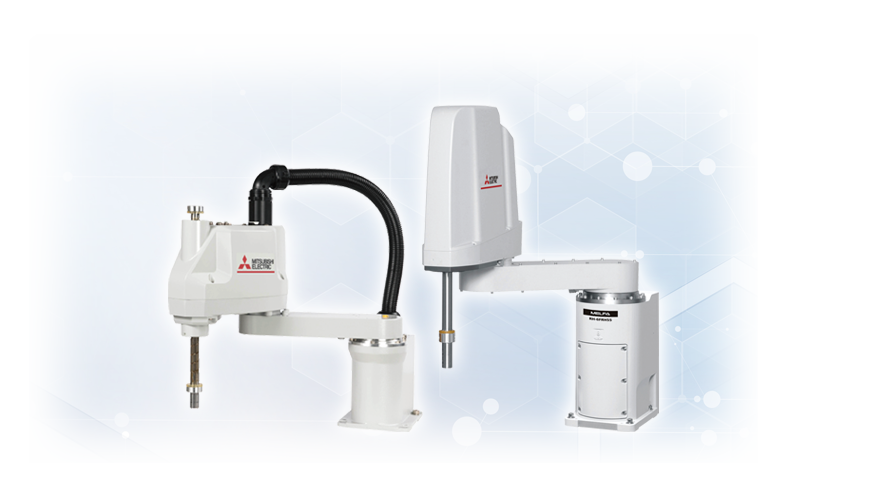
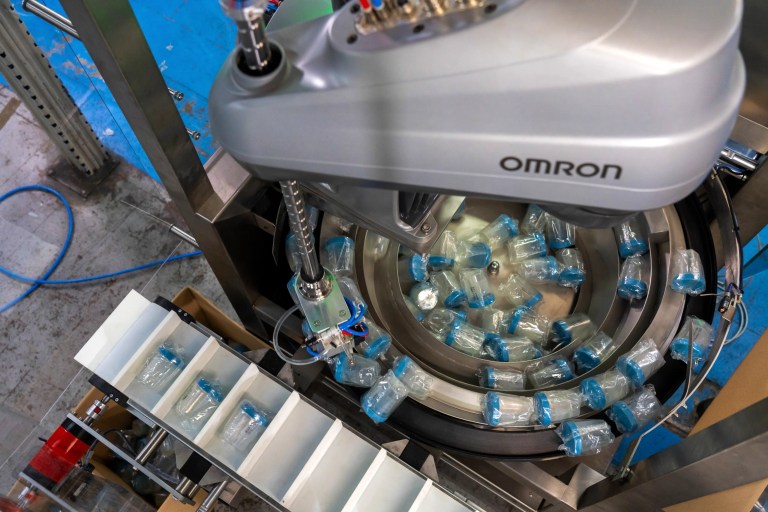
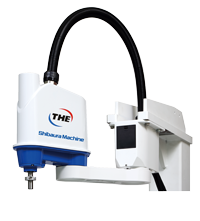
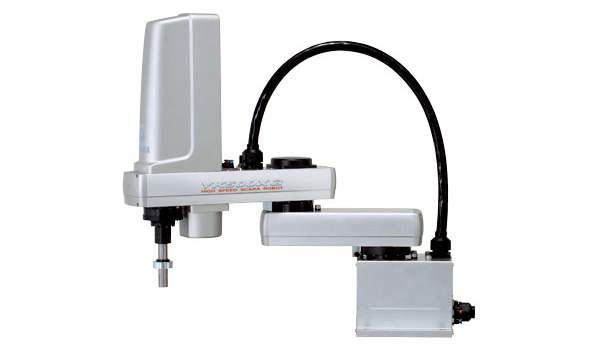
A SCARA robot is a four-axis industrial arm built for fast, precise work in a horizontal plane with vertical insertion. The acronym, Selective Compliance Assembly Robot Arm (also Selective Compliance Articulated Robot Arm), names its defining trait: the arm is rigid in the vertical Z direction but slightly compliant in the horizontal X-Y plane, which lets it seat a pin into a hole or a connector into a socket without binding.
Invented in 1978 by Professor Hiroshi Makino at the University of Yamanashi and commercialized in 1981, the SCARA became the workhorse of electronics assembly and small-parts pick-and-place. With cycle times near 0.3 seconds and horizontal repeatability down to plus-or-minus 0.01 mm, it sits between the high-rigidity, low-speed Cartesian gantry and the slower, fully articulated six-axis arm.
Photo: Hirata Robotics GmbH, CC BY-SA 3.0 de, via Wikimedia Commons
This guide is written for procurement engineers and design engineers evaluating SCARA robots before a capital purchase. Across 6 chapters it covers the four-axis structure and history, classification by payload and reach, drive and control technologies, environment and material variants, spec-sheet decoding, and the selection decision sequence, with 7 FAQs and maker comparisons. Performance figures reference the ISO 9283 test framework, the ISO 10218-1 and ISO 10218-2 safety standards, ISO/TS 15066, ISO 14644-1 cleanroom classes, and published manufacturer datasheets.
Chapter 1 / 06
What is a SCARA Robot
A SCARA robot is a four-axis industrial manipulator whose kinematic chain follows an RRRP pattern: three rotary joints and one prismatic (linear) joint. Joint 1 (the shoulder) and Joint 2 (the elbow) are both rotary axes turning about parallel vertical lines, so together they position the tool center point anywhere within a horizontal working envelope. Joint 3 is the vertical prismatic Z axis that lifts and lowers, and Joint 4 is a rotary axis that spins the end-effector about the vertical. This layout is the source of the name: the arm is stiff in the vertical Z direction yet selectively compliant in the horizontal plane, able to flex marginally under sideways load and self-align a part into a mating feature.
Structurally a SCARA consists of three sections: (1) the base and Joint 1 arm, housing the largest servo and gear reducer; (2) the Joint 2 arm carrying the elbow drive; and (3) the wrist assembly, where a single shaft performs both the vertical lift and the rotary spin through a combined ball screw and ball spline. Because the two main positioning joints rotate about vertical axes, gravity acts along the rigid Z direction rather than across the compliant plane, which is why a SCARA holds vertical position firmly while accommodating small horizontal misalignment during insertion.
The SCARA was developed in 1978 by a consortium led by Professor Hiroshi Makino at the University of Yamanashi in Japan, working with thirteen Japanese companies between April 1978 and March 1981. Makino was prompted by a 1977 presentation of the SIGMA assembly robot and set out to design an arm optimized for the dominant assembly motion of the era: vertical insertion of small components. The first prototype was built in 1978, a second in 1980, and the design was commercialized in 1981 by Sankyo Seiki, Pentel, and NEC. In 2006 the SCARA concept was inducted into the Robot Hall of Fame.
The SCARA arrived as electronics manufacturing was industrializing. Printed circuit board assembly, connector insertion, and small-part handling all share the same geometry: pick from a horizontal feeder, move fast in a flat plane, and press straight down. A four-axis arm that does exactly this, and nothing more, is faster and cheaper than a six-axis arm doing the same job with redundant degrees of freedom. That focus is still why a SCARA is selected over an articulated robot for high-throughput flat work today.
Four engineering metrics dominate SCARA quality: position repeatability, payload combined with allowable moment of inertia, cycle time, and the environment rating. These four determine the total cost of ownership. A robot with marginal repeatability scraps parts; one with insufficient inertia capacity vibrates and overshoots at speed; one with the wrong ingress rating fails early in dust or washdown. The essence of selection is matching these four to the line, not chasing a single headline speed number.
Chapter 2 / 06
Classification by Payload and Reach
SCARA robots are most usefully classified by the two parameters that define the working envelope: payload and arm reach. Commercial models span roughly 1 to 50 kg payload and about 120 to 1,200 mm reach. The table below groups the market into four practical classes, with representative manufacturer series in each band. Reach is the maximum horizontal distance from the J1 axis to the wrist, and payload here is the maximum rather than rated figure.
Class
Reach
Max Payload
Typical Use
Representative Series
Micro / tabletop
120 to 350 mm
1 to 3 kg
PCB, micro-assembly, lab
Epson T3, Epson LS3
Small
350 to 550 mm
3 to 8 kg
Electronics assembly, dispensing
Epson GX8, Yamaha YK-XG small
Medium
550 to 800 mm
8 to 20 kg
Pick-and-place, machine tending
Epson G10, Yamaha YK-XG medium
Large / extended
800 to 1,200 mm
20 to 50 kg
Palletizing, packaging, heavy parts
Yamaha YK1200XG large
Micro and tabletop SCARA robots serve printed circuit board work, optical and micro-assembly, and laboratory automation. At short reach the castings and motors are small, so these are the least expensive SCARA builds, and many are all-in-one units with the controller integrated into the base to save panel space. The Epson T3 is a representative all-in-one model in this band.
Small SCARA robots, roughly 350 to 550 mm reach and 3 to 8 kg payload, are the volume center of the market. They handle general electronics assembly, screwdriving, adhesive and solder-paste dispensing, and feeder-to-fixture transfer. The Epson GX8 (450, 550, and 650 mm arm lengths, 8 kg maximum payload) and the small Yamaha YK-XG types sit here. Cycle times for short standard moves fall near 0.3 to 0.4 seconds, which is the figure that drives line throughput.
Medium SCARA robots cover 550 to 800 mm reach and 8 to 20 kg payload, used for larger pick-and-place, machine loading and unloading, and tray handling. The Epson G10 is a reference point: 650 mm reach (J1 250 mm plus J2 400 mm), 10 kg maximum and 5 kg rated payload, and a standard cycle time of 0.34 seconds. Large and extended SCARA robots reach 800 to 1,200 mm and carry 20 to 50 kg for packaging, light palletizing, and large-board handling; the Yamaha YK-XG large type extends to 1,200 mm reach and up to 50 kg. Across all four classes the same four-axis RRRP structure applies; only the scale of the castings, gears, screw, and motors changes.
A second, orthogonal classification is by mounting and form factor: floor or table mount (the default pedestal type), wall and inverted ceiling mount for overhead feeding, and the all-in-one variant with an embedded controller. Mounting choice interacts with reach because an inverted SCARA changes the gravity direction on the Z axis brake and the cable routing, so it should be specified up front rather than retrofitted.
By application, the SCARA's flat-plane geometry maps onto a consistent set of jobs across every class. The most common are part transfer and pick-and-place between feeders, conveyors, and fixtures; vertical assembly such as connector insertion, snap-fit mating, and screwdriving; dispensing of adhesive, sealant, solder paste, and lubricant along programmed paths; and machine tending where the robot loads and unloads enclosed process stations. The original design intent, inserting a round pin into a round hole without binding, still describes the canonical SCARA task: the horizontal compliance lets the part self-center while the rigid Z axis presses straight down with controlled force. This is why electronics, automotive electronics, small-appliance, and medical-device assembly lines remain the largest end markets.
Chapter 3 / 06
Drive and Control Technologies
The performance of a SCARA comes from three subsystems: the joint drives (servo motor plus gear reducer), the combined ball screw and ball spline that forms the Z and theta wrist, and the motion controller that solves the kinematics. The table below summarizes the dominant technologies and their engineering trade-offs before each is discussed.
Subsystem
Dominant Technology
Key Metric
Engineering Note
J1 / J2 reducer
Harmonic (strain wave) drive
Ratio 30:1 to 160:1
Near-zero backlash; lost motion 20 to 30 arc-sec
Joint motor
AC servo motor + encoder
100 W to 1 kW typ.
Absolute encoder enables homing-free restart
Z / theta wrist
Ball screw + ball spline shaft
Lead 10 to 20 mm/rev
One shaft drives both lift and rotation
Controller
Dedicated robot controller
2 to 4 ms loop
Solves 2-link inverse kinematics, lefty/righty
Harmonic drives (strain wave gears) are the standard reducer at Joints 1 and 2 because they deliver high reduction ratios in a compact, lightweight package with effectively zero backlash. The trade-off is a small elastic lost motion, on the order of 20 to 30 arc-seconds, that contributes the largest single share of the robot's repeatability budget. High-end SCARA designs minimize this with preloaded flexsplines and precise encoder feedback at the joint. Some builders use precision planetary gearboxes on lower-cost models, accepting slightly more backlash for lower price.
AC servo motors with high-resolution encoders drive each axis. Joint power typically runs from about 100 W on small arms to roughly 1 kW on the J1 of large arms. Absolute encoders are now standard, letting the robot restart without re-homing after a power cycle, which matters for cleanroom and continuous-production cells. The servo and reducer pairing sets the maximum joint speed; for example the Epson G10 reaches 8,800 mm/s of composite J1+J2 tool speed, 2,400 deg/s on J4, and up to 2,350 mm/s on the Z axis.
The combined ball screw and ball spline is the mechanical signature of the SCARA wrist. A single shaft carries a helical groove engaged by the ball screw nut for vertical (J3) motion and an axial groove engaged by the spline nut for rotary (J4) motion, so lift and spin are independent on one stiff shaft. Screw leads are commonly 10 to 20 mm per revolution; at a servo speed near 3,000 rpm this yields roughly 0.5 to 1.0 m/s of vertical travel. Some modern designs, such as Yamaha's beltless ZR direct-coupled structure, remove drive belts from the wrist entirely to cut lost motion and eliminate belt stretch and replacement.
The motion controller solves the inverse kinematics that turn a commanded X-Y-Z-theta target into joint angles. Because J1 and J2 form a planar two-link mechanism, the inverse solution has two valid arm configurations, conventionally called lefty and righty (left-hand and right-hand elbow). The controller selects and constrains the configuration so the arm does not flip unexpectedly near singularities, and it interpolates straight-line and arc paths in Cartesian space. Servo loop times of 2 to 4 ms, conveyor tracking, and integrated machine vision are now common controller features that directly affect achievable cycle time.
Two further drive details separate a basic SCARA from a high-throughput one. The first is the repeatability budget: the elastic lost motion of the harmonic drives, on the order of 20 to 30 arc-seconds per joint, is the single largest contributor to the final tool repeatability, so a design that preloads the flexspline and reads the encoder close to the output shaft will hold a tighter figure than one that relies on motor-side feedback alone. The second is motion shaping: modern controllers run jerk-limited acceleration profiles and active vibration suppression so the arm can decelerate hard into a target without the wrist ringing, which is what lets a SCARA settle to a few microns at the end of a sub-0.4-second move rather than waiting out a long mechanical settling time. Both are worth confirming on the datasheet, because two robots with identical headline repeatability can differ substantially in real settled cycle time.
Chapter 4 / 06
Environment Variants and Standards
The base catalog SCARA is built for a clean, dry factory and typically carries only an IP20 housing. Real production lines often demand more: cleanrooms, washdown, dust, electrostatic-discharge control, or hazardous areas. Manufacturers meet these with environment variants of the same arm, and procurement should confirm the rating on the specific model, not the family. The two governing rating systems are the IEC 60529 ingress protection (IP) code and the ISO 14644-1 cleanroom class.
Cleanroom SCARA robots are critical in semiconductor, flat-panel display, and medical device manufacturing. Cleanroom variants are rated to ISO 14644-1 Class 3 to Class 5 (the equivalents of the older US FED-STD-209E Class 1 to Class 100), achieved by sealing joints, using low-outgassing greases, and extracting internally generated particles by vacuum suction. The trade-off is usually a slightly reduced Z stroke and a price premium over the standard arm.
Washdown and food-grade SCARA robots use IP65 or higher housings, stainless or smooth encapsulated surfaces, and NSF-H1 incidental-contact lubricants for hygienic food, pharmaceutical, and humid-environment lines. The Stäubli TS2 series, for example, offers a fully encapsulated arm with IP65 protection and dedicated HE (humid environment), Pharma, and ESD variants. ESD-safe SCARA builds add static-dissipative materials and grounding paths to protect sensitive electronic components during handling.
The table below maps common operating environments to the rating to specify and the typical variant offered. Treat it as a starting point; always confirm the exact certificate and class on the chosen model's datasheet before issuing the purchase order.
Environment
Specify Rating
Typical Variant
Standard dry factory
IP20
Base catalog model
Semiconductor / display cleanroom
ISO 14644-1 Class 3 to 5
Cleanroom (CR) variant
Food / pharma / humid line
IP65 or higher
Washdown / Pharma / HE variant
Electronics handling
Static-dissipative
ESD-safe variant
Dusty / packaging
IP54 to IP67
Dust-protected housing
Beyond environment ratings, deployment is governed by safety and performance standards. Performance is specified and tested under ISO 9283, which defines pose accuracy, pose repeatability, path accuracy, path repeatability, and the conditions under which manufacturers must measure them, so that two datasheets can be compared on equal terms. Safety follows ISO 10218-1 for the robot itself and ISO 10218-2 for the integrated robot system and cell, with ISO/TS 15066 covering collaborative operation where a SCARA shares space with people. Electrical and EMC compliance follows IEC 60204-1 and the IEC 61000 series, and within the EU a complete cell is assessed under the Machinery Directive and CE marked. A standard industrial SCARA is not inherently collaborative and normally needs guarding or an interlocked enclosure.
Chapter 5 / 06
Key Specification Parameters
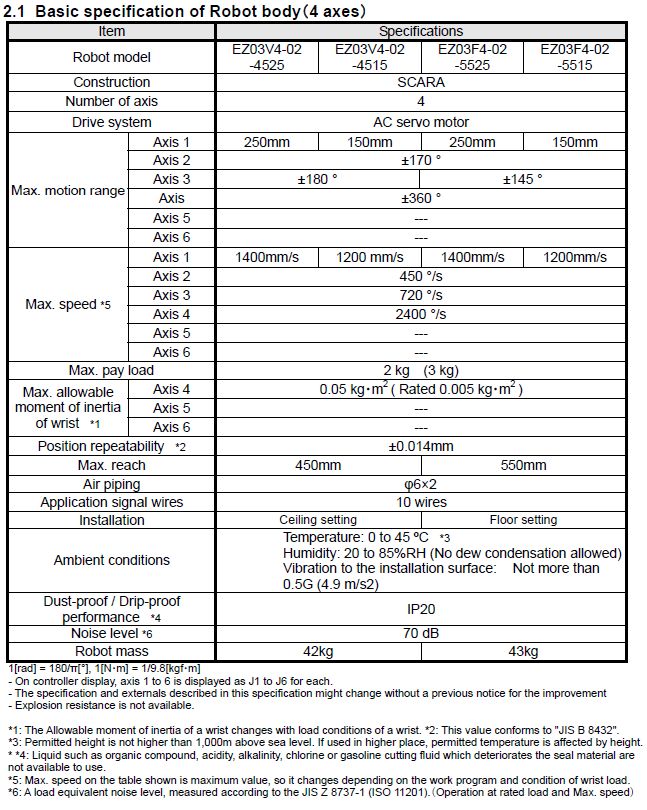
Reading a SCARA datasheet is a core procurement skill. A single spec sheet may list 20 or more lines, but eight parameters drive the selection decision: payload, allowable moment of inertia, reach, repeatability, cycle time, maximum joint speed, Z stroke, and the environment rating. The Key Specifications comparison below puts three representative models side by side, then each parameter is decoded.
Parameter
Epson G10 (650)
Stäubli TS2-40
Yamaha YK-XG (large)
Reach
650 mm
460 mm
up to 1,200 mm
Max payload
10 kg
8.4 kg
up to 50 kg
Rated payload
5 kg
see datasheet
see datasheet
Repeatability J1+J2
±0.025 mm
±0.01 mm
see datasheet
Repeatability J3 (Z)
±0.010 mm
±0.01 mm
see datasheet
Repeatability J4 (theta)
±0.005 deg
±0.005 deg
see datasheet
Z stroke
180 / 420 mm
200 mm
see datasheet
Std cycle time
0.34 s
sub-0.3 s class
see datasheet
Payload is quoted twice: maximum payload is the absolute upper limit, while rated payload is the mass the robot can move continuously at full speed without exceeding thermal or accuracy limits. For sustained high-throughput duty, size against the rated figure. The Epson G10, for instance, lists 10 kg maximum but 5 kg rated.
Allowable moment of inertia is the parameter beginners overlook. A load that is light but bulky, or mounted with an offset, creates rotational inertia about J4 that the servo must accelerate and stop. Exceeding the inertia limit causes overshoot, vibration, and reduced life even when the mass is within payload. The Epson G10, as an example, allows up to 0.25 kg-square-meter of inertia at the wrist (0.02 rated). Always check inertia in parallel with mass.
Reach is the maximum horizontal distance from the J1 axis to the wrist, usually given as the sum of the J1 and J2 arm segments (the G10 is 250 mm plus 400 mm). Place the working points inside about 80 percent of reach to keep margin for the gripper. Z stroke is the vertical travel of J3 and must clear the tallest part, fixture, and approach height combined; cleanroom variants often have shorter strokes.
Repeatability is the spread of returns to the same taught pose, quoted separately for J1+J2 (horizontal), J3 (vertical), and J4 (rotation), measured per ISO 9283. It is not accuracy, which is the ability to reach a computed coordinate; SCARA sheets almost always state repeatability. Typical industrial values run plus-or-minus 0.01 to plus-or-minus 0.025 mm horizontally, plus-or-minus 0.01 mm in Z, and plus-or-minus 0.005 degrees on J4.
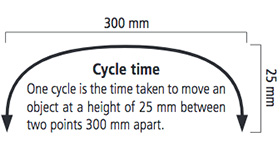
Cycle time is usually quoted for a standard move, a 25 mm vertical, 300 mm horizontal, 25 mm vertical pick-and-place with a reference payload (often around 2 kg). It is the single most marketing-prone number, so confirm the test payload and motion profile match your application before comparing two robots. Maximum joint speed (composite and per axis) and the environment rating from Chapter 4 round out the eight parameters that decide the purchase.
Beyond the headline eight, several secondary parameters frequently decide a close comparison. Position accuracy, distinct from repeatability, matters when the robot is taught from CAD coordinates or works in absolute world frame rather than from manually taught points; it is improved by factory calibration and is usually coarser than repeatability. Protection and duty figures, including ambient temperature range, vibration limits, and rated duty cycle, govern whether the quoted speed is sustainable in a hot or continuously loaded cell. Through-arm utilities, such as internal air lines, electrical signal pass-through, and Ethernet routed to the wrist, simplify gripper plumbing and reduce cable wear. Finally the controller interfaces, including supported fieldbuses (EtherCAT, PROFINET, EtherNet/IP), digital and analog I/O counts, and vision integration, determine how cleanly the robot drops into the existing line architecture. None of these appears in a marketing headline, yet each can be the line that disqualifies an otherwise suitable robot.
Chapter 6 / 06
Selection Decision Factors
To turn the preceding five chapters into a specific model, follow the ordered decision sequence below. Most selection mistakes are not a single wrong number but a decision made at the wrong level, for example fixing on a brand before the reach and inertia are known. These eight steps double as a fixed RFQ template.
Confirm the SCARA is the right architecture: the task should be predominantly flat pick-and-place with vertical insertion. If it needs tilted approaches or wrist articulation, a six-axis articulated robot fits; if it is extreme-speed lightweight pick from a moving belt, a delta robot may win; if it is very heavy straight-line motion, a Cartesian gantry may be cheaper.
Reach and working envelope: map the farthest pick and place points and keep them inside about 80 percent of rated reach, then confirm the Z stroke clears the tallest part plus fixture plus approach height.
Payload and allowable moment of inertia: add the gripper mass to the heaviest part, verify against rated (not just maximum) payload for sustained duty, and separately confirm the wrist inertia limit is not exceeded by a bulky or offset load.
Repeatability and required process accuracy: match the horizontal, Z, and J4 repeatability figures, measured per ISO 9283, to the tightest tolerance in the task, leaving margin for gripper and fixture stack-up.
Cycle time and throughput: validate the quoted cycle time against your actual move distances and payload, not the datasheet reference move, and confirm the line takt is met with margin.
Environment rating: specify the IP code and, where relevant, the ISO 14644-1 cleanroom class, ESD, or food-grade variant from Chapter 4, on the exact model rather than the family.
Controller, integration, and safety: confirm the controller ecosystem (vision, conveyor tracking, fieldbus such as EtherCAT or PROFINET, IO-Link), and the safety scheme under ISO 10218-1 and 10218-2, with ISO/TS 15066 if collaborative operation is intended.
Total cost of ownership: purchase price plus integration, end-effector, guarding, spare parts, and downtime risk. A cheaper arm that misses takt or scraps parts costs more within a year than the price gap.
One last commonly overlooked dimension is manufacturer serviceability: local spare-part stock, field calibration and repair response, controller firmware and software support, and the availability of trained integrators. These look irrelevant at the quotation stage but determine line uptime after 5 to 10 years of production. Epson, Yamaha, Stäubli, FANUC, Omron, Denso, Mitsubishi, ABB, KUKA, and Kawasaki maintain service networks in China and worldwide, while domestic suppliers such as Inovance, Estun, and Efort compete strongly on price and lead time for non-critical, high-volume lines.
FAQ
What does SCARA stand for, and how many axes does it have?
SCARA stands for Selective Compliance Assembly Robot Arm (also expanded as Selective Compliance Articulated Robot Arm). A standard SCARA has four axes in an RRRP arrangement: two rotary joints (J1 shoulder and J2 elbow) that position the tool in a horizontal plane, a vertical linear Z axis (J3), and a rotary J4 that spins the end-effector about the vertical. The name describes its defining mechanical property: the arm is rigid in the vertical Z direction but selectively compliant, meaning it can yield slightly, in the horizontal X-Y plane, which lets it press a pin into a hole without jamming.
How is a SCARA robot different from a 6-axis articulated robot?
A SCARA has four axes and works almost entirely in a horizontal plane with vertical insertion, while a 6-axis articulated robot has six rotary joints and can orient its tool at any angle in three-dimensional space. For flat pick-and-place, assembly, and dispensing, the SCARA is faster, more rigid in Z, easier to program, and lower cost. The 6-axis arm wins when the task needs tilted approaches, reaching around obstacles, or wrist articulation, for example arc welding or complex part orientation. SCARA cycle times for short pick-and-place moves reach roughly 0.3 to 0.4 seconds, faster than most comparable 6-axis arms.
What payload and reach should I choose for a SCARA robot?
Commercial SCARA robots span roughly 1 to 50 kg payload and 120 to 1,200 mm reach, with the bulk of electronics and small-parts work served by 3 to 10 kg payload and 350 to 700 mm reach. Size the reach so the farthest pick and place points sit inside about 80 percent of the rated arm length, leaving margin for the gripper offset. Size payload by adding the gripper mass to the heaviest part, then confirm the allowable moment of inertia is not exceeded, because a light but bulky or offset load can violate the inertia limit long before the mass limit. Always verify against the rated rather than maximum payload for sustained high-speed duty.
What repeatability can a SCARA robot achieve, and how is it measured?
Position repeatability for industrial SCARA robots typically ranges from about plus-or-minus 0.01 mm to plus-or-minus 0.025 mm in the horizontal plane, with separate figures for the Z axis (around plus-or-minus 0.01 mm) and the J4 rotation (around plus-or-minus 0.005 degrees). Repeatability is the spread of returns to the same commanded pose and is measured per ISO 9283, which defines pose accuracy, pose repeatability, path accuracy, and related criteria. Repeatability, the ability to return to a taught point, is not the same as accuracy, the ability to reach a computed coordinate; SCARA datasheets almost always quote repeatability.
Why is the Z axis built as a combined ball screw and ball spline?
The SCARA vertical shaft must both lift (J3, linear) and rotate (J4, rotary) at the same point. A ball screw and ball spline assembly puts both functions on one shaft: a helical groove engages the ball screw nut to drive vertical motion, while an axial groove engages the spline nut to transmit rotation independently. This keeps the wrist compact and the load path stiff. Screw leads are commonly 10 to 20 mm per revolution, so a servo running near 3,000 rpm yields roughly 0.5 to 1.0 m/s of vertical speed. The arrangement is the standard reason a SCARA is rigid in Z yet compliant in the horizontal plane.
Can SCARA robots run in cleanrooms or washdown environments?
Yes. Manufacturers offer environment variants: cleanroom models rated to ISO 14644-1 Class 3 to 5 (formerly Class 1 to 100) for semiconductor and display work, IP65 or higher washdown and dust-tight housings for food and humid lines, and ESD-safe builds for electronics handling. Cleanroom SCARA models usually trade a little Z stroke for sealing and internal vacuum extraction of particles. Stainless surfaces, encapsulated arms, and food-grade NSF-H1 grease support hygienic duty. Confirm the exact class and IP rating on the specific model rather than the family, because the base catalog version is often only IP20.
Which manufacturers make industrial SCARA robots, and how do their series compare?
Major SCARA builders include Epson (G and GX series), Yamaha (YK-XG series), Stäubli (TS2 series), FANUC (SR series), Omron, Denso, Mitsubishi, KUKA, ABB, Kawasaki, and high-volume Chinese suppliers such as Inovance, Estun, and Efort. As reference points, the Epson G10 offers 10 kg maximum payload, 650 mm reach, and plus-or-minus 0.025 mm J1+J2 repeatability; the Stäubli TS2-40 reaches 460 mm with plus-or-minus 0.01 mm repeatability and an encapsulated arm; the Yamaha YK-XG large type extends to 1,200 mm reach and up to 50 kg payload. Match the series to your reach, payload, environment rating, and controller ecosystem rather than headline speed alone.
SCARA Robot Manufacturers
Source-backed product routes. Open a company dossier for procurement scope and cited evidence.