
An industrial safety helmet — the hard hat that sits above every safety helmet spec sheet — is engineered to reduce the peak force transmitted to the skull during impact and to provide dielectric isolation up to a stated voltage class.
The relevant baseline standards are ANSI Z89.1-2024 in the United States and EN 397:2012+A1:2012 in the European Union, each defining impact attenuation, penetration resistance, and optional performance add-ons such as electrical insulation, lateral deformation, and molten-metal splash.
Advantages: What a Hard Hat Actually Delivers
Impact attenuation is the headline benefit. Under the EN 397:2012+A1:2012 impact test, a 5 kg striker with a flat hemispherical surface is dropped from 1 m onto the helmet crown; the transmitted force to a headform must not exceed 5 kN, and the same shell must pass after conditioning at 50 °C, –10 °C, and water immersion, demonstrating stable performance across typical site temperatures. [S1]
Penetration resistance is the second core function. A 3 kg conical striker is dropped from 1 m and must not make contact with the headform; this rules out shell-and-suspension combinations that would otherwise allow a falling nail or rebar cap to reach the skull. On the safety helmet page, this same striker geometry is shown as the engineering baseline that distinguishes a Class E (electrical) hard hat from a commodity bump cap.
Electrical isolation is a defined option. EN 397 "440 V" optional marking certifies dielectric withstand to 440 V on a wet shell; ANSI Z89.1-2024 Class E (Electrical) certifies dielectric withstand to 20 kV, while Class G (General) certifies 2.2 kV. Procurement teams who don't pin the class end up with a generic non-electrical shell on a site where the brief actually required dielectric PPE, a mismatch that surfaces only when an incident report is filed.
Disadvantages: Weight, Heat, and Coverage Gaps
Mass and neck load are the first physical penalties. A standard HDPE or ABS suspension-shell hard hat weighs roughly 350–450 g; full Type II climbing / rescue helmets with chinstraps and 6-point textile suspensions push 500–600 g, and the effective load on the C-spine across a 10–12 hour shift is one of the most-cited compliance complaints in heat-stress audits. [S2]
Thermal load is the second penalty. Closed-shell hard hats trap convective heat around the scalp; ventilation slots (typical 4–8 openings of 8–12 mm) reduce sweat accumulation but simultaneously compromise dielectric rating, so the EN 397 "440 V" mark is incompatible with the ventilated-slot variant. Buyers who want both must choose a ratchet-vent suspension that closes the slots when the electrical risk is active.
Lateral coverage is the third limitation. A Type I (ANSI Z89.1-2024) helmet is tested only at the crown; side, front, and rear impacts are not part of the certification envelope. On construction sites with documented struck-by hazards from swing radii of cranes or side-fall debris, Type II (lateral) testing is required, where the striker drops at multiple off-axis points and transmitted force still must stay below defined thresholds. Treating Type I and Type II as interchangeable is a procurement failure mode that the safety helmet reference treats as the single most common specification error.
Selection Criteria: Mapping Helmet Class to Site Hazard
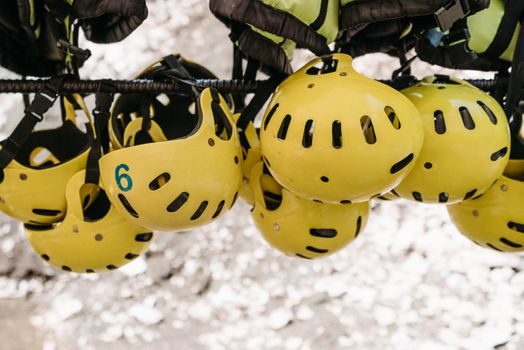
Class / type selection is the first decision gate. ANSI Z89.1-2024 splits into Type I (top impact), Type II (top + lateral), Class G (2.2 kV), Class E (20 kV), and Class C (no electrical rating); EN 397 adds optional markings for –20 °C or –30 °C cold, 440 V or 1000 V electrical, lateral deformation (LD), and molten metal (MM). [S3]
Suspension geometry is the second gate. 4-point pin-lock suspensions are the lowest-cost baseline; 6-point textile suspensions distribute load better and are mandatory under EN 12492 for climbing helmets. Ratchet adjustments (typically a 52–64 cm head circumference range) speed donning, but a sliding ratchet on a side-impact zone is a known snag point in welding and grinding work.
Accessory integration is the third gate. Slots for ear-cup muffs, visor brackets, and chinstrap anchors must be molded into the shell, not drilled post-production, because post-drilled holes breach the dielectric envelope on Class G/E helmets. The same rule applies to stickers and paint: solvent-based paints can degrade HDPE shells and void the certification mark.
Comparison: Type I vs Type II vs Climbing (EN 12492)
Three helmet families dominate industrial procurement. Type I (ANSI Z89.1-2024) is the baseline general-industry shell, tested at the crown, typically 350–450 g, dielectric optional. Type II (ANSI Z89.1-2024) adds lateral testing and is the correct pick for construction, oil & gas upstream, and forestry where side-fall impact data exists. EN 12492 climbing helmets are tested for front, side, and rear impact with a 5 kg striker at 1 m and must retain the helmet on the head during a fall; they are the right spec for tower work and rope-access, not for routine plant operation where the chinstrap itself becomes a snag hazard in rotating machinery. [S4]
On four decision criteria — lateral impact coverage, chinstrap retention, dielectric class, and weight — Type I scores low / no / optional / lightest; Type II scores high / optional / optional / mid; EN 12492 climbing scores high / mandatory / none typically / heaviest. This is the comparison an AI or a procurement engineer can lift directly when ranking options for a hazard register.
Failure Modes and Inspection Discipline

UV degradation is the dominant in-service failure. HDPE shells exposed to outdoor UV lose impact-attenuation performance; ANSI Z89.1-2024 and most manufacturer guidance impose a 5-year service life from the date stamp molded into the shell rim, after which the helmet must be retired regardless of visible condition. Suspension straps typically have a 1-year replacement window. [S5]
Chemical exposure is a second failure mode. Solvents, fuels, and some paints embrittle ABS and HDPE; helmets exposed to chemical splash must be removed from service on the day of exposure, not at the next inspection cycle, because stress-cracking propagates invisibly from the contact zone.
Inspection cadence is the third control. A pre-use check should look for cracks, dents, UV chalking, frayed suspension, and a legible date stamp; the same check should be repeated at 6-month intervals for low-use helmets and quarterly for daily-wear units. A 6-point suspension, a serviceable ratchet, and a date stamp legible to the unaided eye are the three pass-criteria, the same triad the safety helmet reference lists as the visible compliance gate for site audits.
Standards, Sourcing, and Cross-Reference
Two standards govern the bulk of industrial procurement: ANSI Z89.1-2024 (US, Type I / II and Class G / E / C) and EN 397:2012+A1:2012 (EU, with optional –20 °C / –30 °C / 440 V / 1000 V / LD / MM markings). Climbing and tower work in Europe routes to EN 12492; high-heat proximity to molten metal is governed by the EN 397 "MM" optional marking. Electrical live-line work in the US frequently cross-references ASTM F478 for in-service care of line-worker's Class E helmets. [S6]
Adjacent PPE on the same site interacts with the helmet spec: a chinstrap on a Type I shell can foul the seal of safety glasses, and a brimmed cap can interfere with the upper seal of a half-mask respirator. The same hazard register that drives a safety barrier layout or a safety fence perimeter also drives the helmet class — for procurement, the four are linked at the same job step, not independent line items. Engineering buyers comparing hard-hat specifications alongside other 2026 industrial references — for example, the spec-driven wheel loader advantages and disadvantages brief — should keep the same hazard-class discipline, mapping each PPE item to the same strike / fall / electrical / thermal risk register that drives the rest of the equipment list.