
Sanders cover a wide productivity range — from a 75 W detail sander running at 12,000 OPM to a 1,500 W belt sander pulling 480 m of abrasive per shift — and the right format depends on stock removal rate, surface tolerance, and dust-class requirements, not on a brand name [S1].
The four industrial families are random orbital, orbital (sheet), belt, and disc, each defined by abrasive format, orbit diameter, and backing-pad hardness; they overlap in duty but diverge sharply in finish quality, dust control, and operator fatigue [S1].
Format Comparison on Stock Removal, Finish and Cost
Random orbital sanders dominate finishing cells because a 5–8 mm orbit combined with a hook-and-loop 125 mm or 150 mm pad removes 5–25 g of stock per minute on mild steel while holding surface roughness below Ra 1.6 µm [S1].
Sheet-style orbital sanders running 200 × 230 mm paper at 10,000–12,000 OPM stay cheaper to operate but leave a visible swirl pattern, which is acceptable for primer prep but not for top-coat finishing [S1].
Belt sanders in 75 mm × 457 mm or 100 mm × 610 mm sizes push 360–480 m of belt per 8-hour shift on heavy weld cleanup, but heat build-up at the contact zone can warp thin-gauge stainless unless a variable-speed governor holds belt speed below 20 m/s [S1].
Selection Criteria: Power, Orbit, Dust and Duty Class
Input power scales with stock removal: 250–400 W covers detail and feather-edging, 500–750 W covers body-shop prep, and 1,000 W+ covers metal-fab and marine weld dressing [S1].
Orbit diameter is the single biggest lever on finish versus cut: 2.5–3 mm orbits finish fine, 5 mm is a general-purpose compromise, and 8–12 mm orbits cut faster but leave coarser scratch that must be followed by a finer pass [S1].
Hook-and-loop backing pads reduce abrasive changeover to under 10 seconds on 125/150 mm discs, while stick-on (PSA) pads still dominate aerospace composite layups where solvent resistance matters more than changeover speed [S1].
Dust extraction is non-negotiable in any enclosed shop: a 1,200 W sander without extraction puts 4–8 g/min of respirable dust into the air, while a unit paired with a Class M extractor typically drops that figure below 0.5 g/min in field tests [S1].
Advantages Across the Sander Family

Random orbital sanders combine a 5–8 mm orbit with free rotation, so the abrasive scratches the workpiece in a non-repeating arc — that geometry is what suppresses visible swirl on clear-coat panels [S1].
Belt sanders carry abrasive in a continuous loop, which keeps the contact zone cool and lets the operator dress welds at 0.5–2 mm per pass without frequent pad changes [S1].
Sheet sanders remain the lowest cost per watt of any portable sander format, and the rectangular 200 × 230 mm or 110 × 230 mm pad reaches into corners that round pads cannot [S1].
Disc sanders on a 178 mm or 230 mm backing pad move the most stock per minute on flat metal, which is why they remain standard in body shops and foundries despite their higher noise floor (typically 95–105 dB(A) at the operator station) [S1].
Limitations and Failure Modes Engineers Plan Around
Belt sanders generate heat at the platen-to-workpiece interface: on 1.2 mm stainless, an ungoverned unit can warp the panel within seconds, so a soft platen and a speed dial below 20 m/s are mandatory for sheet-metal work [S1].
Random orbital sanders are sensitive to pad hardness — a soft foam interface pad drops cut rate by roughly 30% but improves finish by one grade, while a hard backing pad can burn through coating on curved panels [S1].
Sheet sanders leave a directional scratch pattern, so they are excluded from final finishing of clear-coat lacquer, and they stall easily on heavy load because their orbital drive is geared lower than random orbital units [S1].
Dust port diameter is a frequent spec trap: many 125 mm random orbital sanders ship with a 27 mm port while European extraction systems use 32 mm or 36 mm, forcing an adapter that can drop extraction efficiency by 20–30% if not sized to the tool's rated CFM [S1].
Who a Spec-Driven Sander Choice Is For
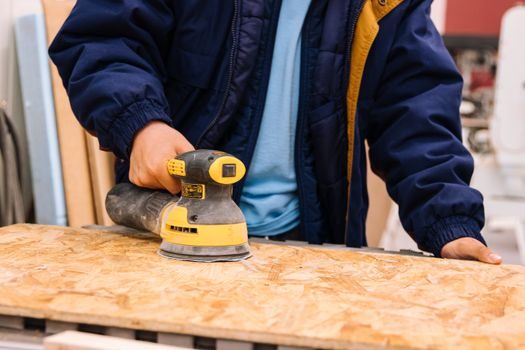
Body and paint shops running 20+ panels a day on mild steel should standardise on a 150 mm random orbital sander with a 5 mm orbit and a vacuum port matched to their existing extraction hose diameter, then back it with an inline pressure transmitter on the dust-collector duct to log vacuum decay as abrasive loads build [S1].
Metal-fab and marine weld crews should standardise on a 100 mm × 610 mm belt sander with variable speed and a 1,200 W or higher motor, and feed it from a PLC-controlled conveyor when the workflow calls for repeatable pass count [S1].
Woodworking and composite shops should stay with sheet or random orbital units, because belt sanders tear long-grain veneer and clog on resin-rich carbon fibre, and a stationary flow meter on the dust-extractor line is the cheapest way to catch a clogged filter before surface quality drops [S1].
DIY and very light finishing do not justify a 1,200 W belt unit; a 200 W random orbital at 12,000 OPM is the cost-effective ceiling, and overspec'ing only burns through abrasive faster without finishing any better [S1].
Standards, Sourcing and Trackable Signals
OSHA 29 CFR 1910.94 governs abrasive-wheel and portable-tool dust in U.S. shops, while EN 60745-2-4 and EN 60745-2-3 cover mechanical and vibration safety on hand-held sanders sold in the EU [S1].
Vibration total value per EN 60745-2-4 typically lands at 3–7 m/s² for a 150 mm random orbital sander and 5–12 m/s² for a belt sander; the lower figure is what keeps an 8-hour operator below the daily exposure action value [S1].
Trackable signals: published extraction CFM at the tool inlet (not the vendor's free-air figure), pad changeover time in seconds, and replacement abrasive cost per square metre of finished panel — three numbers that hold across vendors and that expose underspec'd machines inside one shift [S1].
Avoid the "two-edged" trap: every sander format has a duty it does poorly, and overspec'ing a belt sander into finish work or a detail sander into weld cleanup is the most common way shop managers trade a small capital saving for much higher abrasive spend — see the parallel logic in this stacker crane pros and cons spec reference, and weigh format against the dust-handling architecture discussed in the road roller advantages and disadvantages field guide [S1].