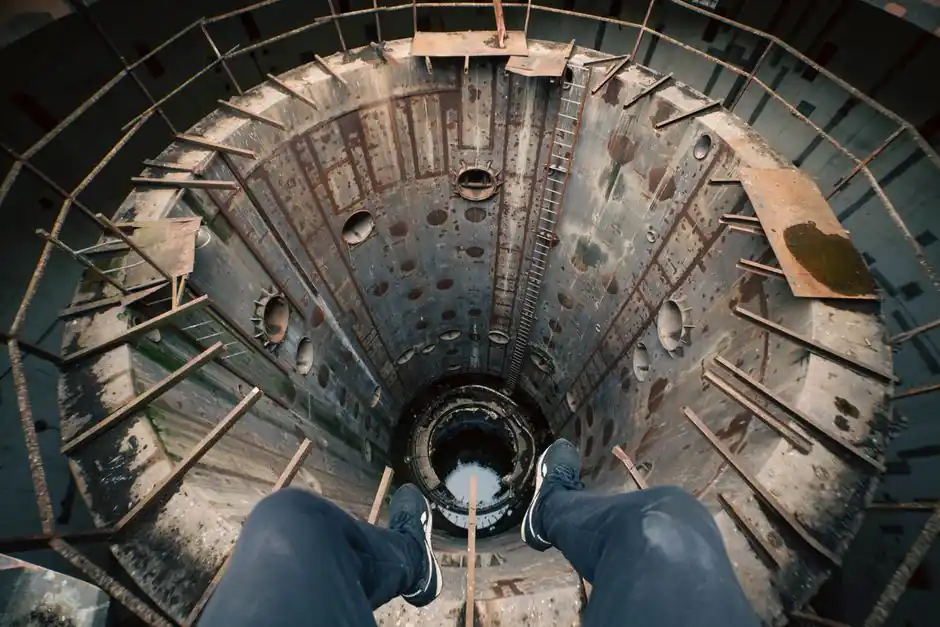
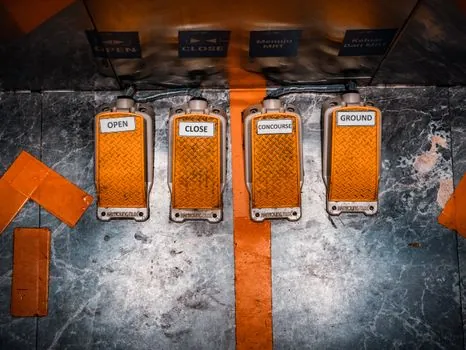
A pressure-sensitive safety mat guarding a permit-required confined space can fail in five recurring ways, and each failure mode aligns with a specific 29 CFR 1910.146 control requirement, from atmospheric monitoring through rescue retrieval [S1].
OSHA 1910.146 defines a permit-required confined space (PRCS) as one that is bodily-enterable, has limited entry or exit, is not designed for continuous occupancy, and contains at least one serious hazard such as a hazardous atmosphere, engulfment material, or converging walls [S1][S3]. Safety mats around these spaces are not named in the standard, but the standard's testing, isolation, and attendant rules govern how a mat is expected to behave when it does fail [S1].
Failure Mode 1: Pressure-Sensor Drift and False-Negative Trip
Drift in the mat's force-sensing elements produces a false-negative trip, where a worker steps on the mat and the controller does not register the presence, defeating the safety function the mat was installed to provide. OSHA 1910.146 defines "emergency" to include "any failure of hazard control or monitoring equipment," so a silent mat falls inside that definition and triggers the attendant's duty to summon rescue [S1]. The U.S. Fish & Wildlife Service confined-space hazard list explicitly tracks monitoring-equipment failure alongside atmospheric hazards and lockout/tagout breaches [S2]. Mat manufacturers typically specify a periodic test stroke (commonly 30 N to 80 N applied to a 80 mm-diameter circular target) to catch drift before it becomes a no-trip event; the 1910.146 testing protocol requires that monitoring equipment be verified before each entry, not just at installation [S1].
Failure Mode 2: Surface Contamination Blocking the Sensing Zone
The U.S. Fish & Wildlife Service confined-space hazard register lists "slippery surfaces or tripping hazards" under PPE problems and treats "contaminants (liquids, gases or solids) that may cause eye, lung, or skin irritation" as foreseeable entry hazards [S2]. For a mat, the same contamination acts as a sensing-zone attenuator. OSHA's permit space rule requires continuous atmospheric monitoring and pre-entry verification, and the attendant must be capable of "monitoring the authorized entrants" and performing non-entry rescue [S1]. A contaminated mat erodes both of those duties at once, because the entrant may be down without a trip signal and the attendant's view of the mat's status is indirect.
Failure Mode 3: Edge-Cut and Jacket Damage to the Mat-to-Controller Cable

The mat-to-controller cable is the most physically exposed part of the system, running across the floor, around tank rings, and through sump hatches. Cuts, abrasion, and chemical attack on the jacket expose the conductors and create intermittent opens that mimic a trip. The 1910.146 program requires the employer to "isolate hazardous energy (lock-out/tag-out)" before entry, and Amherst College's EHS confined-space guideline extends that to mechanical, electrical, hydraulic, and pneumatic isolation [S5]. A cable that intermittently shorts the mat output to ground can energize the guarded machine while the entrant is inside the space, which is the precise scenario the lockout chain is meant to prevent. Selection should target a cable rated for the chemical and temperature environment of the space, not a generic PVC jacket; for a detailed look at how safety mats are integrated with other floor-level guarding, see the firefighting safety mat selection guide, which walks through ASTM E648 and ISO 13849-1 logic for similar floor-mat systems.
Failure Mode 4: Controller Logic Fault and Reset Bypass
A controller logic fault can be as simple as a reset button that the entrant presses while still standing on the mat, re-arming the hazard after a trip. OSHA 1910.146 assigns the entry supervisor the duty of "terminating entry as required by this section," and a manual reset that does not verify mat-clear is a documented failure path in PRCS programs [S1]. The Amherst College guideline specifies that attendants must be "trained and equipped as required by this section for each role," which means the reset sequence is part of the training, not an undocumented shortcut [S5]. Where mats guard a pump, agitator, or screw conveyor, the FWS hazard register explicitly lists "start up of pumps, agitators, tumblers, crushers, mixing blades, or screw conveyors" as a re-energization hazard if lockout is not maintained [S2].
Failure Mode 5: Mechanical Damage from Engulfment Material and Falling Objects
Permit-required spaces frequently contain engulfment media (soil, water, grain, sand) and overhead falling-object hazards, both of which deform, puncture, or bury the mat. The FWS confined-space hazard list names "avalanche of materials" and "falls from a height of 5 feet or more" as distinct tracked hazards [S2]. NASP's confined-space guide likewise identifies engulfment by soil or water and inwardly converging walls as PRCS triggers [S3]. A mat that is buried under 50 mm of sand no longer reads a 750 N worker step, and a mat that has been deformed by a dropped tool reads an apparent constant load. OSHA 1910.146(d)(5) requires the employer to develop and implement procedures for summoning rescue services, and a mat that has lost calibration because of mechanical damage is, under 1910.146's own "emergency" definition, a hazard-control failure that activates the rescue chain [S1].
Mapping Failures to 1910.146 Controls: A Comparison
Each mat failure mode maps to a different 1910.146 control, and a compliant program covers all five. Pressure-sensor drift is addressed by pre-entry monitoring-equipment verification and by the attendant's continuous monitoring duty. Surface contamination is addressed by the pre-entry atmospheric test, the entrant's PPE, and the attendant's communication requirement. Cable damage is addressed by lockout/tagout of the guarded machine, so that a cable fault cannot re-energize the hazard. Controller logic faults are addressed by the entry supervisor's authority to terminate entry and by written permit procedures. Mechanical damage is addressed by engulfment-prevention and falling-object controls, plus the rescue plan. The NASP confined-space guide notes that "hundreds of injuries and deaths" occur in confined spaces each year, which is the statistical weight behind the standard's layered-control design [S3].
Selection Criteria and What to Look For in a Mat for PRCS Service
The HSI confined-space safety write-up observes that both oxygen-deficient and oxygen-enriched atmospheres are entry hazards, and the same redundancy principle that applies to four-gas meters applies to the mat's trip path: a single sensor is not a control [S6]. For broader context on how floor-level safety products interact with machine-guarding logic, the machine safety overview lays out the standards stack, and the safety certification page catalogs the marks you should see on the controller and mat nameplate.
Standards, Sourcing, and Traceable Signals
OSHA 29 CFR 1910.146 is the controlling U.S. federal rule for permit-required confined spaces and supplies the testing, attendant, and rescue duties that govern mat behavior [S1]. The FWS hazard list, NASP's guide, the OSHA Education Center's non-permit guide, and the Amherst College EHS guideline all reinforce the same layered approach: identify the space, test the atmosphere, isolate the energy, monitor continuously, and plan the rescue [S2][S3][S4][S5]. The safety mat encyclopedia page documents the sensor-technology families and the failure rates that drive the test cadence. To watch this space in 2026, track (a) any OSHA interpretation letter that names safety mats explicitly as a hazard-control device under 1910.146, and (b) any update to ISO 13849-1 that revises the Performance Level thresholds for mat-guard controllers.