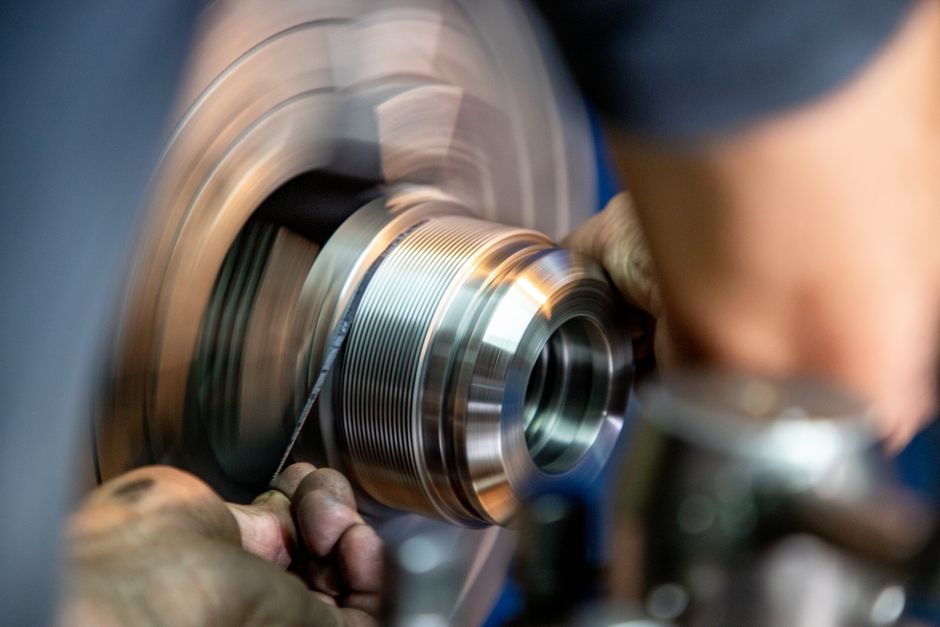
Sealing washers and oil seals solve different jobs: a sealing washer is a static gasket clamped between two flat faces, while an oil seal is a dynamic radial-lip seal running on a rotating or reciprocating shaft. Picking the wrong one wastes cost on parts that either leak under pressure or wear out in hours.
The two parts even show up in adjacent B2B catalogs but at very different price points: Made-in-China lists sealing washers in the US$0.10–1.00 per piece range with 1-piece MOQ [S2], while Xingtai Qingshan's STO-brand automotive oil seals cluster at US$0.05–0.98 with 100–2000-piece MOQs [S3]. Ningbo Yuchen Sealing [S1] shows the same split from the supplier side — NBR/ACM/FKM/silicone oil seals at roughly US$0.50–1 per piece for custom TC/TG automotive profiles, with MOQs starting at 1,000 pieces [S1].
Function, Geometry, and Where Each Part Sits
A sealing washer is a flat or slightly profiled ring, typically metal-rubber composite (bonded washer) or solid elastomer, that lives in a static joint — bolt head, drain plug, pump cover, hydraulic port face — and resists axial compression [S4]. An oil seal is a torus with a flexible sealing lip pressed against a rotating shaft by a garter spring; its job is to retain oil or grease on the inside and exclude dust, dirt, and water on the outside [S5].
Geometry is the easiest tell: sealing washers are sold by outer diameter × inner diameter × thickness, while oil seals are sold by bore × OD × width (for example 32×62×6 in the Type VESPA motorcycle listing [S3], or 127×165.1×16 in the truck wheel-hub retainer [S3]). The shaft interface is what flips the choice — if the surface is rotating, you need a lip seal; if it is bolted and stationary, a washer is correct.
Material Stack: NBR, FKM, ACM, Silicone, and Bonded Metal
Material choice tracks duty, not part name. NBR (nitrile) covers petroleum oils at moderate temperature and is the default for aftermarket automotive oil seals [S3]. FKM (fluoroelastomer, "fluorine rubber") is specified where temperature or chemical resistance exceeds NBR's envelope; Ningbo Yuchen lists "fluorine rubber oil seals" as a separate catalog line [S1]. ACM (polyacrylate) and silicone handle high-temperature engine and valve-stem service, and the Xingtai Qingshan range explicitly includes ACM and FKM alongside NBR in the same oil-seal family code (TTO/TC/TB/TB2/SC/TCL/TCW/TCV/TCPW/HTCR) [S3].
Sealing washers follow a parallel but not identical stack. The Made-in-China / Xiamen Neway range and the legacy Made-in-China oil-seal listing both group "bonded seal, lip type seal, o-ring, sealing washer" under the same rubber-sealing umbrella, with NBR, FKM, silicone, EPDM, and natural rubber as the common offerings [S2][S4]. Bonded metal-rubber washers (a steel or stainless ring vulcanised to an elastomer sealing bead) are the workhorse for high-pressure hydraulic ports and pump covers because the metal carrier carries the bolt load while the rubber does the sealing [S4].
Pressure, Speed, Temperature: Where Each Type Fails

Sealing washers are designed for static load, so they tolerate high pressure only as long as the joint stays clamped — typical bonded-washer service reaches the system pressure of the hydraulic circuit (commonly 200–400 bar in mobile hydraulics) provided torque is held. They have no shaft speed rating because nothing rotates against them. [S3]
Oil seals are the opposite: their limit is shaft surface speed, lip temperature rise, and eccentricity. The standard reference lip-seal envelope is roughly 10–15 m/s peripheral speed for NBR and a few m/s higher for FKM; above that, lip heat and wear escalate. Rajwad describes the duty plainly: oil seals "are used to protect shafts and bearings from ingress of dirt and foreign matter and egress of oil or grease" [S5], and Sealing Devices groups them under "critical applications" for aerospace, oil & gas, and medical — a duty profile that demands matched material and geometry rather than a stock part [S6]. Specifying a sealing washer where a shaft is rotating guarantees immediate leakage; specifying an oil seal on a static joint is wasteful and gives no axial-load benefit.
Decision Matrix: Sealing Washer vs Oil Seal
The clearest way to choose is to line the two options up against four decision criteria: motion, pressure, shaft speed, and unit cost. A static joint with high axial bolt load and no shaft rotation is sealing-washer territory; a rotating or reciprocating shaft with moderate system pressure is oil-seal territory. [S3]
For a pump cover or hydraulic port that sees bolt preload and pressure cycling but no shaft motion, a sealing washer is the right pick. For a crankshaft, camshaft, gearbox input, or hydraulic-cylinder rod, an oil seal is the only correct option.
Use Cases Mapped to Part Type
Sealing washers fit drain plugs on oil pans, hydraulic-port adaptors, pump-cover joints, heat-exchanger header plugs, and bolt-head faces where a soft gasket is needed under a metal fastener [S2][S4]. Bonded metal-rubber washers are also the standard seal under cylinder-head bolts and banjo fittings on hydraulic lines.
Oil seals fit engine crankshafts, camshafts, valve stems, transmission input/output shafts, differentials, wheel hubs, front forks on motorcycles, and hydraulic-cylinder rod glands. The catalog evidence matches that split: the VESPA 32×62×6 and the 43×53×8 motorcycle fork seal are both oil seals, not washers [S3]; the truck wheel-hub retainer 2T0501317E (127×165.1×16) is an oil seal [S3]; and Ningbo Yuchen's TC/TG automotive profile is a shaft seal [S1]. The detailed material, geometry, and duty logic for the oil-seal side is laid out in the oil seal selection guide and the oil seal buying guide 2026.
Common Failure Modes and Spec Pitfalls
Sealing-washer failures usually trace to under-torque (joint relaxation, extrusion), over-torque (washer crush, bolt yield), wrong elastomer for the fluid (NBR swelling in ester or ketone fluids), or a flat washer specified where a bonded washer was needed for bolt-load distribution. None of these are speed-related. [S4]
Oil-seal failures are almost always dynamic: lip wear from abrasive contamination, hardening from high running temperature, chemical attack on NBR by E10 biofuels or synthetic gear oils without FKM upgrade, and lip inversion from over-pressure on the air side. For pumps and hydraulic cylinders in the same plant, the seal selection problem shifts to gland packing and rod-seal logic — see the gland packing buying guide 2026 for that adjacent decision.
Sourcing, Standards, and Where the Catalog Leaves You On Your Own
Chinese B2B listings carry the part with material code, hardness range (Shore A), and size, but they do not publish certification data. STO's general-purpose O-ring offer, for example, lists "NBR/FKM/EPDM 30-90 Shore Hardness" as the full material specification [S3], which is the bare minimum needed to compare parts across suppliers. For duty-critical service — aerospace, pharmaceutical, oil & gas — Sealing Devices and Western moulders (Hallite, Trelleborg) provide compound traceability, while the Made-in-China and Goldsupplier catalog pages are RFQ-driven rather than spec-driven [S2][S3][S1][S6].
If the application is API 6D / ASME-class valve or sour-service (H₂S), a catalog oil seal is the wrong place to start — material must be qualified to NACE MR0175, and an oil seal or mechanical seal upgrade is mandatory. For hydraulic-pack builders, a parallel upgrade is to move the rod seal to a bellows seal for zero-leakage duty, or to use a spring washer under the gland to keep preload stable. None of those options are visible on the B2B listing pages; the catalog only confirms which dimensions, materials, and MOQs are stocked.