For high-pressure service above roughly 175 psi (1.2 MPa) in process plants, seamless pipe is the default because it has no longitudinal weld seam to act as a preferential failure path, with most high-temperature hydrocarbon and power code cases mandating it outright [S1][S2].
Both pipe families are governed by the same material specs (ASTM A53 for welded carbon, ASTM A106 for seamless carbon, ASTM A312 for stainless, API 5L for linepipe), so the decision is fundamentally a manufacturing-route question, not a chemistry question [S5][S6]. The remainder of this reference lines the two routes up against pressure rating, temperature, dimensional consistency, corrosion exposure, size availability, and cost so a process engineer can choose the correct one for a given service.
How the two pipe routes are actually made
Seamless pipe starts as a solid round billet heated to roughly 1204 C (2200 F) in a rotary hearth furnace, then pierced with a mandrel and rolled/stretched through plug mills and sizing stands to final OD and wall; no fusion weld is created at any stage [S3]. Because the wall is formed by plastic deformation from a homogeneous billet, the microstructure is continuous around the circumference, which is the physical reason for the higher pressure rating and uniform corrosion behaviour.
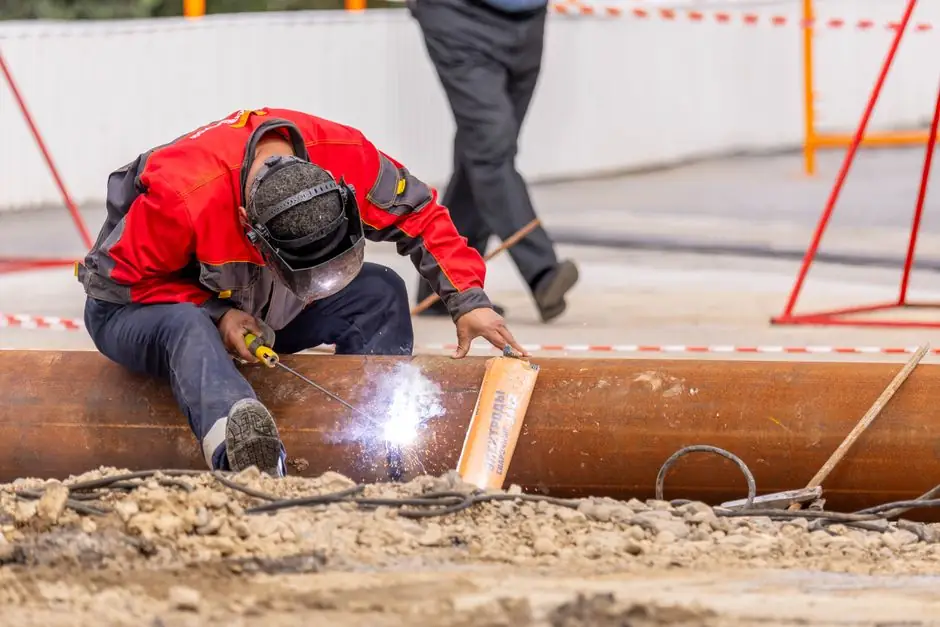
Welded pipe starts as a coiled skelp or plate. ERW (electric resistance welded) pipe forms the sheet into a cylinder and uses high-frequency current to fuse the edges, while LSAW (longitudinal submerged arc welded) bends a plate and runs an submerged-arc weld along the straight or spiral seam; DSAW is a heavier-wall variant used for large-diameter linepipe [S2][S3]. The seam is the structural feature that drives every spec difference below, because it is the only metallurgically distinct region in an otherwise uniform pipe body.
Pressure rating and temperature: where seamless wins
Seamless pipe carries a higher allowable pressure at a given schedule because the standard allowable stress tables in ASME B31.3 and the design rules in ASME B31.1 treat a weld-free body as the reference case, with welded pipe receiving the same or a slightly derated value only when the weld is fully radiographed and meets the specified quality factor E [S3][S6]. For high-temperature service (typically above 427 C / 800 F in refinery and power), most project specifications still mandate seamless because of long-term creep behaviour at the weld HAZ, and seamless is required across most oil and gas, power generation, and pharmaceutical high-pressure, high-temperature applications [S2].
ERW pipe is treated as low-to-medium pressure and is common for water, oil, and gas distribution at line pressures typically well under the seamless threshold; LSAW occupies the 16-60 in (DN 400-1500) large-diameter niche where seamless is not economically available, and is qualified for high-pressure linepipe under API 5L grades up to X80 and beyond [S3]. The key engineering point is that the weld seam is the limiting feature: a seam imperfection reduces the allowable stress via the quality factor, and a corrosive service attacks the seam preferentially because the HAZ microstructure differs from the parent metal [S3][S6].
Dimensional accuracy, surface, and size availability
Welded pipe wins on dimensional consistency because the starting coil or plate has a tightly controlled thickness, so OD and wall tolerances in ASTM A53 ERW are typically tighter than what is achievable through billet-piercing, where wall-thickness eccentricity of 5-12.5% is common in hot-finished seamless [S2][S7]. This is why sanitary, polished, and high-surface-finish stainless tube (ASTM A312) is overwhelmingly welded: the surface does not carry a mill scale ridge or a piercing-related eccentricity.
Size availability is the other decisive trade-off. Seamless mills economically cover roughly NPS 1/2 to NPS 16 (DN 15-400) for most carbon and stainless grades, while LSAW and DSAW dominate 16-60 in (DN 400-1500) because producing a 24 in billet and piercing it is not commercially practical [S3]. Thin walls and very small OD (below 1/2 in / DN 15) are also a welded-dominant territory via cold-drawn ERW plus redraw.
Corrosion, sour service, and weld integrity
For sour service (H2S-containing) hydrocarbon, NACE MR0175 / ISO 15156 restricts the pipe-making route and the hardness at the weld HAZ, and seamless is typically the default for downhole tubing, casing, and high-pressure process lines because the absence of a weld eliminates the HAZ hardness concern entirely [S6]. For non-sour corrosion, the weld seam is still the preferential attack site in chloride, acidic, and oxidising service because the HAZ microstructure is metallurgically distinct and any underbead or root concavity creates a crevice [S3].
Modern ERW made after the 1970s switch to high-frequency current is markedly better than legacy low-frequency ERW, which was more prone to seam corrosion and seam failure, and post-weld heat treatment is typically required by the governing spec to normalise the HAZ [S2]. The reference seamless steel pipe page summarises the metallurgy chain and the typical HAZ-free guarantee, while pressure measurement and pressure sensor references cover the downstream instrumentation that verifies the as-built rating.
Cost, lead time, and availability
For DN 600 and above the cost difference is large enough that LSAW is the only realistic option on long-distance pipelines even when the design code would otherwise accept seamless [S3].
Lead time also favours welded: ERW and LSAW mills maintain a broad stock of standard A53, A106, A312, and API 5L sizes, while seamless in heavy schedules (e.g. XXS) and in stainless or nickel alloys (Inconel 625, Hastelloy C276) routinely carries 12-26 week mill lead times [S6][S7]. This is why specifying seamless "because the project is high pressure" without checking size, schedule, and alloy first can blow the schedule: a 24 in NPS 80 A106 seamless is essentially not a catalog item, while an LSAW in the same size and grade is a 6-10 week delivery.
Spec-driven decision matrix: which to pick
Use the following four-criterion matrix as the default tie-breaker. (1) If service pressure exceeds 175 psi (1.2 MPa) AND temperature exceeds 200 C (392 F) AND size is NPS 16 or smaller, specify seamless per ASTM A106 (carbon), A335 (chrome-moly), or A312 (stainless), with the appropriate ASME B31 code reference [S1][S5][S6]. (2) If size is NPS 16 to NPS 60, specify LSAW per API 5L for linepipe or ASTM A671/A672 for pressure-service welded, with full radiography and the code-required quality factor [S3]. (3) If the service is low-pressure water, air, or non-sour hydrocarbon at ambient temperature, specify ERW per ASTM A53 Grade B for cost reasons [S5]. (4) If the service is sanitary, polished, or tight-tolerance stainless, specify welded per ASTM A312 because of superior surface finish and dimensional control, even at higher pressures, provided the seam is fully qualified [S2][S7].
The "seamless is always better" rule is a myth in modern welded pipe: welded pipe often wins on dimensional consistency and surface finish, and a fully radiographed, post-weld-heat-treated ERW or LSAW will perform to the same design factor as seamless in many non-sour, non-creep services [S4][S7]. The correct rule is that seamless is mandatory where the code or the service environment excludes a weld seam, and welded is acceptable everywhere else, at lower cost and shorter lead time. Verify with the project piping class and the pressure gauge or pressure calibrator on the as-built test certificate before sign-off.
Track two signals before the next requisition: (a) any project-specific NACE MR0175 / ISO 15156 crack on the welded-pipe route at the HAZ, which would force a re-spec to seamless in that service; (b) the differential between ASTM A106 seamless and API 5L LSAW unit prices for the project's main line class, which usually moves inside a 5-15% band quarter to quarter and drives the make-or-buy call on long-lead pipe. For a related downstream decision on linepipe fittings, see Rubber Lined vs PFA Lined Butterfly Valve for HCl.